“Watch your thoughts; they become words. Watch your words; they become actions. Watch your actions; they become habit. Watch your habits; they become character. Watch your character; it becomes your destiny.”
-- Lao Tzu
Perhaps you’ve heard the wonders of mindfulness practice, perhaps you haven’t. The truth of the matter is: Mindfulness is one of the most important skills you can develop. Why? Because it gives you control over your own mind.
So many of our problems come from our inability to exert control over our minds. Mindfulness cultivates this ability.
Note: A supplementary article discussing some of the theory which underlies the claims in this article exists in Mindfulness Theory. That article discusses (in depth) why mindfulness works from a first principles approach. It may prove useful in understanding parts of this article or you may just find it interesting.
The modern problem
– 1%
In the past, people had to be mindful. There was nothing else to do! Today, we are inundated with distractions that keep us from cultivating the skill of mindful living. And with a brain that evolved over thousands of years of danger, death, and disaster, we are ill-prepared to deal with the inherent negativity in our minds. Is it any wonder why the generation who engages constantly with distracting content is also the most anxious and depressed generation yet?
In the developed world, with our relative safety and prosperity, we have fewer physical problems to account for. We have deeply rooted anxiety mechanisms that were at one time valuable to protect us from potential dangers lurking in the shadows. But now, without constant physical threats, our minds may create mental threats. And while some of these threats may be real, many of them may not be as bad as they seem. We tend to be bad at evaluating danger and overreact more than we need to.
Simultaneously, our mental spaces are being invaded by constant information causing chronic overwhelm. We are ingesting information at the fastest rate in history. In some cases this can be good (having more information can be valuable for effective decision making – see Developing A Good Understanding Of The World). But we haven’t developed the skills or intuitions to manage this volume of information properly yet.
Some clarification on terminology
– 4%
Oftentimes the terms mindfulness and meditation get conflated. So I’d like to draw the distinction clearly.
Meditation is an exercise which cultivates mindfulness; mindfulness is the manifestation of that exercise in day to day life. If meditation is like working out in a gym, mindfulness is playing the sport. What sport are we playing here? Mind control. Mindfulness is a skill you can develop to utilize attention whenever you want or need to.
The activity of exercise has emerged recently from most humans’ lifestyles becoming primarily sedentary and food becoming abundantly available. Our lifestyles don’t keep us active enough to work off the calories we are ingesting. In the same way, our lifestyles don’t require us to learn valuable skills to exert control over our minds. Therefore, we must train our minds in the mental gym.
What we hope to be able to do through mindfulness practice is exert greater agency over ourselves so that we act more along the path that we truly desire rather than be swayed by the whims of our passions. We have significantly less free will than we realize. If you’re shocked by this claim or curious to learn more, the supplemental article, Mindfulness Theory, discusses this more in depth.
There are many ways to become mindful
– 6%
There are likely many ways to become more mindful. Being active, engaging deeply with an activity, and challenging yourself have secondary effects of mindfulness. They ground you in the present and make you focus on your actions. There are also some cultures in which the members “throw their children into the deep end” as they transition into adulthood.
There’s a tribe in the Amazon who make gloves out of leaves and fill those gloves with fire ants. The adult men put these gloves on young boys. The boys must endure the pain to become a “man”. The boys have to do this process not once, but as many as 20 times in order to become a “man.”
Moral claims aside, I would imagine this works as a mind-strengthening technique because in order to withstand this torture, you must master your mind. This is a sort of fast-track to mindful living. Of course I wouldn’t recommend this approach for the average bear.
Meditation is the go to way to cultivate mindfulness
– 7%
We’ll discuss various techniques shortly in Mindfulness→Meditation. What’s nice about meditation is that it’s universally approachable. Anyone can do it anytime, anywhere. It’s free. The tools to practice it are already inside you. You can meditate on a plane, on a train, on a boat, while you float.
What I hope you’ll see is that with some very simple techniques, we have a wide and robust toolset to deal with the complications and difficulties of everyday life.
Why is it called a practice?
– 8%
"We're talking about practice."
-- Allen Iverson
It’s called a practice because like bodily muscles, mental muscles have to be maintained. Mindfulness specifically strengthens your attentional muscles. And just like skipping leg day causes your legs to weaken, not practicing mindfulness will cause your attentional muscles to weaken.
Like almost anything, the more effort you put in and the more you practice, the better results you’ll see. Full stop. Stick with mindfulness even when things are good, lest you slip back into a bad state.
The real check to see if you are living mindfully is for you to see if you can successfully apply the ideas you learn within the practice outside of the practice. Can you successfully stop yourself when you feel an urge or an anxious thought arise? Can you stay focused on difficult tasks? Is your mood better on the whole?
Interception
– 9%

"The greatest weapon against stress is our ability to choose one thought over another."
-- William James
I was on vacation sitting at a bar overlooking Lake Geneva with my friend. I was talking with him about some insecurities I had at the time and he told me I was being too hard on myself. He pointed out some evidence that my insecurity wasn’t really valid to which I replied, “Yeah I really struggle to remember that sometimes.” He responded, “I get it. You know what really helped me with that? Meditation. Meditation is about reminding yourself about those things when you need to.”
That conversation kick-started my mindfulness journey. Soon thereafter, I learned what he said to be true.
The key mechanism by which mindfulness enables us to live a better life is a term I’m coining as interception. Interception is the ability to notice a thought or sensation arising, observe it, and decide what to do with it instead of acting on it by default. For example, you might remind yourself of evidence against an insecurity. You could replace a bad thought with a more positive one. Or you can even divert your attention away from a given thought altogether.
Each push-back against a default action compounds over time, allowing you to change your behavior. What’s happening in your brain is you are lowering the weights of neurons which lead you toward your default action and strengthening the weights of neurons which act in a different way. Over time, the weight of the neurons bias away from the default action and toward neurons that do an alternative action (see Mindfulness Theory→The brain can be modeled as a circuit). It’s a slow, iterative process that can eventually alter your behavior against whatever behavior you were trying to change.
When you can use interception
– 12%
You can use interception:
- to not judge yourself when you mess up
- instead of berating yourself, you can replace the thought with a thought of acceptance and moving on
- to mitigate anxiety
- when you notice yourself getting into a thought loop, you can choose to break out of it and reassure yourself
- to prove to yourself that some negative thought isn’t true
- e.g. when your mind tries to convince you you’re not good enough, you can provide evidence to the contrary
- to choose to do something else if you feel compelled to be lazy, get on social media, watch porn, eat unhealthy food, etc. at the wrong time
- instead of just acting on a feeling, you can pause and assess if you want to actually do that
- to stand up for yourself
- instead of letting fear keep you quiet, you can urge yourself to speak up
- when you’re afraid
- to remind yourself to push forward
- when you’re sad
- to remember that it is okay to feel sad and that this feeling will pass
- when you feel yourself becoming jealous of someone
- to remember to drop comparisons
- when you find yourself being close minded
- to pause and remind yourself to be open and to listen
- when an intrusive thought comes to mind
- to remind yourself that you are not those thoughts
- to develop a thicker skin
- to pause and intercept your anger before it arises
How I’ve used it
– 15%
The elevator
– 15%
When I first moved to the big city I moved into an apartment complex. Sometimes, when getting into my apartment’s elevator, I would observe how people position themselves in the elevator. I would often see people picking the side that I wasn’t on. I had such low self esteem that I concluded that there must be something wrong with me that would make people not want to be near me. Maybe I was stinky, creepy, or ugly.
Once I discovered interception, I started to push back against those thoughts. I would notice myself thinking this was and would say to myself, “What side they pick has nothing to do with me,” or “They’re just picking the space that has the most room.” Now, I no longer even give a thought to what side of the elevator people pick.
Why did these thoughts come to mind? Probably my mind was wired to think negatively of myself (see Mindfulness Theory→A lot of who you are and how you behave is a product of unconscious circuitry). I didn’t have a choice with what thoughts arose, but I did have the choice to not entertain them.
Others’ approval
– 17%

I historically sought the approval of others to a high degree (see My Past→My Search For Belonging And Acceptance). Whenever I met new people, I wanted to make a good impression so that they would like me. I was (and still am) quite sensitive to changes in mood and so if someone was friendly to start, but changed subtly, I would pick up on that.
I used to take those moments as definitive proof that they didn’t like me or that I did something wrong and now they must hate me.
Now I can intercept that thought and say “No, that’s such a small shift. It probably doesn’t mean anything,” or maybe they’re just not feeling well. Their reaction has nothing to do with me.”
Controlling my behavior
– 18%
I used to not have a filter. Whatever came to mind I would state out loud. This would lead to oversharing, saying inappropriate things at inappropriate times, or ruining a surprise, mystery, or secret.
Now, I’m able to notice myself wanting to open my mouth and can replace that desire with a pause. That pause allows me to better assess whether I should actually open my mouth and, if not, say something else or nothing at all.
Breaking out of thought loops
– 19%
I used to be terrible at managing my anxiety. A negative thought would arise and my mind would take it and run. I would follow that thought as far as it could go, causing me to catastrophize, jump to unwarranted conclusions, or view things in black and white.
Now, when I notice myself getting into an anxiety spiral, I recognize that I’m thinking anxiously – which brings me out of the anxious thought process – and I choose to direct my attention to anything else. Maybe I’ll pick a different idea to think about or maybe I’ll do an anxiety exercise (see Managing Unnecessary Anxiety).
How do you not delude yourself?
– 20%
When you intercept a thought, you’re not necessarily deluding yourself. For example, let’s say you’re having pain. Your mind might jump to the worst case scenario: cancer. I certainly did this.
You can intercept that thought and say “It’s probably not cancer” or “It might be that I’m sore from doing that exercise.” This is okay to do so long as you also go see a doctor and ensure it’s not something serious. You push back against negative thoughts until you have evidence to react in the appropriate way. But you shouldn’t let yourself be anxious before you have evidence.
That example serves to say this: the counterpoint you’re intercepting the thought with has to be something grounded in reality, like patience (waiting for more information) or something that you know to be true. Your mind and/or body will know if you are lying to yourself.
If you don’t believe this is possible
– 21%
I used to be a skeptic as well. When I would deal with bad thoughts, my mom would often tell me I had a choice in the matter. I refused to believe her. Moreover, I wanted to just stop the thoughts all together.
While it is impossible to stop your brain from producing thoughts (at least sustainably), it is possible to choose which thoughts you engage with. I figured this out by learning about Stoicism through the book Breakfast with Seneca (see About→Recommended Reading). Stoicism really makes a strong claim that you can control your thoughts and so I recommend it as a valuable philosophy to explore. It’s also listed as a important mindset shift in How I Cultivated Eudaemonia→The Mindset Shifts.
Regardless of if you believe mindfulness works or not, it does. And if you simply do the things which cultivate mindfulness (like meditation), your mind will change. In the same way that you don’t need to believe that consistent exercise combined with good diet won’t cause you to lose weight, if you do it (and do it right) you will lose weight.
Things happen in the world regardless of what your belief is about the thing.
Meditation
– 23%
The Basic Practice
– 23%
You’re likely familiar with some form of the basic practice of meditation. But why do meditators do this? Let’s break it down.
Prep
– 23%
Think of this like stretching before a workout. Some meditators describe this as the process of “arriving”. You are “arriving” at the mental space where you are ready to begin your meditation.
To prep:
- Put yourself in a quiet area.
- This isn’t a requirement, but it is useful as it reduces the amount of potential distractions. It’s much easier to meditate in your quiet home than at a club.
- Take a comfortable seating position. Your back should be tall. Your shoulders relaxed. It helps to have your feet on the ground.
- If you’re sitting upright, you can imagine a balloon attached to your head by a string pulling your spine up so it is tall and alert.
- This is done 1) to give a consistent form to the practice, reducing variability and 2) to ground yourself through the seat and floor.
- Technically, you can meditate lying down if you want. But sitting (with your feet on the ground) has benefits. Lying down might make you fall asleep. Having your feet on the ground helps with grounding yourself. Sitting is the most robust position for many types of meditation, but do what’s comfortable for you.
- Close your eyes.
- This reduces the amount of information we have to process and potential distractions, allowing us to more acutely focus our attention.
- You actually don’t need to close your eyes if you don’t want to. Some people just focus on a spot on the ground. Generally, closing the eyes makes the practice easier, but do what’s comfortable.
- Take a few full deep breaths.
- Ideally, this should be a nice, strong inhale followed by a slow, controlled exhale. The exhale ideally takes more time than the inhale.
- This is done to relax the body, release tension, and slow the mind down.
- With each inhale, inhale up the spine. And with each exhale, relax tension out.
The main exercise
– 26%
- Return your breathing to normal and begin focusing your attention on your breath.
- The breath is an ideal object of focus because it is in constant motion, but it is also relatively still. It has a consistent rhythm that is easy to tap into. It’s innocuous, but dynamic.
- That being said, your object of focus doesn’t have to be the breath. It can be anything that you can put your attention on – an itch, a part of your body, a spot on the ground (if your eyes are open), etc..
- In fact (as we’ll see shortly), there are meditation techniques where your object of focus is something aside from the breath or constantly changes throughout the session.
- If you find that your mind has wandered off, catch yourself.
- For most people, it’s not a question of if your mind wanders off. It almost certainly will – especially if you are a new meditator. There is absolutely no problem with this.
- Non-judgmentally (see Mindfulness→Non-judgement) let go of what your mind wandered off to and return your focus to your breath.
- This is the core of the exercise. We are observing that the mind does what it wants, but are consciously choosing to focus on something else. This is interception. Every time you do it, you get better.
- We don’t blame ourselves for having wandered off. We don’t beat ourselves up and call ourselves “bad meditators” (even the best meditators’ minds wander). We accept that “it really do be that way sometimes” and simply return to our breath.
The exercise is not in the focus on the breath, but the return
to it
– 29%
Most people find meditation frustrating because their mind wanders off frequently and they lose the focus on their breath. They think they are “bad at meditating” because they can’t stay focused. This is a complete misconception.
Mind-wandering is 100% normal, dare I say expected. You’re mind runs on it’s own (see Mindfulness Theory→Your mind is a machine). And this is why steps 2 and 3 of the main exercise are so critical.
To keep the gym analogy, every time you catch that you have wandered off, it’s like doing mental bench press – this is where the mental strength is cultivated. It doesn’t matter if you daydream for 15 minutes before you realize you’ve wandered off. It’s okay. Once you realize it, return to your object of focus.
Meditation can be a lot less about doing and more about
being
– 30%
"To give your sheep or cow a large spacious meadow is the way to control him."
-- Shunryu Suzuki
Another common misconception is that with meditation, we’re supposed to quiet our mind. I remember thinking this when I first started. But this is an impossible task. I was so frustrated that the second my focus faltered, the floodgates of thoughts opened back up and I was drowning amongst them once again.
If you’re really struggling with even the basic practice, it’s possible your mind runs at a very fast rate. My mind is like this. People think that having constant mental chatter is a bad thing. When in reality it is just a thing. When you realize that your thoughts are just going to be thought, you can exercise non-judgement (see Mindfulness→Non-judgement) and return to the breath.
And so, I actually found it valuable to just sit with my mind and not try to do anything at all – not even focus on the breath.
It turns out this is a totally valid practice. It’s called “Noting” which we will go over shortly in Mindfulness→Techniques. What this does is help you understand how your mind is producing thoughts. Turns out, it’s functionally random!
Once you get comfortable with this idea, it’s much easier to focus on and return to the breath as you are no longer blindsided by the constant barrage of thoughts you have. You understand it as normal.
Techniques
– 32%
Here, I will describe a few meditative techniques (beyond The Basic Practice) that I find useful. This isn’t a comprehensive list of techniques. Rather, it’s a list of techniques that I use because they help me handle the issues that come up in my life. There may be other techniques I will need to learn in the future and I will update this article as I discover them.
It’s worth stating here that I don’t think you can just read the items below and then be able to go and apply these techniques in your practice. I would recommend you do guided meditations – either through Calm (my meditation app of choice – see Mindfulness→Calm), a different meditation app, YouTube, or therapy.
Guided meditations will help refocus and remind you what you should be doing while you’re in the practice. It’s very easy to get lost when first starting out. Eventually, once you’ve practiced the techniques enough, you’ll be able to guide yourself.
I only include these here to explain the rationale for the practice, which I find is often missing.
Note: You don’t have to read the step-by-step for all of these techniques (see About→How To Read This Blog). I’m just including the information here in an effort to be as comprehensive as possible.
Noting
– 34%
Noting is a technique where we only examine the behavior of the mind. Noting is a practice of recognizing thoughts as they arise. It helps us get an understanding of how our brain is creating thoughts. It is an exercise in self-awareness. It is related to Mindfulness→Meditation can be a lot less about doing and more about being.
This technique helps cultivate the skill of interception (see Mindfulness→Interception).
The idea is, as soon as you notice that you’re thinking of something, you can pop out of the thought so you’re no longer inside the thought. That is, when you say to yourself “I’m thinking about pink elephants”, you’re no longer thinking about pink elephants. You’re thinking about the fact that you’re thinking about pink elephants, which is an easier thought to remove yourself from.
How to do it
– 36%
To start, perform the prep part of Mindfulness→The Basic Practice.
Then, instead of focusing on the breath, let your mind go where it will. Observe how your thoughts just sort of appear – how they arise unconsciously.
When you notice a thought arise, examine it. Say to yourself what the thought is.
- “I’m thinking about that itch on my nose.”
- “I see people dancing in my head.”
- “I hear the sound of the wind blowing outside my window.”
That’s it.
Non-judgement
– 37%
"Incessantly, he learned from it. Most of all, he learned from it to listen, to pay close attention with a quiet heart, with a waiting, opened soul, without passion, without a wish, without judgement, without an opinion."
-- Hermann Hesse, Siddhartha
In step 3 of Mindfulness→The main exercise, I state that you should “non-judgmentally let go of what your mind wanders off to”.
In noting, we observe thoughts as they arise. What we don’t want to do is necessarily identify with that thought and make a value statement about it. We don’t get mad at ourselves. We don’t get frustrated that we can’t “just stick with the breath”. We don’t believe the thought to be us. We just say “Okay. This is where my mind is.”
In getting mad at ourselves for not “being a better meditator”, we are making a value judgement on ourselves. That judgement is unfair. It is SO hard to not have our mind wander. Even the best meditators fail at it. This practice shows you that. Give yourself grace.
How to take this outside of the practice
– 38%
Applying noting
– 38%
Noting allows you to understand the distribution of thoughts in your mind.
This can actually make it easier to ignore random thoughts when you are trying to focus on the breath. If you’re struggling with focusing on the breath, perform noting for a few sessions before going back to the basic practice. You’ll know what to look out for when you return.
Outside the practice, when you find yourself getting into a thought loop you don’t like, zoning out, or becoming unfocused, notice that – describe to yourself what is occurring. This will pull you out of a thought loop that might otherwise spiral or get you to refocus on what’s in front of you.
Applying non-judgment
– 39%
When something happens to us, we often immediately make a value assessment of what happened. “Was this thing good or bad?”
We may be prone to defaulting to thinking it was bad. But what if there was a third option? What if it were neither? What if it just was?
What if it’s just raining today? What if it’s just cold today? Why is that good or bad? What if it just is? What if that person that cut you off in traffic wasn’t a bad person? What if they are just human? What if they just made a mistake? (see Hanlon’s Razor)
Being present
– 40%
"The present alone can make no one miserable."
-- Seneca
It’s very likely you’ve heard the advice that being present is incredibly important for happiness (although I would argue eudaemonia (inner peace) is the better goal – see The Happiness Trap). This is true. Mindfulness will increase your well-being. Sam Harris once said on The Lex Fridman podcast, “It sounds trite, but you can’t actually become happy, you can only be happy.”
Being present is inherent to Mindfulness→The Basic Practice. In focusing on the breath and choosing not to identify with the thoughts that arise, we are learning how to only pay attention to what is directly in front of us in this moment. This is why we remove all distractions by closing our eyes, sitting in a consistent form, and (ideally) meditating in a quiet place.
It is that simple.
How to take this outside of the practice
– 42%
"If you can cut free of impressions that cling to the mind, free of the future and the past... then you can spend the time you have left in tranquillity. And in kindness. And at peace with the spirit within you.”
-- Marcus Aurelius, Meditations
When you find your mind has wandered into the past or the future, you can use interception to break out of the thought loop and return to the present – just like that.
If the present doesn’t feel good
– 43%
Some people push back on the idea that being present is a good thing. This likely comes from the fact that their present doesn’t feel good for them. At one point, this was me.
It’s important not to pretend that only being present is going to save you from misery. To want to be present requires a peaceful present, but also being more present will make your present more peaceful. It seems like this would lead you to a vicious loop. But I think the better approach is to attack it from both sides.
Strive to be more present and also strive to make the present better. You can do both at the same time. Don’t make the present better by retreating into hedonism. We see that’s a bad idea in The Happiness Trap.
A few guides that will help with making the present better include:
- Managing Unnecessary Anxiety
- Balancing Self Maximization With Self Compassion – If you’re not happy with yourself
- Developing A Good Understanding Of The World – If fear is preventing you from being present
Body Scan
– 44%
This technique is useful for introducing you to information from other parts of your body outside of your mind. It helps in truly feeling your emotions and listening to your intuitions. It helps train your attentional mechanisms to find the useful information through the nuanced, noisy information coming from your body. And it is a very relaxing practice.
Body scan allows you to feel when you are stressed and realize it. You may not even realize how clenched you are all the time until you actually relax (it may be scary to face this reality and you might reject actually relaxing, but it’s the right thing to do).
How to do it
– 45%
- Perform the prep part of Mindfulness→The Basic Practice.
- Allow your breathing to return to normal.
- Beginning at either extreme of your body – the top of the head or tips of your toes – make that body part the object of your focus.
- Observe any sensations in that part of your body without judgement.
- You may observe tingling, aching, itching, pulsing, tension, or heat among other sensations.
- You may not notice anything at all. That’s okay too.
- Move your focus across your body linearly, focusing on each part for 5-10 seconds at a time.
- If you start at your head, move from your head to your forehead→eyebrows→nose→mouth→jaw, then neck→shoulders→biceps→forearms→hands→fingers, then chest→back→abdomen→hips→pelvis, then thighs→knees→shins and calves→ankles→feet→toes.
- If you start at the other extreme, just do it in reverse.
- Wherever you feel tension, try to relax and release that tension.
- If can be useful to use Mindfulness→The healing power of the breath here.
This technique is more easily done in a guided meditation session, but you can apply it on your own if you know how.
How to take this outside of the practice
– 47%
This practice makes you more aware of the information coming from your body. When you need help making a decision (and you can’t figure it out with just your mind), you can listen in for information from the rest of your body that might help you make that decision (see Emotions and Intuitions). This is also utilized heavily in Mindfulness→Co(hear)ance.
The healing power of the breath
– 48%
This is a practice where I don’t know if there is a specific name, but the point of this exercise is to use the breath to relax parts of the body.
This is done by “putting the breath” into a part of your body. What does that mean? It’s really just making a certain body part the object of your focus and imagining the breath flowing into that body part.
This really focuses your attention on that body part, allowing you to feel the tension in there and (potentially) relax it. It’s almost like a placebo, but it does work. The mind is a powerful thing.
How to take this outside of the practice
– 49%
I won’t pretend you can cure your pain just by breathing into the area, but I think this technique shows how powerful of a relaxant the breath is.
Whenever I feel stressed or I feel anxiety coming on, I remember that I have an analgesic right inside of me. I remember to take a few full deep breaths to relax my body. This prevents the anxiety from getting to a point where I can’t manage it.
Letting go
– 50%
I don’t think there’s a specific name for this practice either, but the core idea behind this technique is to get attached to something and then let it go. And it will prove very helpful in learning The (not so) Simple Art Of Letting Go.
How to do it
– 50%
- Perform the prep part of Mindfulness→The Basic Practice.
- Like in Mindfulness→Body Scan, we want to make the object of focus a specific part of our body.
- Observe that part of the body and identify with it for a few seconds.
- Drop your attention from that body part.
- Pick a new part of your body to be the object of focus and repeat.
This technique has two benefits: 1) it shows us what it feels like to let go of something (the body part being an analog for something we care about) and 2) it challenges our attention to move quickly between important things.
How to take this outside of the practice
– 51%
Obviously, letting our attention go from a body part we briefly identify with is going to be much easier than letting go of, say, a friend, a pet, a sentimental object, control, etc..
But this practice gives us a safe way to observe what that process is like to make it easier to do so when it really matters.
Mantra
– 52%
Mantra is the practice of focusing on a simple phrase or word and engaging with that single concept over and over. If you’ve heard this word before, you might think of this as a chanting exercise. As it turns out, chanting is not the optimal way to engage with a thought. The ideal way to engage with a thought is to say it to yourself by subvocalizing (talking under our breath).
The core idea of mantra is about cognitive reframing. Most of what I know about this practice derives from the linked video so rather than repeat the information that Dr. K so eloquently put together, I’ll just suggest you watch that video.
Applying it within the practice
– 53%
You can apply mantra in the practice by making the thought you want to integrate into yourself the object of your focus. What this will do is bias the thoughts being produced in your mind into a space more centered around that mantra.
Now when you observe a thought arise, you don’t necessarily have to ignore it. You may want to pick it up and examine it. First, you want to see whether or not that thought is relevant to your mantra. It may not be, in which case you can put the thought down and continue on.
When you do find a thought related to your mantra, examine it and you can make a judgement on whether it is good or bad or neither. If the thought is good, you can choose to identify with it. If it isn’t, you can choose to 1) put it back down or 2) (the better approach) provide some evidence to the contrary (see Managing Unnecessary Anxiety→Cause and counter evidence)
How to take this outside of the practice
– 54%
More importantly than identifying with the thought is observing the distribution of all the thoughts that arise to see what your mind thinks about that subject. You’re sort of bringing up new information that might have been hidden. With an understanding of how your mind thinks about a given subject, you can better catch yourself when the thought arises in your day to day life.
The important thing here is that you say this to yourself under your breath. Say it only to yourself. In repeated practice of this, eventually your mind will start to get the message.
Examples
– 55%
If you are worried you’re going to bomb a job interview, your mantra can be: “I have the necessary skills and expertise to do well in this interview.”
If you are worried about a trip your child or friend is taking abroad, your mantra can be: “They’ll be fine. They’re very self-reliant.”
If you are worried about a partner cheating on you, your mantra can be: “They love and respect me.”
Talk to yourself as though you were telling the advice to a friend. (Importantly, this will only alleviate the anxiety if the thought you are replacing the bad thought with is true. You don’t want to delude yourself – see Mindfulness→How do you not delude yourself?.)
Co(hear)ance
– 56%
"There is more wisdom in your body than in your deepest philosophy.”
-- Friedrich Nietzsche
The name for this technique is one I made up. From what I can tell there isn’t a specific name for this technique. A therapist I had worked with came up with the technique himself and showed it to me during a session.
Regardless, I think this is an incredibly powerful technique for seeking coherence (see Core Tenets→Coherence) between your mind and body. It is a fairly advanced technique, but I have found incredible utility in it.
As I mentioned in Emotions and Intuitions, there is valuable information within our bodies. For those of us stuck in our head all day, we don’t listen to this information. This technique allows us to more effectively tap into our bodies and get a more complete understanding of how we feel about a situation.
Preparing to use this technique
– 58%
For this technique, you need to be in touch with your emotions. The better you can tap into your emotions, the more you’ll be able to hear from the other parts of your body outside your mind.
Mindfulness→Body Scan is foundational for this technique, particularly if you don’t already know how to observe your body. I won’t tell you you can’t use this technique without first having a good grasp on the body scan, but I will say that the better you are at listening to the sensations in your body, the more valuable this technique will be for you.
The process
– 59%
- Get into your meditative position.
- Close your eyes.
- Take incredibly deep breaths.
- The breaths should be so deep that you feel your chest, back, and ribcage expand. It shouldn’t hurt, but you should feel that expansion.
- The reason we do this is to “activate” the torso. We’re putting pressure on that part of us which brings blood and energy to that area, amplifying signals from those neurons.
- Do this for several minutes.
- Return your breathing to normal.
- Begin to “look toward” your gut or your heart, whichever one you want to listen to – that is, point your attention to that part of your body.
- Pose your question or problem to that part of you.
- Listen intently.
- Your mind will pick up the information from that part of your body. Your heart isn’t going to speak back to you, but you’ll feel a sensation and then you can use your mind to verbalize that sensation to yourself.
- Write down what you feel so that you can find coherence between your mind and that part of you later.
- Whenever you write something down you might need to take the full, deep breaths again to reactivate your body as the signal may have decayed.
- Rinse and repeat for other parts of your body you want to listen to.
If you find that you can’t tap into the information from the part of your body that you’re focusing on, perform the hyper-deep breathing again for a few minutes to reactivate that part of you.
What you’re looking for is the feeling you get in response to posing a question. You need to ask a variety of questions to get a full understanding of how your body reacts. These questions should (generally) be yes or no questions since your heart and gut can’t speak directly back to you, but instead provide sensations as responses. You can use the valence of the feeling you get as a binary indicator of that part of you liking or not liking something.
Ideally, you’ll want to align your mind, heart, and gut. For example, if your gut reacts positively to a question that means your gut agrees. If you feel a negative feeling when posing the same question to your heart, then your heart isn’t in it. If you feel nothing, that means that part of you may be indifferent or there’s too much noise to get a clear signal.
You might not always find one hundred percent alignment, but by listening into the other energies in your body you can better assess the conflicting information to determine whether it’s valuable, true, constructive, etc. and get close enough resonance that you can make a more sound decision that aligns with who you are and who you want to be – with who all of you wants to be.
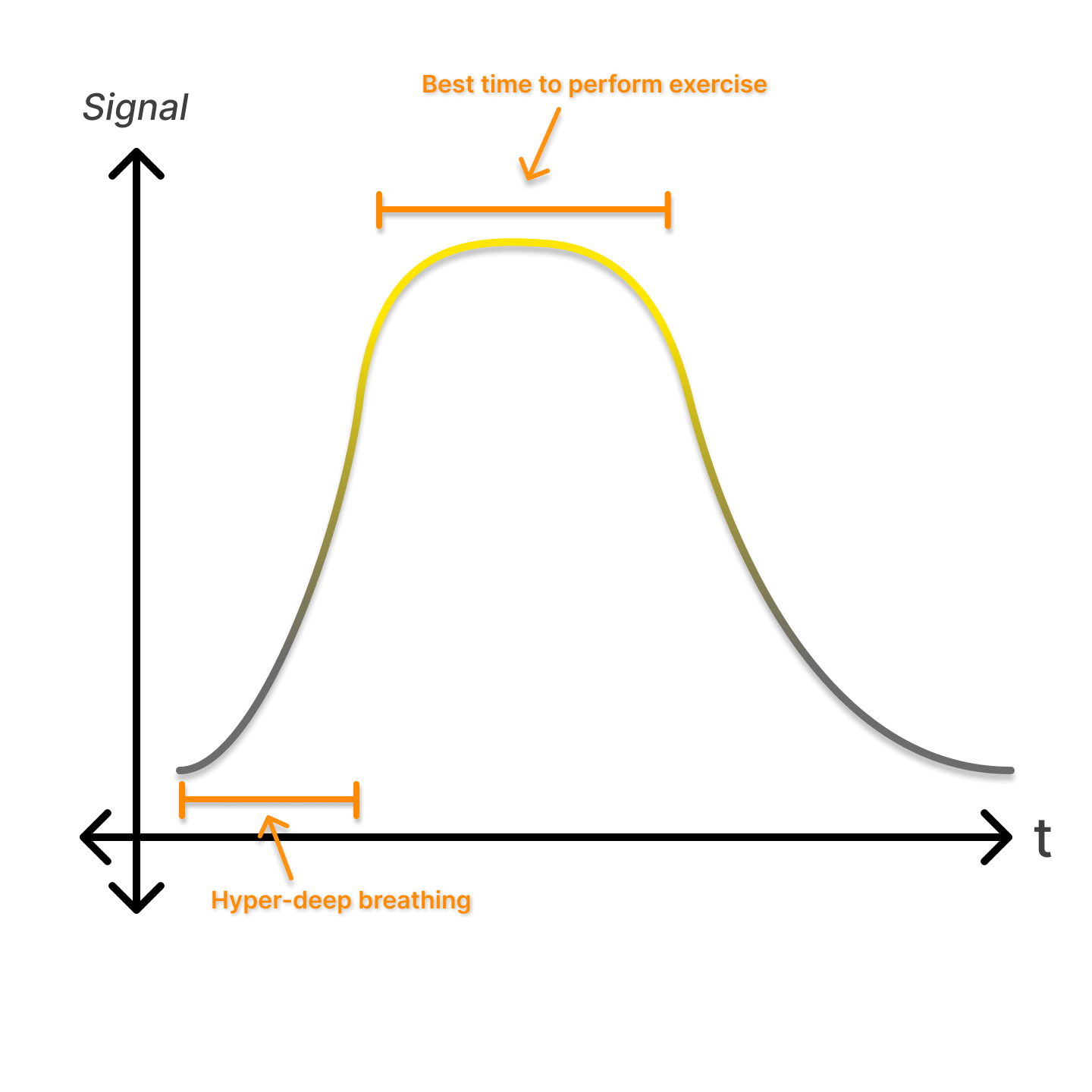
The point of the hyper-deep breathing
– 63%
The hyper-deep breathing done at the start of the exercise serves to “activate” the area in your torso where your heart and gut lie. This brings more blood, energy, and attention to these areas. This amplifies the “signal” coming from this part of your body allowing you to tap into that information and sift through the noise.
The amplification of the signal decays over time, which is why you may need to reactivate it to get a clear answer.
How to take this outside of the practice
– 64%
This technique is useful when you have a tough decision to make that you can’t figure out mentally. If you’re having trouble making a decision on something, it might be that your mind is in conflict with your heart and/or gut. One part of you may want one thing, another part may want another. We think that our mind alone can make the best decisions for us. The reality is, a truly rational assessment of a situation comes from integrating the mind with the other parts of your body (see Emotions and Intuitions).
When I’ve used this technique
– 65%
My decision to write this blog came from performing this exercise. At the time I was considering starting this, I was looking for a new activity that would functionally be my “purpose” (see Spending Idle Time Meaningfully→Finding Purpose). I wanted to find something that would become so important to me, I could focus solely on that.
Mentally, I was torn between:
- Volunteering within my local community
- Starting martial arts classes
- Starting this blog
- Going back to school to get a PhD
- Moving to a new city
I posed each of the above options to both my heart and gut.
My gut wanted to volunteer or start taking martial arts classes. My gut didn’t like the idea of moving or going back to school. My gut was indifferent to starting the blog. It almost felt like my gut was concerned that the blog wouldn’t be successful.
However, my heart wasn’t into the volunteering. It thought my specific skill sets were better applied elsewhere. My heart saw the value in school, but wasn’t convinced it was the best path either. My heart was into the blog, very deeply.
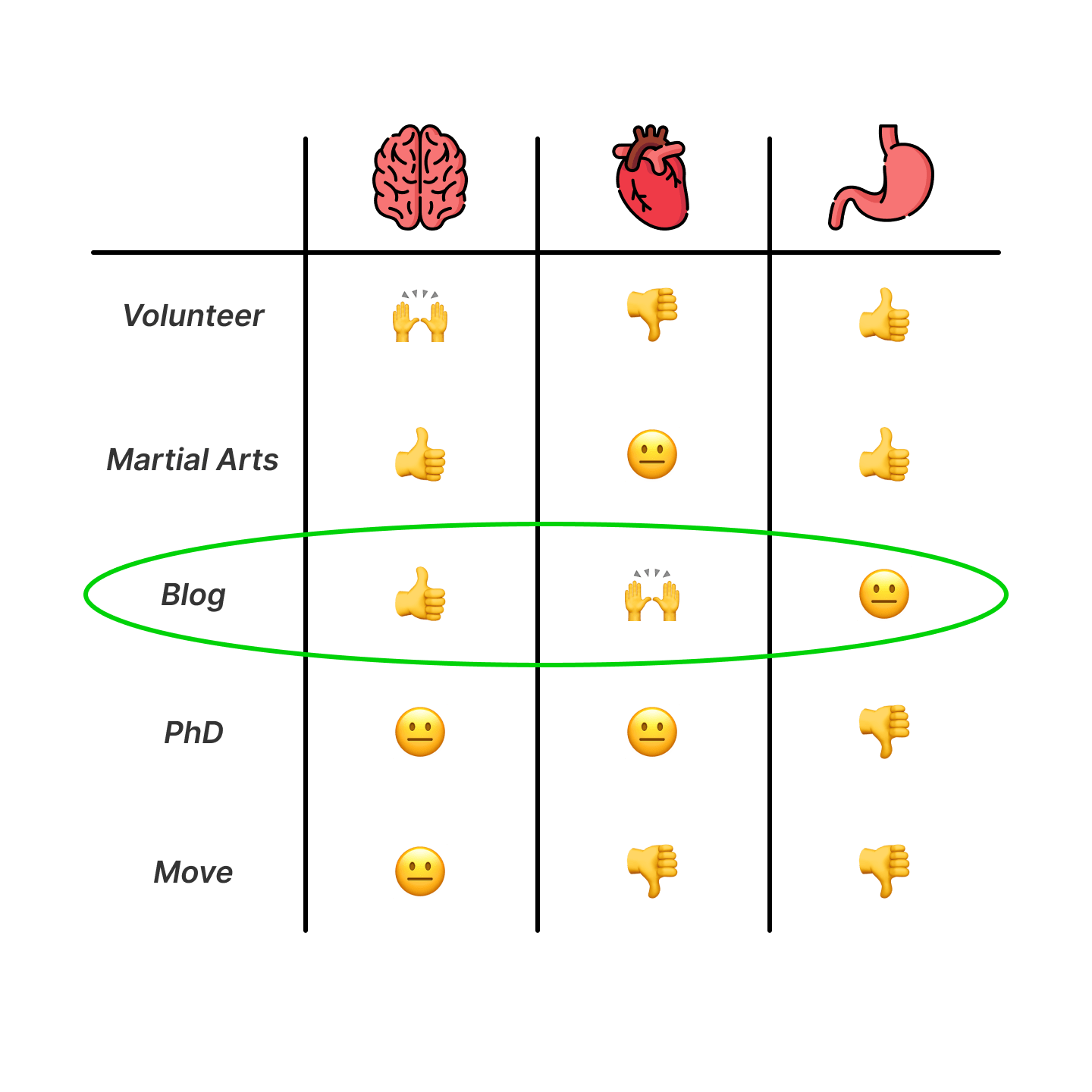
And so, I used my mind to integrate this information and decided that the blog was the best strategy. I didn’t find one hundred percent approval across all parts of me for the blog, but it had the most approval of any of the options. As I started writing, I started to feel more and more right about the decision. My gut now consistently pushes me to write. This blog has ended up being incredibly fulfilling.
Mehta
– 68%
Metha translates into “loving kindness”. The goal of this practice is to feel loving kindness for ourselves by first producing that feeling for someone else and understanding what that feeling feels like attributed to the other person. Once we understand that, we can replace the other person with ourselves as the object of that loving kindness.
It’s likely that you’ve experienced loving kindness for someone else, but if I asked you what that sensation is like, you’d likely struggle to define it. This is because while we’re experiencing an emotion we often aren’t analyzing it or trying to understand it. We are simply feeling it (which is what you should be doing in that situation).
But in meditation practice, there’s no reason why we shouldn’t analyze a feeling. That’s actually precisely what we should be doing! Like a scientist in a lab, we can spend all the time we need examining and learning in a simple, non-noisy environment without having to worry about “missing out” on the experience.
Once we understand a feeling, we can not only apply it to ourselves, but recognize when it is being applied to us. It’s like when you hear a word for the first time and all of a sudden you start hearing it everywhere. You may think it’s strange that a word you’ve never seen before is suddenly used everywhere. But in reality, it was probably already out there in the world, you just weren’t looking for it.
How to do it
– 70%
- Perform the prep of Mindfulness→The Basic Practice.
- Imagine someone you care deeply about.
- It could be a friend, a parent, a sibling, a lover, even a pet.
- With their image in your head, imagine them smiling. Imagine them getting everything they want. Imagine them being loved and adored.
- Pay attention to the sensations that arise when you do this.
- Feel the sensations that arise from this. You may feel warmth, calmness, happiness, etc..
- Replace the person you are envisioning with yourself.
The sensations may not be all that intense and that’s okay. We just want to be able to give ourselves some love every once in a while.
The last step takes some practice, particularly if you have a lot of shame or toxic self-talk. You can use Interception to stop these thoughts from interfering with the sensations. But importantly, this is a practice so you need to practice it repeatedly. Over time you will get better at it.
This practice is best done in a guided meditation session because having another person tell you when to perform each step can prevent your mind from wandering. That being said, if you are a strong enough meditator, you can do this on your own.
How to take this outside of the practice
– 72%
In learning how to apply loving kindness to ourselves in a quiet noiseless meditation environment, we hope to be able to apply this feeling to ourselves on demand whenever we need a pick me up.
This practice also helps us cultivate self-compassion. Think about this: you might have someone in your life who you love, but they have flaws. You may want them to get better, but you still accept them for who they are. By imagining them, you can create the feeling of wanting the best for them. This practice helps you apply that same compassion to yourself.
Just because you’re not where you want to be yet, doesn’t mean you can’t extend warmth and kindness to yourself.
Calm
– 73%
Disclaimer: This is not an ad. I am not sponsored. I do not have an affiliate link. I do not benefit in any way from you downloading this app. I just genuinely believe in its value.
The Calm app has been my meditation app of choice since I started my journey. It has provided me everything I needed out of a guided meditation app. Most guided meditation apps should be good. I’ve heard good things about Mindspace. I just haven’t independently verified its value so I can’t personally recommend it.
Cost
– 74%
Calm is charged on a yearly basis with no monthly option. But I think that’s by design and I actually agree with this pricing model. You do have to stick with mindfulness long enough to see the results, so being forced to pay for a full year is a great incentive to commit to the practice.
The cost is $70 USD a year (which is really less than $6 USD a month; very worth the money if you ask me). There’s also a lifetime subscription for $400 USD.
If you like Calm, I would absolutely recommend getting the subscription. It may be one of the best investments you’ll ever make.
Some of my favorite sessions
– 75%
My one gripe is that it’s not easy to find specific meditations on the app. You do have to do some digging. For example, there’s no way to find a list of all the courses (as distinct from individual sessions) available across the app. You have to know what type of session you want and search for that session.
Because of this, I’ll provide links to some of my favorite courses and sessions here:
- Mindfulness For Beginners with Jeff Warren
- This is a great starting point for beginners. He really spends the time exploring different techniques and showing you the variations you can make on the practice to fit what works for you.
- He also has a session on the “object of focus” I discuss in this article (he calls it “home base”)
- Relationship with Self Series
- This is a great series of lessons related to developing a more positive relationship with yourself. This is great for people who have toxic shame.
- In particular I like the session on self compassion and it serves as the basis for my article on Balancing Self Maximization With Self Compassion
- 7 Days of Self-Esteem is a great session for people working on their self-esteem.
- There’s another great session on self compassion (as distinct from the session right above this).
- 7 Days of Focus is great for people working on becoming more focused.
- It’s also great for Modern Moderation.
- Anxiety In The Mind and Body
- This is just a single session on understanding anxiety and how it manifests in the body and mind.
- This is part of a larger collection in the Letting Go of Anxiety course which is incredibly helpful in Managing Unnecessary Anxiety.
- Breaking Habits Series
- This series is really valuable for breaking bad habits.
- Addiction and Compulsion are good sessions that help with Modern Moderation.
- Busyness is a good session which helps in recognizing that constant busyness is a bad habit (see Modern Moderation→Busyness).
- There are other sessions on overthinking, complaining, comparison, negativity, worry, and cravings (which is given in the context of food, but you can apply it more generally). There’s a lot of valuable sessions in this series.
- Investigating Anger
- This is a single session on understanding anger, how it arises, and what to do with it.
How much do I need to practice?
– 79%
Some meditators would argue that you should ideally practice every day. I won’t say you need to do that, because not even I do that. We’re all busy people and sometimes it can be hard to carve out even a little time in the day to do it.
What I do
– 80%
Sessions per week
– 80%
I typically meditate 3-5 times a week.
I usually meditate in the morning because if I wait until after work, I risk being so tired that my session is more about fighting off the urge to fall asleep than actual practice.
Time per session
– 80%
My sessions range from 10-15 minutes on average. Sometimes I do a non-guided meditation, particularly when I just want to practice Mindfulness→Noting or Mindfulness→Co(hear)ance. For co(hear)ance I typically do a longer session for 15-25 minutes, but I only really do that when I have time.
Find your way to make this practice sustainable
– 81%
You should try mindfulness consistently for a month at minimum, although it might take three months to really see results. But again, we have lives. You want to find a way to integrate this into your life in a way that is sustainable.
You want to have a practice that you can be consistent with and sustain over the longer term. So figure out what works for your life.
Just like physical exercise, some days are going to be better and easier than others. Don’t give up after a couple bad days. There are ups and downs, but the general trend is up.
Making time for meditation
– 82%
Many people believe that they don’t have time to meditate. I certainly felt that way. Before cultivating eudaemonia, I was constantly trying to escape myself both through hedonistic pursuits and productivity.
The truth is: you (probably) do have time. And if you care enough, you’ll make time. But if you need some inspiration for how to make time, I can offer two solutions.
First, you can cut back on the time you spend consuming content. I detail this in Modern Moderation. If you cut down 10 minutes of Instagram or Netflix a day, you’ll have enough time to meditate.
Second, you can start to set healthy boundaries at work. The degree to which you can set boundaries will depend on the field that you’re in, but for a lot of people, you can set a time in the day when you stop working. It’s more in your control than you think. I detail this specifically in Modern Moderation→Managing overwhelm.
Start small
– 83%
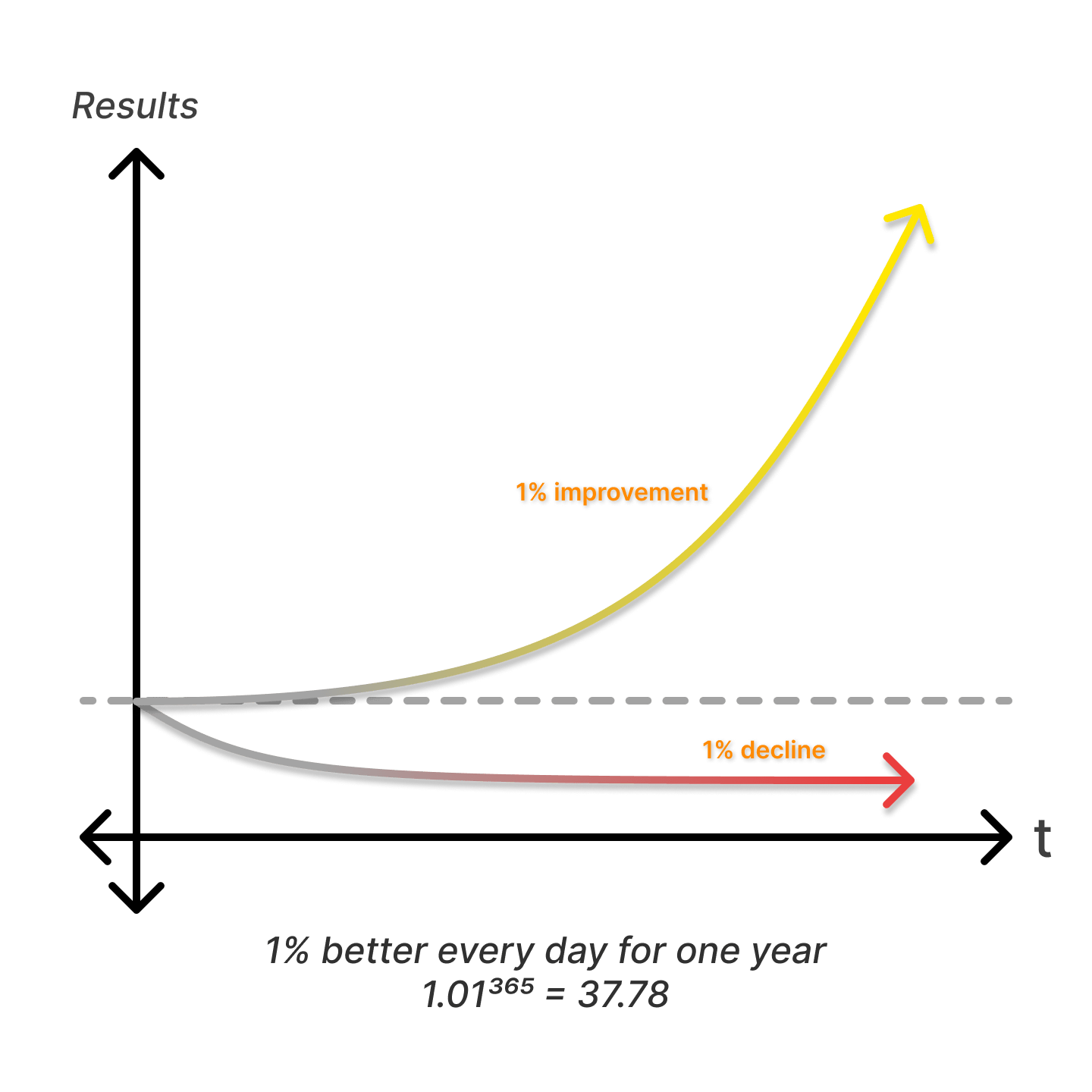
Maybe you start with just one session a week. Or once every two weeks. Work your way up. You might not see results right away, but you will in the long term. A small improvement everyday compounds to massive improvements over the long term.
The hardest part is getting started
– 84%
"Nothing will work unless you do."
-- Maya Angelou
Mindfulness is the most powerful tool for developing control over yourself and allowing yourself to live a more intentional, valuable, and full life. You probably won’t believe everything I’m saying until you do it and that’s fine. But seriously, give it a shot.
The proof is in the pudding. Calm allows you to track your mood in app (see Mindfulness→Calm). This is the change in my mood in just the first few months of consistent meditation practice.
You can see that for the first three months my mood was generally negative. I wasn’t in a good place. But as time went on, my reported mood ended up becoming more positive.
I had a lot of other changes I was making in my life at the time, so it’s not just meditation that made the difference. But the control over my mind that I cultivated through mindfulness allowed me not to slip back into that negative space. Even today over a year later, my mood has been consistently positive.
How mindfulness helps cultivate eudaemonia
– 86%
I’d like to conclude with relating mindfulness to the components of eudaemonia from How I Cultivated Eudaemonia→The Equation.
Note: I’ll be invoking the framework from The Happiness Trap→Well-being as water in my following descriptions, so you may need that to understand what I detail below.
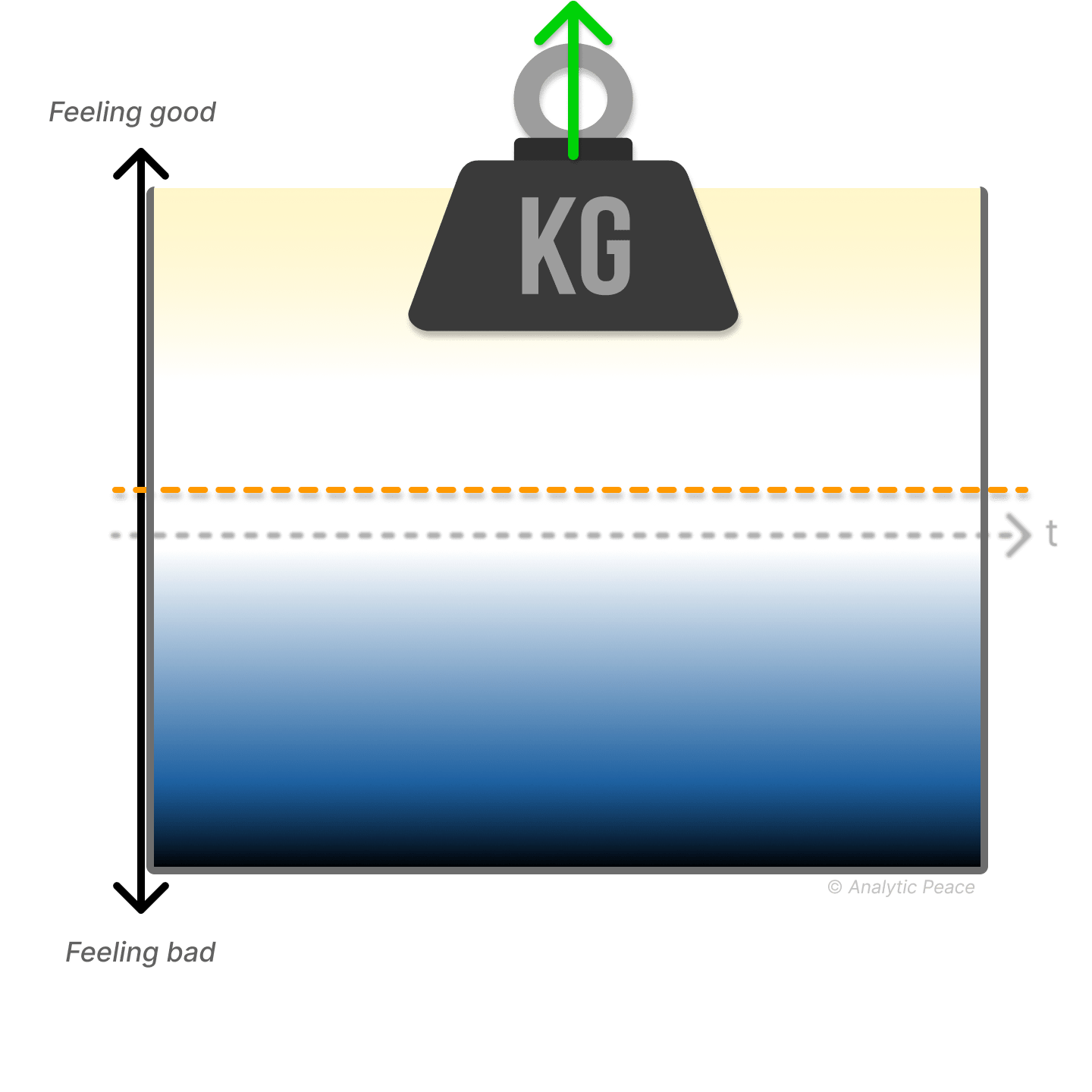
It’s worth saying upfront: Mindfulness will not make you happy. But as we’ve discussed in The Happiness Trap, happiness shouldn’t be the goal anyway. Eudaemonia (inner peace) should be the goal. This is cultivated by doing things which move your baseline water level above the center line.
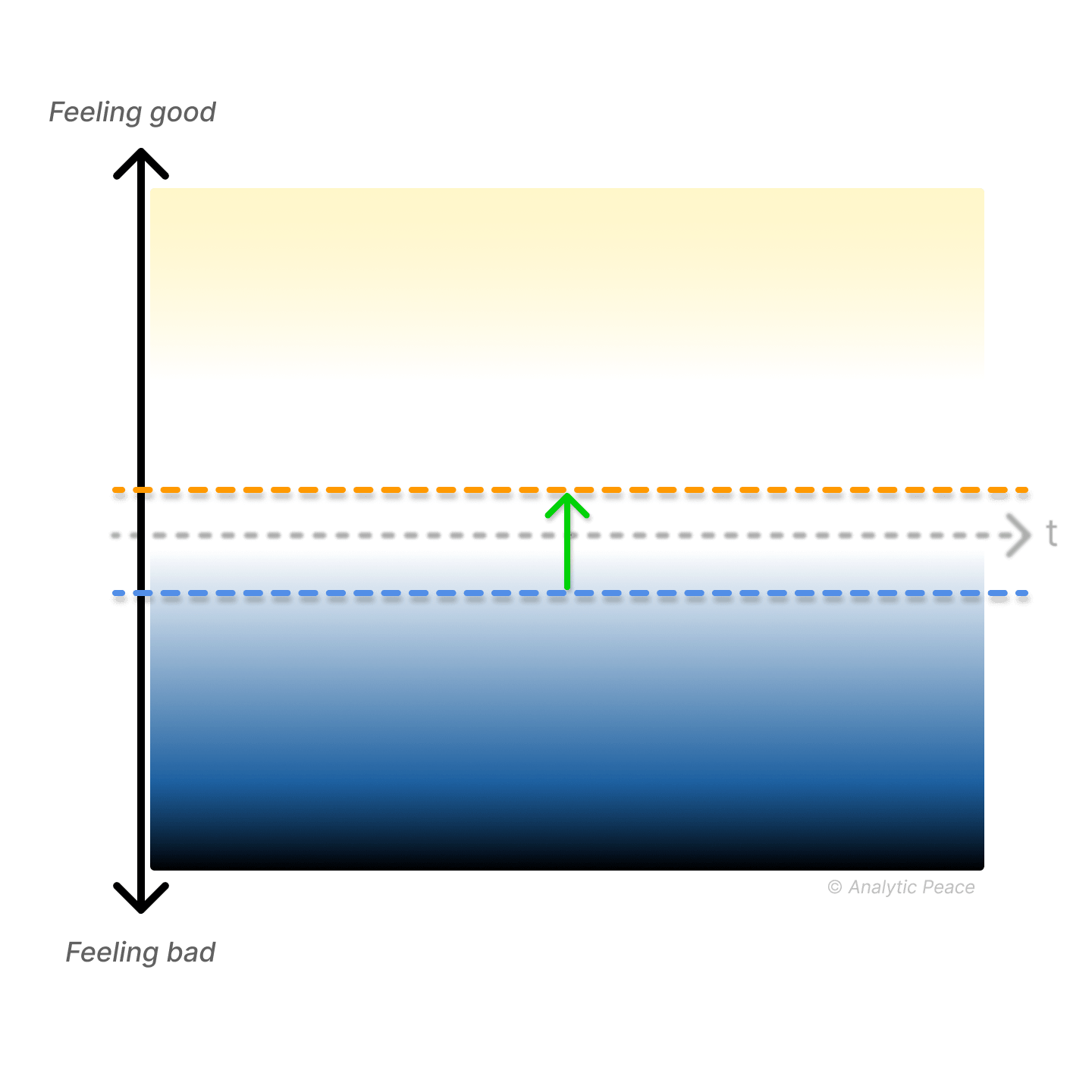
This can be achieved by:
- preventing cracks from forming in your tank (and allowing existing cracks to heal)
- adding water to your tank
Through the mechanisms described above, mindfulness will prevent cracks. There are also specific mediation practice that focus on gratitude or self love which can add water to your tank (e.g. Mindfulness→Mehta).
Interacting with more positive thoughts
– 87%
"The mind can be a powerful ally, or your greatest enemy."
-- Katara, The Legend of Korra S3E2
Our minds are constantly producing thoughts. Some are good, some are bad. Some are real, most are not. You may have heard the phrase “you create your reality”. The thoughts that your mind chooses to interact with will be the ones you incorporate into your life and thus become the story of you.
Some of us are predisposed to negative thinking particularly about ourselves. It may come from a traumatic experience, bullying, lack of success, or just bad luck. It might even be a feature, rather than a bug! Humans have a negativity bias. We’re more motivated by a potential loss than a potential gain. And this makes sense given the dangers we faced for a majority of our evolutionary history. The floor for negative experience can be much lower than the ceiling of positive experience.
Some of us (by default) feel like we have to interact with every single thought that arises. Or more accurately, our circuitry is designed such that we interact with every thought that arises (see Mindfulness Theory→Your mind is a machine). I certainly behaved this way.
This negative thinking creates self-inflicted cracks in our tank, which ultimately leads to water leaking out of our tank.
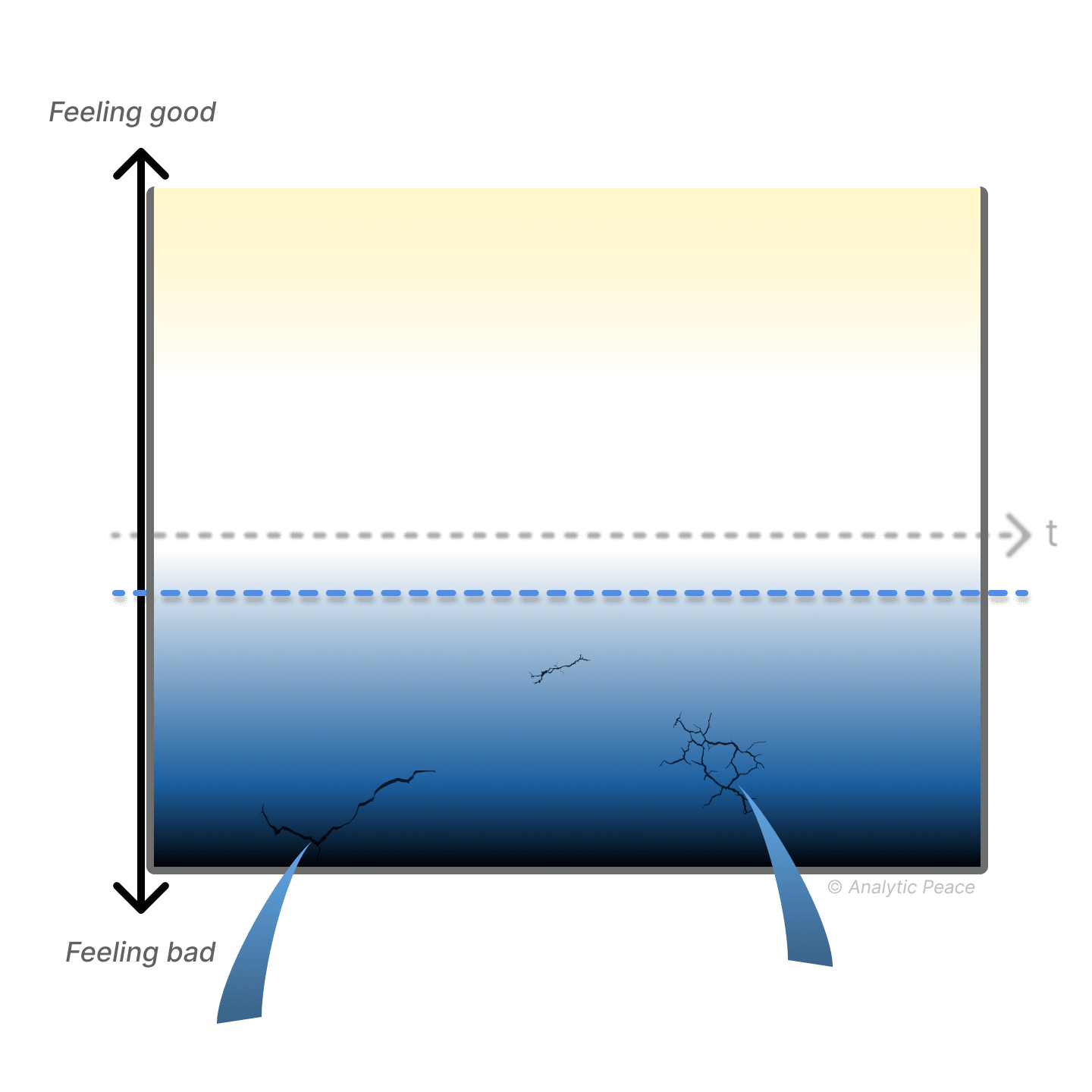
We can adjust our wiring such that we interact with fewer negative thoughts (and, if we like, more positive thoughts). As you start interacting with more of the good thoughts your unconscious processes will start to become wired to manufacture more good thoughts than before. It’s unlikely that you can make your mind produce solely positive thoughts. But you can certainly make the majority of your thoughts positive.
An example
– 90%
If you believe everyone hates you, then you will manifest it for yourself.

On the other hand, if you start with a positive belief about the world, it can manifest in a positive world.

Having more positive thoughts won’t make your life better (on
its own)
– 90%
While your thoughts will influence your world, it’s not a silver bullet and it’s not like reality depends only on what you think about it. I won’t pretend that it is. There are still lessons to learn and lifestyle and mindset shifts to make (see How I Cultivated Eudaemonia).
And this is a slow process. Remember: you can’t change the direction of the boat on a dime (see Mindfulness Theory→The sailboat analogy). But focusing on our positive thoughts is a simple way to get started on the path to a more positive life. For some people, we’re just focusing on the wrong things, so this is a small but incredibly effective mindset shift.
Preventing overthinking
– 91%
“We say “peace of mind” but really what we want is peace from mind.”
-- Naval Ravikant
A lot of overthinking is not so much that there are too many thoughts, but rather there are too many negative thoughts. So while you don’t have control over how many thoughts your mind produces, you do have the ability to influence which thoughts you interact with.
Preventing overthinking requires the ability to realize when you’ve been swept away into a thought spiral so that you can return to something else (see Mindfulness→Interception). This will help you from creating cracks in your own tank.
Incorporating mindset shifts
– 92%
"The happiness of your life depends upon the quality of your thoughts." -- Marcus Aurelius, Meditations
As we learn about the world, our brain encodes those lessons into the circuitry of our mind (see Mindfulness Theory→Your mind is a machine). The encoding isn’t always correct which results in discord – we lose coherence with the world (see Core Tenets→Coherence). The behavior which manifests from these incorrect mindsets, creates cracks in our tanks.
We may have to unlearn these mindsets or we may have to adopt entirely new ones. This can be a difficult process for all the reasons described above. But by the same notion, we have an ability to adjust this wiring, saving us from unnecessary cracks in our tank.
Knowing yourself
– 94%
Mindfulness is a critical tool for better Knowing Yourself. And it exists alongside Knowing Yourself as a foundational component of cultivating inner peace (see How I Cultivated Eudaemonia→The Foundational Components).
By having a clear head and being in touch with your emotions and intuitions, you can more effectively assess yourself and your life and make the necessary adjustments to the necessary degree to bring your water level above the center line.
Cultivating discipline
– 95%
Mindfulness is a major key in developing discipline. A lack of discipline typically comes from us not caring enough about something to give it appropriate attention.
It’s easy to give our attention to things we want or care about. But sometimes the things that are good for us require our attention in a less attractive direction. Mindfulness makes it easier to pay attention to the things you may not care about, but are ultimately good for you. It also makes it easy to remember the things you should be doing and motivating yourself to actually do them (e.g. exercise – which is crucial for Health – or resisting temptation – which is crucial for Modern Moderation another foundational component of eudaemonia).
My frustration with self help
– 96%
I’ve detailed this in About→My Problem with Self-Help: without mindfulness, any self-help idea really has to impact you in order for you to be motivated to incorporate it into your life.
With mindfulness you can take a more active role in reminding yourself of the good ideas you’ve learned because you have more control over where your attention and awareness are focused.
Therefore, you’re more likely to incorporate more of the advice you receive by approaching it mindfully.
Calming Yourself
– 97%
"The more relaxed you are, the better you are at everything."
-- Bill Murray
When people hear “mindfulness” they often think of “meditation.” And when people think meditation, they often think it is just about calming yourself. And (as we’ve already discussed at length) while that’s not what mindfulness is only about, mindfulness does have calming effects. Mindfulness gives you a moment of stillness in an otherwise busy and hectic life, which can lower anxiety – a common crack in our tanks (see Managing Unnecessary Anxiety).
For one, meditating in the morning can be very useful for starting the day with a calm and clear head. There is an inherent relaxation to the basic practice and there are techniques within meditation that can help relax different parts of your body, reducing stress (see Mindfulness→The healing power of the breath).
Additionally, applying the techniques performed in the practice outside of the practice will help you to remain calm and lower your anxiety in the face of troubles throughout your day. Mindfulness can help you reduce stress by creating quiet time in your life that has lasting impressions throughout the day.
All of this serves to put less pressure on your tank, which will prevent cracks from forming.
Self Regulating
– 99%
“Mindfulness gives you time. Time gives you choices. Choices, skillfully made, lead to freedom. You don’t have to be swept away by your feelings. You can respond with wisdom and kindness rather than habit and reactivity.”
-- Bhante H Gunaratana
Mindfulness is incredibly important for Managing Unnecessary Anxiety. Anxiety is a great drain on the water in our tank. Anxiety is another area where we self-inflict damage on our tank. By being able to exert greater control over our thoughts, we can self-regulate much more effectively. This is part of cultivating resilience.
To be clear, we don’t practice mindfulness to cure our anxiety. We practice mindfulness to prepare our minds to be able to push back against our anxious thoughts. There is still work to do to stay on top of the anxiety (I have a whole article on this in Managing Unnecessary Anxiety).
Summary
– 100%
In short: be mindful and your life will be better. Like any of the components of eudaemonia, the more you emphasize it, the better you’ll cultivate inner peace. Even just a little bit of mindfulness in your week can go a long way. There’s a lot of value for little work, but it does take time. That time spent is worth it.
This is just one of the many components of eudaemonia (see How I Cultivated Eudaemonia→The Equation). But many of these components are linked to one another. For example, you need good sleep for the benefits of mindfulness to be under your control. When you’re tired, your mind relies more on instinct and predefined processes than intentional behavior. To sustain control, you need to be rested which is why healthy sleep is so important (see Health→Sleep is essential for control over your mind).
Maybe you’ll want to check out that article next. If you’re looking for more reading I can recommend these articles as well:
- Knowing Yourself
- Modern Moderation
- The (not so) Simple Art Of Letting Go
- Spending Idle Time Meaningfully
What do you all think? Feel free to share your thoughts in the comments. Your story, likes, and constructive disagreement are all appreciated. If there’s someone you know who might appreciate this too, share this with them. Word of mouth is one of the best ways to amplify this message. And if you’ve gotten any value from this article or any of the others, consider supporting me. It really helps me to dedicate more resources to getting this message out there. Go in peace.
Leave a Reply
You must be logged in to post a comment.