
"Knowing yourself is the beginning of all wisdom."
-- Socrates
At the entrance to the Temple of Apollo at Delphi was the inscription ΓΝῶΘΙ ΣΕΑΥΤΌΝ (know thyself). Yuval Noah Harari writes in his book Sapiens, that the implication of this was that “the average person is ignorant of his true self, and is therefore likely to be ignorant of true happiness.” Many historical thinkers have taken this perspective and I don’t think it’s totally wrong.
Our coming into this world is not a choice we have. We are flung from empty, non-existence into a world full of color and experience. Our minds are assembled in the wombs of our mothers according to instructions encoded in our DNA, which only work as a result of the physics which drives their chemical motion.
We have no choice in this matter. We do not control how our minds are designed or when we’re born. Throughout our lives, our brains are continually influenced and reconfigured based on our environment and the experiences we have within them. And while (generally) the older we get, the more control we have over the direction of our lives, there are parts of our brains that have existed since we were born which very much define who we are today.
We are not who we want to be, we are what we were made to be. And so, for the purposes of cultivating inner peace, it is particularly important that we figure out who we are. Knowing who we are enables us to not live in conflict with ourselves – an affliction that would otherwise disrupt our peace. To link to my framework of well-being as water (see The Happiness Trap→Well-being as water), living in conflict with yourself (and who you want to be) is a crack in your tank.
So many people go through life on auto-pilot or otherwise confused about the direction of their life. And while there is benefit to entertaining what the universe has in store for you, there are times that you will need to step in and take control over your life to help guide it in the best direction for yourself. In order to do that effectively, you must know who you are and what you want.
The Prerequisites
– 4%
Self-awareness
– 4%
Surely, this is self-explanatory. To know yourself, you must be able to self-reflect. If you’re reading this blog, it’s likely you already have this ability – most people don’t go out and pursue self-help without the awareness that something is not right in their life. Discomfort makes people want to look for solutions.
I started self-reflecting because I had experienced a lot of mental pain and wanted to discover a way out. I believed there were things I could do about it. A key lesson I learned about self-awareness is that it involves opening up to your Emotions and Intuitions (the ideas I have on this are a bit too long for this article, but you can explore that article too to learn more).
Mindfulness
– 5%
In particular, the technique of noting (see Mindfulness→Noting) allows you to better understand how your mind functions (see Mindfulness Theory→Observing the functions of the mind). This will be useful in knowing what it is you truly desire.
You don’t need to be an expert meditator to have success in knowing yourself. It’s just that the better control you have over your mind, the easier it will be for you to know yourself.
Moderation
– 7%
Finally, knowing yourself requires Modern Moderation. In this age of abundance in which we live, there are strong influences pulling us toward pleasure (e.g. calorie dense food, functionally infinite stimulating content, abundant goods available to be shipped to you immediately). The availability of these things – combined with the influence of advertisers and the addictive designs of the platforms which serve them – gives us the impression we want these things. We might actually want some of these things, but maybe not.
I would urge you to read Modern Moderation and the The Happiness Trap (in particular The Happiness Trap→The Consequences) before continuing in order to understand why moderation is important.
You can’t be clear about who you are and what you (truly) want if you’re living up in the clouds. What you believe you want may be influenced by things which are compelling you to consume them, not by your own true intention.
Who you are at your most fundamental level is what is left after everything that can be taken from you is taken from you. In the absence of anything, who are you and what do you want?
I hope you’ll never be in a position where everything has been taken from you. But moderation is an important step in getting down to who you are at your core. Living a life without moderation will cause your priorities to be in the wrong place. The more you are away from your baseline, the less clarity you will have on who you are at your core.
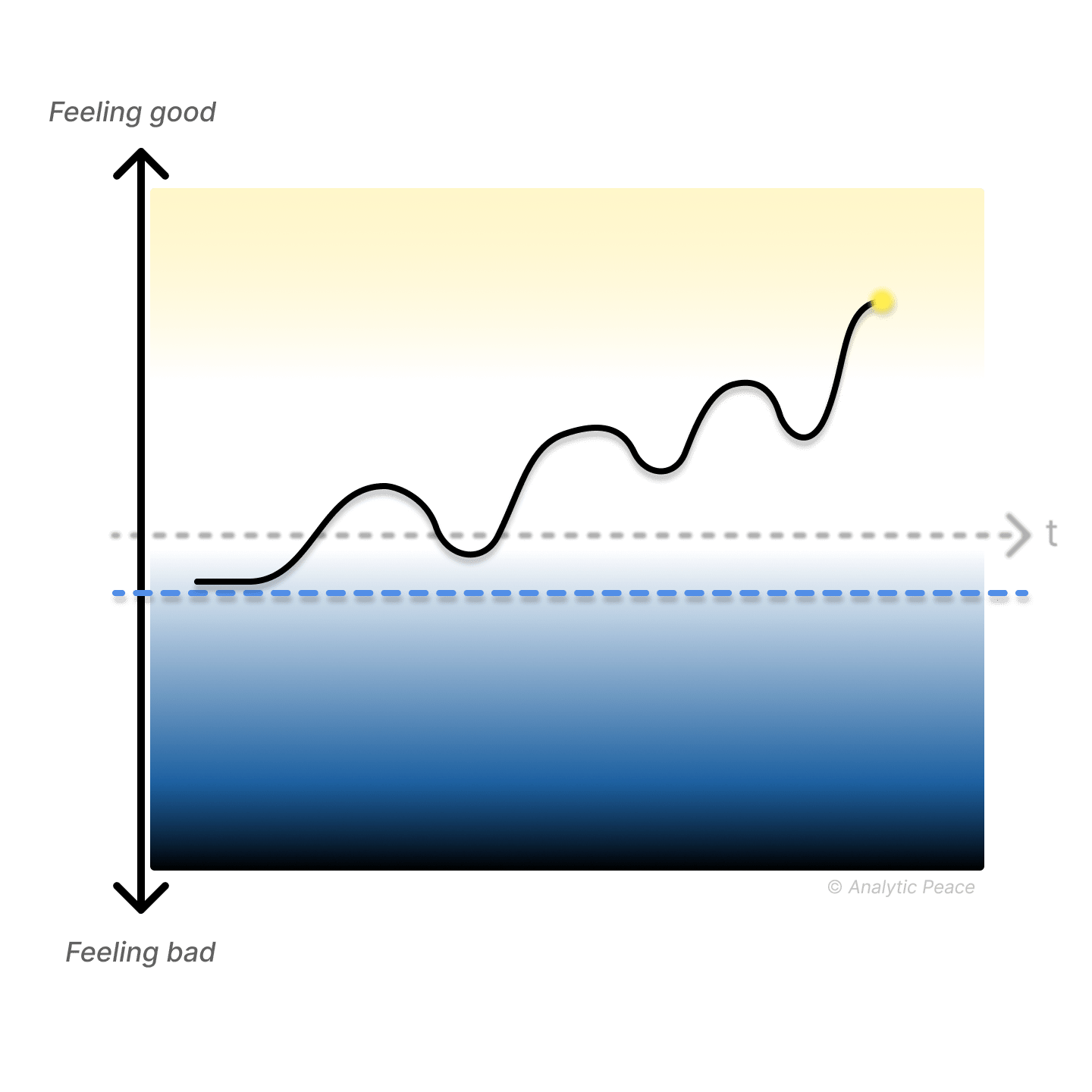
And, if you don’t want to learn moderation before performing the exercises I’ll introduce below, there’s no problem. Knowing yourself is not something you do once and you’re done. The exercises below won’t give you finality. Knowing yourself is a lifelong process and we are always changing and growing. So if you want to perform these exercises again after learning moderation – or whenever you want, really – you can.
What you should know about yourself
– 11%
"Of all knowledge, the wise and good seek most to know themselves."
-- William Shakespeare
With those prerequisites understood, you will be better able to “figure out who you are”. I’m sure you’ve heard that phrase dozens of times, but what does that phrase really mean?
Here’s a few things I think are important for you to figure out:
Write down your core values
– 11%
"Freedom is obedience to self-formulated rules."
-- Aristotle
You might expect that the first piece of advice would be to know what you want out of life. But figuring out what you want out of life is a big ask. You may not even know what you want, particularly when you’re young. There’s a lot of noise in between what we perceive and who we are at our core, particularly with a lack of moderation. Getting to what you want out of life is easier if you start with smaller, more concrete explorations of yourself.
The most profound development toward my inner peace came from defining and writing down my core values. There was an amazing relief that rushed over me when I actually figured out what my core values were. After writing my core values down, it felt like I was catapulted into eudaemonia.

Your knowing of your values will underlie what you want out of life and how you choose to operate within it. It will set a limit for how much you allow your Boundaries to be pushed. It will help you understand what you look for in Social Relationships and Romantic Relationships. It will influence the causes you stand up for. It will help you decide which rules you want to (and will actually) follow.
Defining your values doesn’t mean actively evaluating whether every single decision you make is in alignment with your core values. But just like how advertising nudges you in a particular direction, defining your core values (and reminding yourself of them) will keep them in the back of your mind and will have a subtle effect on your behavior.
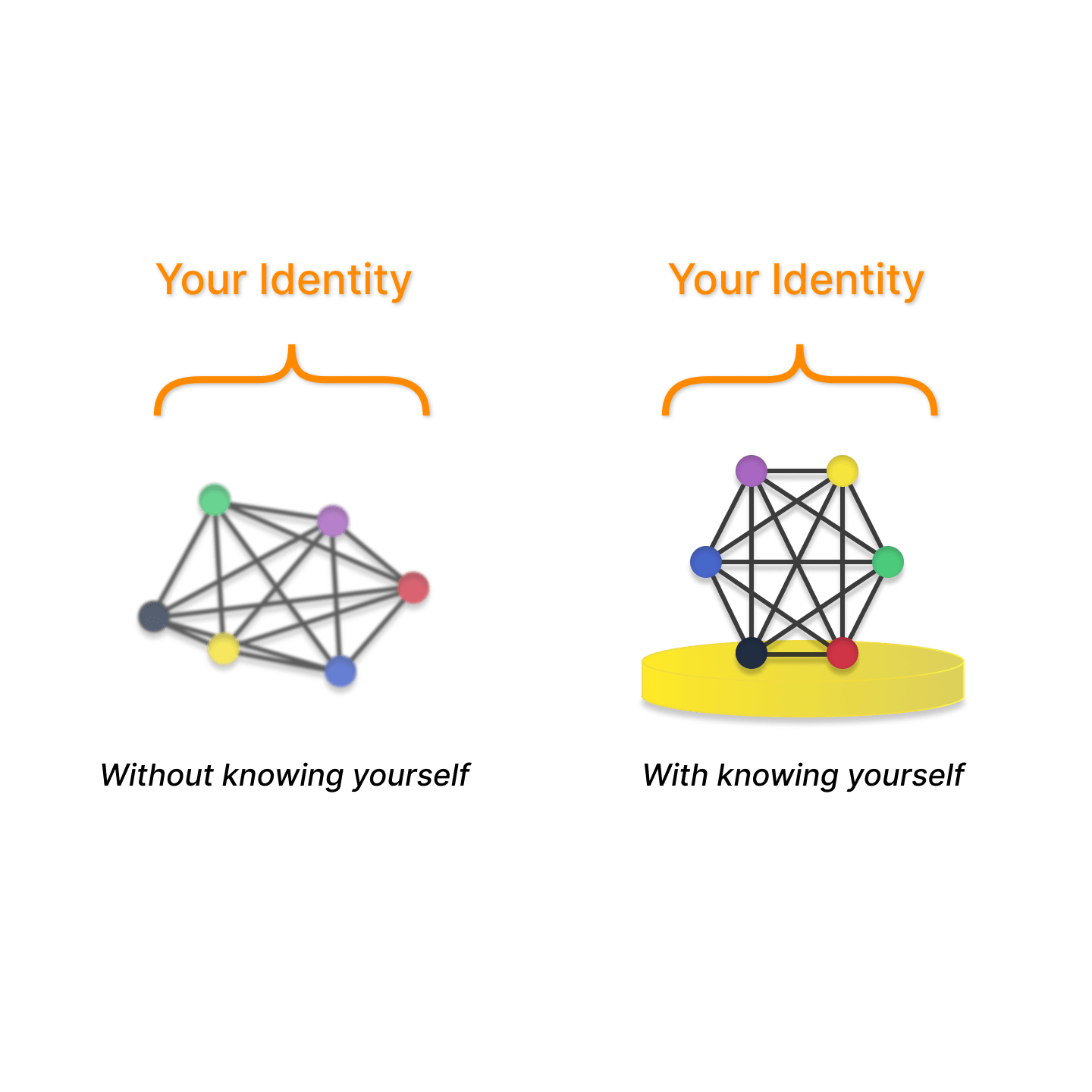
Knowing yourself will give you a foundation to base your identity off of, rather than having it be something floating in the aether, influenced by whatever persons or things hit it.
My Story
– 15%
"Wanting to be someone else is a waste of who you are."
-- Kurt Cobain
If you’ve read My Past→My Search For Belonging And Acceptance, you know I struggled for a long time trying to determine the “right” way to live: how to be a good person, how to be attractive, how to live a good life. What were the “right” sets of values to have. I never found the answers because eventually I was led to the intractable problem of discovering or defining “absolute Truth”.
The reality is this: we are nowhere close to finding “absolute Truth” (see Developing A Good Understanding Of The World→The Problem With Objectivity) so don’t wait for that to be the foundation for your values. Make what you believe the foundation for your values. It’s the only thing you can do now.
The next best thing I had for guidance was external validation. I had no foundation to rest my qualities on top of. The only thing I had to tether my conception of myself to the world was feedback from other people.
This manifested in me being solely influenced by the people around me, particularly those I considered to be “high value” – the cool people I knew and pretty girls I was dating. Being validated by everyone else was the only thing that gave me confidence that I was doing the right thing. It was my positive reinforcement.
The idea in my head was this: I’m young. I know I don’t know what being “good” means yet, but I think if people like me, that means I’m “good”. So therefore, I should do the things that people like and then I’ll be “good”. This isn’t a terrible perspective, but without my own core identity, I was being jostled left and right by whatever feedback I was getting.
And, the other side of this was that when I did something that someone else didn’t like, I would take this as direct negative feedback. I would crumble. I thought I was a failure. So, I would adjust in order to be accepted by that person.
To some extent this is okay and will happen naturally. We are social creatures and thus get socialized by the people around us. It’s a generally positive force that aligns our society (see Social Relationships→Socialization). But when your entire personality is at the whims of the people around you, it becomes a problem. You need to have at least some understanding of yourself to know when you are right and others are wrong. Even if you have the humility to say, “I don’t know enough to say this is right or wrong,” other people don’t necessarily have it figured out either. So fully aligning yourself with what other people think is not a great strategy.
After defining my core values, I had guiding principles to follow. Now, I’m less insecure about how I present myself so long as I’m presenting myself in alignment with those core values which I defined. Knowing myself helped me in Becoming Sustainably Confident.
How do you pick core values
– 20%
"Waste no more time arguing what a good man should be. Be one."
-- Marcus Aurelius, Meditations
Defining your core values is actually quite easy. It may only take an hour or so. When I was deciding on what my values were, I literally just googled a couple lists of values.
These are the the two I used:
Some people may already have an idea of what their values are. So using your own understanding of yourself or an exploration of the lists above (or any lists you find), write down values that resonate with you. What’s important here is that we make the value tangible by putting it on paper (or a screen). There is great power in writing things down (see Knowing Yourself→Write it down).
Now, you may already have a vague notion of this “resonance” feeling. But what if you don’t? What is it like? Resonance is a sort of satisfying feeling. It’s a bodily experience. It almost feels like something clicks in place properly. If you have already experienced this feeling, congratulations! You’ve listened to your Emotions and Intuitions. This isn’t an intellectual exercise, so don’t try to intellectualize it.
Some of these values might be things you’re already doing and some may be things you want to do more of. The only thing you need to ensure is that these are values that you believe in. Don’t pick a value because you think someone else would want you to pick that value.
Additionally, make sure you write down the appropriate name of the value you want. For example, happiness might seem like a good value on the surface, but valuing this highly leads to The Happiness Trap. Perhaps more of what you want is inner peace (eudaemonia). This hits on a core tenet of this blog (see Core Tenets→Call things by their proper name).
To start, don’t worry about picking too many (we’re going to reduce them next). If you read a value and don’t immediately “get it” (another feeling), then it’s not a value for you.
Next, reduce your list by grouping similar values together. Are they redundant? Pick the one which resonates with you more.
Finally, go through one last time and make sure that it is a core value. Do you stand by this value? Would you defend it if someone pressed you on one? Could you defend why it’s a good value if someone pressed you? If not, remove it.
What you’re looking for is the coherence feeling across all your values (see Core Tenets→Coherence).
By the end of this exercise you should have a stripped down list of what is essential and important to you. It doesn’t matter what other people think. This is for you.
My core values
– 25%
As an example, my (current) list of core values includes:
- Love
- Beauty
- Learning/Curiosity
- Sharing Experience/Community
- Contribution/Service to Others
- Balance
- Challenge
- Respect
- Laughter
If you’re concerned about how many to pick
– 26%
Just consider this: if you pick too many, you run a risk of your values not being compatible with each other (“and” is an expensive word). It may ultimately prove to be very difficult to account for them all.
If you pick too few, you run the risk of not accounting for every part of yourself. For example, if you limit yourself to three values (e.g. love, balance, and ambition) you may not account for a part of you that wants to help others. In which case, you should add “service to others.”
Five to ten is probably a good number, but your plus/minus will be dependent on what you can handle.
Use your emotions as a guide
– 27%
I cover a foundational understanding of emotions and how to listen to them in a separate article (Emotions and Intuitions), but since it is relevant now: increase or reduce the number of core values you want to have such that you feel satisfied with your number. Again, this isn’t an intellectual question.
You can do this exercise as many times as you need
– 28%
The values you pick today don’t need to be the values you hold onto for your entire life. They are only the values that you hold right now.
If you’ve read My Past→Meaning and Truth, you know that I used to highly value truth. As I matured, I saw that the difficulty in determining an absolute Truth from which to guide myself was deeply disturbing my peace.
It’s okay for your values to change over time. If the system you designed stops working, shake it up.
As you learn more about the world you are free to adjust your values whenever you like. Remember, this is only for you. So there’s no pressure to “get it right” or stay married to the values you’ve picked.
In fact, you may land on values today that may ultimately not prove good or useful in your life. In which case, you wouldn’t want to be married to them. You want to be free to adjust them in light of new experiences. Don’t get too married to your identity.
For example, I have a friend who used to have a core value of not exerting himself too much. This idea was central to his identity. It formed in high school as he was attending a particularly competitive school which forced him to work extremely hard and put a lot of pressure on himself at a very young age. After finishing high school and getting a scholarship to attend college (where we met), he swore he would never work that hard for anything ever again.
He had a growth mindset, but he had a limit to the amount of effort he was willing to put into any given thing. A few years out of college, he was feeling stuck – stagnating in a dead-end, corporate job that he wasn’t enjoying. He wanted to get out, but he wasn’t exactly doing everything he could to get out or into a better role.
As he matured and gained new experiences, he ultimately had a change of heart. He determined that, actually, exerting oneself isn’t necessarily a bad thing. Maybe he could move the threshold for effort up to a more balanced position (reference Core Tenets→Balance). He still has healthy limits for over-exertion, but he started to take his job more seriously, he started volunteering in his community, and he started practicing a new language. Through letting go of his value of non-exertion, his growth mindset was really allowed to shine and this ultimately freed him from feeling stuck.
How to know that these values are good
– 32%
"Follow your own nature and Nature along the road they share."
-- Marcus Aurelius, Meditations
It’s not guaranteed that the values one picks will be good. What even is the definition good in this context? I’m not here to be the arbiter of morality. What anyone believes as good is ultimately subjective. It’s a product of how they see the world, their experiences, their success and their failures, their traumas and their healing. In lieu of a concrete definition of good, allow me to provide some guiding thoughts.
Do your values make your life – and the lives of those
around you – better?
– 33%
"That which isn't good for the hive, isn't good for the bee."
-- Marcus Aurelius
A good general principle for determining if your values are good is this: are your values making both your life and the lives of those around you better?
Of course, both “good” and “better” here are subjective terms, but in accounting for the lives of others around you, you provide a check against values that may be self-serving, but destructive on the whole.
Study philosophy
– 34%
Philosophers have spent millenia thinking about what good values are and they’ve defined a pretty good set already. You don’t have to figure it all out from scratch. Tons of people have done the work for you. My personal favorite flavor is Stoicism (which you’ll hear referenced many times throughout this blog), but there are many flavors that provide good values.
One great introductory resource that I believe makes quality, insightful content is Horses on YouTube. Some of my favorite content of his has been on various philosophers. His videos are certainly very introductory, but valuable resources nonetheless. Here’s a list of some of my favorite videos of his:
Values from tradition
– 35%
To be clear, I am not a religious person (anymore). And while there are many fair critiques of religion, I do see the value religion provides to a society (see Disclaimers→Religion).
If you look up the etymology of religion it comes from the latin religio which means “to bind.” There are two interpretations of this: 1) to bind as in “restrain” or 2) to bind as in “unify.” Anti-religious people might take the first interpretation, but I take the latter. People don’t often voluntarily walk into restraint (unless they’re into that 😏).
Religion is a community-level value definition developed to bind groups of people together around a shared identity, belief system, and values. It’s a societal glue.
You can think of this like pre-packaged values, ready-made. Just pop them in your microwave!
So if you can’t figure out good values for yourself, you may be able to find them through religion. Religion is itself philosophy – I mean, it is often more than just philosophy, but a good portion of it is an attempt to understand the world (see Developing A Good Understanding Of The World).
Experimentation and multiple perspectives
– 37%
Figuring out what is a good value will come from experience. And to get experience, you will need to experiment (see Developing A Good Understanding Of The World→Go out into the world). Turns out, if you do fuck around, you will find out.
So if you don’t know what values to pick yet – or you’ve already written some down, but want to find more – try different values throughout your life, live by them for a few months to observe their effect. If the values stop working for you, adjust them. It’s okay for your values to change so long as you are working in a positive direction for yourself and those around you.
Never maximize your value system
– 39%
This hits on one of this blog’s core tenets (Core Tenets→Everything in moderation, including moderation). When you maximize any system, you risk it becoming too rigid or creating too much distance between you and other people.
Your core values are values core to you (duh). In most cases, you’re already living by them. In some cases, you may be inclined to optimize for those values. This optimization process can lead to maximization. And maximization is generally problematic.
Even if you feel in your bones that a value is True (that is, True with a capital “T” – indubitable, unquestionable, given by God), you will almost certainly encounter at least one case where that value doesn’t work. Or you may find that as you scale that value within or beyond yourself that it opens up other problems for you and those around you. Be humble in your beliefs. Humility will allow you (and your values) to grow and become more robust to the situations life will throw at you.
The world will check your values for you
– 41%
For example, if you pick food as a core value, you risk becoming overweight which can cause health problems that will make you feel bad, disturbing your peace. The inherent rationality of the world comes from the fact that your body evolved to operate well under specific conditions with specific sustenance. When you step out of these bounds, your body experiences pain or decay, indicating to you that you need to make a change. Your body is giving you feedback.
Say you pick happiness as a core value. A big risk here is that, in today’s world, you may be incentivized to pursue fleeting, cheap pleasures (e.g. constant media consumption, drugs, sex, pornography, etc.) instead of cultivating sustained well-being. This idea of happiness being a poor choice of value is one that underlies this entire blog, but I tackle the subject in depth in a separate article: The Happiness Trap. Don’t get me wrong, I’m not saying you shouldn’t try to make your life good and enjoyable. But the definition of it as a core value can be dangerous.
The world will give you feedback. Listen for it (I’ll touch on this more below in Knowing Yourself→Listening to feedback). If you’re not getting what you want out of the world, the problem may be you. You may be living in accordance with values that aren’t serving you. And you can change that (I’ll also touch on that shortly in Knowing Yourself→You can change who you are).
Even though these are core values, some flexibility within them is valuable. You don’t necessarily keep a core value over the course of a lifetime.
Live in accordance with your values
– 45%
Of course, writing something down is easy. Actually living those values is the real test. These core values will be a guiding principle for you. But, being realistic, you may not align with them perfectly. The world will challenge you in ways you can’t imagine. You will act in ways you don’t intend to (see Mindfulness→Your mind is a machine).
However, the more you can live in accordance with your values, the less you will suffer at your own hand. Not living in conflict with your core values is an exercise in Coherence – another core tenet of this blog (see Core Tenets→Coherence).
Putting on a mask
– 46%
"Sometimes the mask is who we really are"
-- Uncle Iroh, Avatar The Last Airbender (2024)
Throughout life, we may put on a mask to hide ourselves, to fit in, or to try to become something. This isn’t necessarily a bad thing. As you discover yourself, you have to try on different masks in order to figure out which fits best or which works best for you. The same is true for values. You may want to incorporate a value into your life as a core value; at first, you may struggle to implement it, but persisting in that effort can yield success.
If you find yourself not living in accordance with a value, that is not necessarily evidence that that value isn’t important to you. For example, say you want to make kindness a core value, but you find that it doesn’t come easily to you. This doesn’t mean it can’t eventually. Instead, you might want to examine yourself and the circumstances which are preventing you from living in accordance with that value and determine what actions you can take to be more kind. Mindfulness and Therapy can be beneficial here.
Just because something doesn’t come easily to you, doesn’t mean you shouldn’t try to implement it in your life. It might feel disingenuous for a while. You may appear (to both yourself and others) to be in conflict with yourself. But understand that that is okay. If you persist, eventually it will become you. At first, people will see the mask. Over time, the borders will blur.
Define a small list of people who align with your core values
– 49%
"Nothing will attract people to you as much as your values."
-- Naval Ravikant
Not all of us start out with a strong sense of identity. We often care about the opinions of others and let their (dis)approval affect the way we behave. In letting ourselves be influenced by everyone we run the risk of never settling on a proper identity. This is something I struggled with for years.
In My Past→My Search For Belonging And Acceptance, I talk about being bullied as a kid and routinely ghosted as a young adult. These experiences led to a lifelong search for acceptance from others. This manifested in me taking rejection very personally. It started in high school and continued into adulthood. I thought myself a good person, yet the people I wanted to be around didn’t always want to be around me. That damaged me deeply and took me over a decade to untangle. I spent that decade doing whatever I could to appeal to the broadest swath of people. I wanted to be such an amazing person that no one would want to not be with me.
I learned that this is an impossible task. No matter how good of a person you are, some people just won’t like you. Some people won’t dislike you, but just won’t give you any time of mind. This can be a tough pill to swallow, but accepting it frees you to define for yourself the list of people who you do want to influence you.
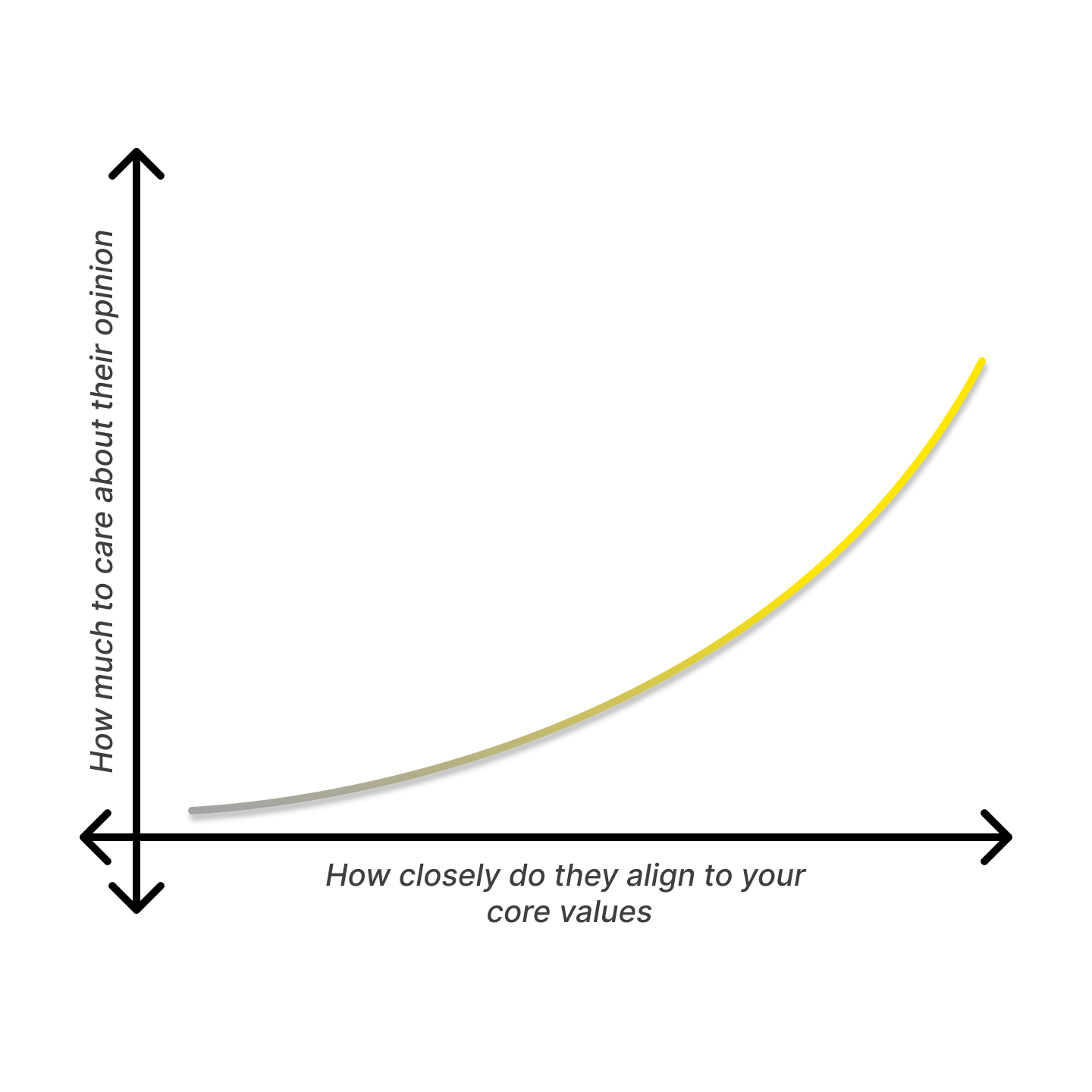
In all actuality, defining your core values won’t prevent you from caring about the opinion of others. But what it will do is allow you to create a list of people whose opinions you will care about more than others and whose advice you will take into greater consideration.
So do that next
– 52%
“Public opinion is a weak tyrant compared with our own private opinion. What a man thinks of himself, that it is which determines, or rather indicates, his fate.”
-- Henry David Thoreau
Create the list. If you already have people in your life, this will be easy. Perhaps these are people you look up to or people who inspire you. Maybe they’re just good friends. But the most important quality is that they align (at least in some part) with your core values.
Creating this list allows you to have a reference for whenever you feel negatively affected by someone. If the person you’re feeling affected by is not on that list, you need not integrate their opinion. There’s deep power in knowing that only certain people can have an effect on you.
What if you don’t have people who align with your values
– 53%
The only solution to this problem is to cultivate more relationships. And if you need advice on how to do so, my article Social Relationships dives into that topic.
You will probably still be affected by the opinions of people
– 54%
A lot of self help will say “just be your own person” and “stop caring about the opinions of others.” In truth, it’s unrealistic to not be affected by the opinions of people (whether or not they align with your values). We’re human after all. We’re social creatures and are evolutionarily wired to care about the opinions of others because cooperative groups are what helped our species survive.
Which is to say, it’s okay that you care about the opinions of other people. You would have to either be really detached from others, be a sociopath, or have an incredibly firm handle on your mind to completely disregard the opinions of others.
In reality, how this exercise will manifest is that you’ll weigh the opinions of those who align with your values significantly more than anyone else’s. Not all opinions need to be weighted equally.
So if some random person makes you feel like you’re a bad person, you can go to a friend who aligns with your values and get their opinion. You should listen to them more than you would that random person.
Boundaries
– 56%
Boundaries are an important component of inner peace. They are listed as a component of eudaemonia in How I Cultivated Eudaemonia→The Equation. But we often don’t give thought to what our boundaries actually are. In not knowing where our boundaries lie, we allow them to be pushed by other people.
Boundaries is such a deep topic, I dedicated a full article to it. Rather than duplicate the content here, I’ll suggest you go read that article.The one thing I’ll say here is you’ll have to experiment to know where your boundaries are (just like you would with your values). Your boundaries should be slightly malleable because we all have gaps and there’s no guarantee we’ve picked appropriate boundaries by default (see Boundaries→How malleable should your boundaries be?). That being said, the least malleable part of your boundaries should be boundaries you set to protect your core values.
Define the life you want to live
– 58%
"The only person you are destined to become is the person you decide to be."
-- Ralph Waldo Emerson
Once you’ve defined your core values, you can use those values to better define what your ideal life looks like. You can dream now knowing that you have a north star for your life. Just make sure what you define is what you want, not what someone else wants of you.
When you’re young, you may doubt yourself and feel like you don’t know what’s the best direction to go. In this situation, just go in any direction guided by your core values. If your core values lead you astray, the world will correct you (see Knowing Yourself→The world will check your values for you).
Some additional exercises
– 59%
Forecast your life out five years
– 59%
My senior year of college I wrote out what I wanted my life to look like in five years.
I wrote:
- An idea of the city I would like to live in
- An idea of what type of apartment I would have
- An idea of what type of lifestyle I would be living
- What type of person I would be
- What type of job I wanted to have
- How much money I wanted to be making
- What type of mood I wanted to be in
It wasn’t super specific, just general ideas. The exercise only ended up taking about an hour.
I re-read it 4 years later. In that time, I had achieved most of what I had written.
I’m definitely lucky that it worked out that way, but writing things down has some sort of subconscious effect where you actually internalize what you wrote. There’s some research that shows that you’re much more likely to accomplish something if you write it down.
Get a Journal
– 61%
Journaling is a very powerful tool for introspection. A journal is a private place for you to explore what is going on in your mind – kind of like Mindfulness→Noting.
A journal doesn’t have to be anything fancy. It doesn’t even have to be physical. My first journal was a Word document on my computer. Whenever I felt the need, I would just word vomit onto the page. It was just a stream of consciousness. I didn’t care about grammar or spelling, I just wanted to see what was going on in my head.
If a guided journaling practice is better for you, I highly recommend The Human Being Journal (not sponsored). A friend of mine got this for me for my birthday one year and it proved a great tool for understanding myself. The journal is a once-a-month journaling practice. It starts you off by walking you through a goal-setting process for the following 12 months. The goals you set are to be accomplished over that period of time. Each month you check in on your progress with these goals and respond to a few questions that help you explore who you are.
I found it to be a very valuable tool and it made the introspection process very easy.
Know your traumas
– 63%
This can be one of the hardest parts of knowing yourself. Being able to recognize 1) that you experienced trauma and 2) how that trauma manifests in your life requires deep awareness and introspection. Trauma can be experienced when we are young and (with little information about how to appropriately deal with it) we develop defense mechanisms that may not be healthy. As we grow older we rely on these (potentially) dysfunctional mechanisms to protect ourselves, reinforcing them over and over again.
Like a fly trapped in amber, your damaged inner child builds up these mental callouses to protect itself. But if you don’t eventually set it free, it will always become a knot in your mental muscles. That knot will create friction and may cause you to behave in inappropriate ways.
It’s not unreasonable that we develop potentially dysfunctional behavior in this way. What people don’t often recognize about dysfunctional behaviors is that they develop because they function well. Function is part of the word dysfunction. If they didn’t work, people wouldn’t rely on them. However, just because dysfunctional behaviors “work” (air quotes), that does not mean you should not address those behaviors. Trauma is not your fault, but you do have the ability to heal yourself.
An example
– 66%
Say you were betrayed by a good friend when you were a kid. A natural defense mechanism would be to not trust people moving forward, develop a fiercely independent personality, and avoid cultivating close friendships. If and when you get too close to a person – in an effort to protect yourself – you may (un)intentionally sabotage the relationship or pull away to protect yourself from being hurt again. In doing this, you can make your life very lonely – which, as I discuss in Social Relationships→Loneliness, will create cracks in your tank and disturb your peace. As humans, we need other humans to live a good life.
But if you can recognize how you were hurt and how that manifests in your life now, you can then learn to make peace with those circumstances. In the example above, this might be you opening up to allow your life to be enriched by the presence of others and avoid the negative consequences of loneliness.
So, knowing your traumas will enable you to better control when and how they manifest and direct them away from hurting other people.
Your shadow
– 68%
"One does not become enlightened by imagining figures of light, but by making the darkness conscious."
-- Carl Jung
The examination of your traumas is related to Carl Jung’s concept of examining your “shadow”. Your shadow is the hidden or otherwise repressed aspects of your psyche. It’s often the parts of you that you may not like about yourself and don’t want to show the world. These may be parts of you that you tried to express when you were young, but were punished for doing so (for good or bad reasons).
Everyone has a shadow. And most of us keep it hidden. But is this a good strategy? Should we repress ourselves? Or should we be trying to make peace with all of ourselves?
If you know the parts of you that are bad, you can work to fix them.
For example, I struggled with setting firm Boundaries, because of what I observed in my family life as a kid (see My Past→My Parents). I wouldn’t stand up for myself, speak up, express dissatisfaction, or even push my way through a crowd even when I really wanted to. I always wanted to take the diplomatic approach. I saw an inappropriate use of boundary setting as a kid, so I chose not to speak up and address conflict head-on, instead leaving that ability hidden in my shadow.
A lot of addressing your shadow is about knowing when a certain behavior is appropriate. As I opened up to my shadow, I learned what were appropriate and inappropriate uses of my voice, force, and firmness to address conflict in productive ways. Had I just left all that in my shadow, I would have never learned how to have a spine.
It’s possible this section didn’t quite scratch the itch for understanding the shadow. However, this video by Charisma on Command might. I feel like it has summarized the major ideas about the shadow correctly and coherently so I recommend checking it out. There’s also this video by HorsesOnYT that does a deeper philosophical analysis of the shadow. It’s also very well done and I highly recommend it.
The other things
– 72%
"Interrogate yourself, to find out what inhabits your so-called mind and what kind of soul you have now. A child's soul, an adolescent's, a woman's? A tyrant's soul? The soul of a predator or its prey?"
-- Marcus Aurelius, Meditations
Above I covered the most important and foundational aspects of knowing yourself. There’s so many things to learn about yourself and I can’t list them all. But I’ll give a short list of other important aspects of yourself that you will benefit from knowing.
- Know your goals in life
- Know what makes you tick
- Know what makes you happy, sad, angry
- Know what you want out of a romantic relationship
- Know what you will and will not tolerate from people
- Know your insecurities
- Know what you’re good at
- Know what skills you have, strengths, weaknesses etc.
- Know your biases
- Know your impulses
- Understand how you react under stress
- So that you don’t inadvertently hurt others
- Understand where your beliefs comes from
- Understand which are serving you and which are not
- Asses your gaps
- Think about what things you might not know
Moving forward
– 74%
Write it down
– 74%
Writing things down has many benefits, but here are a few worth calling out:
- an idea can feel right in your head, but when you look at it on paper (or a screen), you’re better able to see the gaps in it.
- Doing this builds coherence (see Core Tenets→Coherence)
- writing things down makes those things easier to reference when you need to
- writing things down makes it easier to articulate your ideas both to yourself and others
Writing everything down can be tedious, but the most important things to write down for reference are your core values and your list of people. I find immense benefit and power in being able to see my core values and the people whom I believe align with them. I can reference my list whenever I find myself unsure of how to act or when I find myself being affected by someone.
If you really want to go deep in knowing yourself, it can be valuable to think about and write down the “why.” Why do you value a given value? Why do you respond the way you do to a given situation? Why do you have the boundaries that you do? Why do you have those goals? The better you can answer these questions, the better you can adjust your behavior to align with who you want to be.
Listening to feedback
– 76%
"If anyone can refute me - show me I'm making a mistake or looking at things from the wrong perspective - I will gladly change. It's the truth I'm after, and the truth never harmed anyone. What harms us is to persist in self-deceit and ignorance."
-- Marcus Aurelius, Meditations
This is both good advice for knowing yourself and a general guideline for life. The world will give you feedback. Feedback is ever-present. The way you act in the world has consequences. Those consequences can be good or bad. A typical response would be: if something good happens when you do something, repeat that behavior. If something bad happens, change that behavior. But is this the optimal policy? Can we assume that the world is always right?
A better policy might be something like this: if something bad happens to you once, write it off. If it happens twice, you may just be unlucky. If it happens three times, it’s time to consider whether the problem is you.
And this isn’t a rule. But what I’m trying to say is this: nothing is certain. Sometimes you endure unfair consequences or bad luck. You can do everything right and still lose. That’s not failure. That’s just life. Take a statistical approach to understanding the consequences of your actions (see Developing A Good Understanding Of The World→World models should be probabilistic). And if after you’ve observed a similar consequence to the same action a few times, have some humility and explore if you played a role in that.
No one person or group of people has it all figured out. So you don’t want to be changing yourself immediately at the whims of others and of the world. At the same time, you shouldn’t assume you have it right either. Be open.
It’s not right or wrong
– 79%
When receiving feedback from the world, people tend to think in black and white. You might observe that something bad happened, and take that as feedback that you shouldn’t do that. But the world is never really so clearly defined.
You might get feedback that (on the surface) appears to be invalid. But what if they were 30 percent right? What if there was some valid criticism hidden within what they said? It might actually be worth exploring this.
Granted, this takes extra analysis. I wouldn’t expect the average person to spend a ton of time sifting through the good feedback from people who are being assholes. But what I am saying is this: if you’re looking for feedback, don’t think in black or white. The better you can mine for bits of valid information, the more information you’ll have to better align yourself with the world.
An example from the environment
– 81%
I started to notice that when I would doom scroll during the day I would have trouble sleeping at night. I started to correlate that my good nights of sleep came after the days I was on my phone the least. My body was giving me feedback that all that dopamine surging through me was not helpful for my body’s health. As I learned to moderate my social media usage, my sleeping improved dramatically. I observed the negative feedback of the lack of sleep in the former case, and the positive feedback in the form of good sleep in the latter.
I detail this example more as part of Modern Moderation→It’s effect on sleep.
An example from people
– 82%
While I was first learning how to enforce boundaries and speak up for myself, I was involved in a volleyball league. The league was competitive, so people took the game seriously and called out rule violations. We were playing one team who, at one point, messed up their rotation mid-game. They were spending time discussing and trying to figure out what to do. They were taking a while, bordering on a delay of game. So I said (sarcastically and loud enough for the other team to hear), “Is this a timeout? What’s going on?” And some other things like, “you guys just gotta play through the rotation.”
Effectively, I was calling them out for an unofficial timeout and implying they may be cheating for changing their rotation. I felt fairly righteous in saying that, but as I examined the reactions of both the other team AND my team, I realized I was being an asshole. Was the other team doing something wrong? Probably. But was there a lesson I could learn there too? Absolutely. I was out of line. It’s the referees’ job to handle that situation, not mine.
How to best incorporate feedback
– 84%
Humility
– 84%
The first principle is that you must not fool yourself, and you are the easiest person to fool.
-- Richard Feynman
This is one of my favorite quotes. You may find it multiple times across this blog. My point here is that you should always maintain a bit of humility in what you believe you understand about yourself and the values you hold. Like I said above, no one person or group of people has it figured out. That includes you! That includes me!
I recognize these things as I’m writing them. I have to speak with some conviction so that people will resonate with what I have to say, but I make sure to always stay open to feedback and criticism. When editing my articles, I allow certain people (aside from my editor) to read them before I publish. I ask them explicitly, “tell me what you disagree with,” “tell me what you don’t like.” That feedback allows me to have a better article.
When people are critical of me or what I have to say, I take it under consideration. Granted, I’m discerning between what is valid criticism versus what is trolling or anger-driven criticism. I take the latter with a grain of salt, but I don’t necessarily cast it aside (especially if the feedback is repeated across multiple people). And importantly, I weigh the feedback of the people from my list of people who align with my core values much more than anyone else’s.
I actively seek feedback from my friends. If I’m ever wrong, I stand to correct it. I don’t assume I have the whole truth and I’m always willing to learn more. I have some more writing on epistemic humility in Developing A Good Understanding Of The World→Step 0 Be Curious and open-minded.
The best feedback comes when emotion is diminished
– 87%
This is true for both the person giving the feedback and the person receiving the feedback. It’s not that emotional information isn’t valuable. It is (see Emotions and Intuitions→It’s not emotional vs rational thinking it’s slow thinking vs fast thinking).
But when you think emotionally, you’re thinking fast. And that speed makes the information processing noisy. The clearest signal comes from a slow, rational, objective discussion or exploration. I would advise against looking for feedback while you are angry, anxious, or even while you are riding a high. Look for it when you are at your baseline (reference Knowing Yourself→Moderation).
So if someone gives you feedback that touches a nerve, allow your anger to pass before you start to assess whether the criticism is valid. The same is true if you are buzzing from the achievement of some great goal.
Do it all over again
– 89%
“It’s a life’s work to see yourself for what you really are and even then you might be wrong.”
-- Cormac McCarthy, No Country For Old Men
Growing up, the advice I would hear from everyone is “just be yourself.” But “being yourself” implies that there is a fully formed you that is ready to be. But this isn’t really the case. You are not a static thing. You are constantly changing. Your values, expectations, responses, boundaries, desires, and goals will all change over your lifetime – especially as you understand the world better (see Developing A Good Understanding Of The World) and even more so if you choose to cultivate eudaemonia (see How I Cultivated Eudaemonia). You’ll find that you’ll want different things then than what you want now.
We are constantly in the process of knowing ourselves. So it’s important to go back over what you know about yourself over time. And it doesn’t have to be that frequent. Once every couple of years is probably appropriate for reviewing your core values and list of people who align with those values. If you want to set reminders on your calendar, go ahead and do that now.
You can change who you are
– 91%
“Everything was sacrificed to this end. A man’s character became involved to the point that he was caught in a mental turmoil which threatened all the values he held and threw them into doubt.”
-- Victor Frankl, Man’s Search for Meaning
In addition to the talk about just being who you are, people talk about accepting yourself for who you are. It’s not obvious to me that this is good advice either. For some people, this works. In particular, it works for people who are already happy (or at peace) with themselves. But not everyone is there. And it’s important to recognize that if you notice habits or qualities within yourself that you don’t like, you can change them. If you have an addiction or you treat people poorly and recognize these are not things you want in your life, you can change. You don’t have to accept yourself the way you are if the way you are doesn’t align with what you want to be.
Personally, I don’t think we should necessarily be telling people to just “be who you are.” I think the more optimal suggestion would be to encourage people to grow and become the best version of themselves. We should celebrate people adjusting their core values in response to learning about the world as much as we celebrate people who already know what their core values are.
People can get so married to their identities that they become inflexible. This inflexibility can result in stagnation. And when you stagnate, you get left behind. The world is moving and you must adapt to keep up.
As I compare who I am today to who I was even one year ago, I see the world so differently now. If I compare myself now to who I was ten years ago, I’m not even the same person. And the person I was ten years ago would get chewed up and spit out (and booed off stage) by the world today. You should always be able and open to updating yourself in light of new information.
All I’m saying is, try to be humble about what you know and don’t get too married to the idea you create of yourself. It’s gonna change and evolve over time and that’s okay and incredibly natural to do. And if you know the direction you want to go in, then go for it. It takes hard work, discipline, and exploration, but you do have the power to change yourself.
Mindfulness is a great starting point as it gives you the ability to catch yourself when you’re behaving in a manner you don’t like. It strengthens your ability to choose. It’s a slow gradual process, but if you remain vigilant, you will become what you want. You can also reference Mindfulness Theory for a more fundamental exploration of why we can change.
Don’t spend too much time on this
– 96%
“The belief that you can ‘truly know yourself’ is largely delusional since your identity is always unstable and shifting. If you're not a robot, the chances are, you're terribly complex, fragmented, and contradictory. This mystery provides great news: it means you're fully human.”
-- Vizi Andrei
I know people who spend years journaling, trying to figure themselves out. But in truth, the best learning about yourself is going to go from going out into the world and experiencing it. Just like The Happiness Trap, there is an introspection trap. Avoid this.
So let’s go over how long it should take to do some of these exercises:
- Defining core values: 1-2 hours
- Defining the list of people whose opinions will affect you: 0.5-1 hour
- 5 year life forecast: 1-2 hours
- Human Being Journal: 1-1.5 hours (each month)
And remember you don’t have to do everything I’ve listed in this article. The two exercises I would say are essential are 1) the core values list and 2) list of people who align with those values. This brings the total time to between 1.5 and 3 hours. Things like knowing your boundaries, traumas, what you want out of a relationship, what makes you tick, how you react to a given stimulus, etc. will all arise on their own. Therapy will draw things out of you too. And it’s useful to write things down as you discover them, but you don’t need to sit and spend enormous amounts of time squeezing it out of your brain if you’ve done the essentials.
After you have your values and your people, there’s diminishing returns to spending more time evaluating yourself deliberately. You can still get more benefit if you choose to continue exploring (and it can be fun and valuable), but the value will just be less so. It’s more valuable to be paying attention to yourself most of the time, but you don’t need to spend every waking moment understanding yourself.
Summary
– 100%
Knowing who you are at your core is a foundational component of inner peace (see How I Cultivated Eudaemonia→The Foundational Components). The better you can understand yourself, the more clarity you will have on what you really want out of life. The less you are in conflict with who you want to be, the more you will be at peace.
If nothing else, you should spend a few hours considering what your core values are (Knowing Yourself→Write down your core values) as well as defining a list of people (who align with those values) whose opinions you’ll take under greater considerations than Joe Schmoe (see Knowing Yourself→Define a small list of people who align with your core values).
Understand that knowing yourself is an ongoing process and you are always learning and developing. Just because you write down your values today, doesn’t mean they can’t change tomorrow. Be humble and open to feedback.
There are other parts of yourself that you can – and should – explore, but don’t get caught in the trap of spending all your time introspecting. Do just what you need to get out into the world and start living.
Some further reading that can help with knowing yourself can be found in the following articles:
What do you all think? Feel free to share your thoughts in the comments. Your story, likes, and constructive disagreement are all appreciated. If there’s someone you know who might appreciate this too, share this with them. Word of mouth is one of the best ways to amplify this message. And if you’ve gotten any value from this article or any of the others, consider supporting me. It really helps me to dedicate more resources to getting this message out there. Go in peace.
Leave a Reply
You must be logged in to post a comment.