"...and inside you is a stillness and a refuge, into which you can enter at any time and be at home, just as I can. Few people have this, and yet everyone is capable of having this."
-- Hermann Hesse, Siddhartha
This article is purposely called “How I Cultivated Eudaemonia” not “How To Cultivate Eudaemonia.” In this article, I offer you a path to inner peace. I do not offer you the path. There’s no reason there can’t be other formulations. This is just what I know worked for me. Perhaps it will work for you, or give you a starting-off point to develop your own formulation. That being said, I don’t think there’s anything particularly special about me that enables me to have peace that others cannot also adopt.
I don’t presume to be an expert here. I didn’t study psychology in school. All I know is this: I spent a lot of time reading self help, learning about psychology, and paying attention to my own. From that, I was able to find inner peace.
I was an overthinking, extroverted maximalist – a “work hard, play hard” type. I lived hedonistically (see My Past→The Age of Abundance). I had almost everything I wanted and I still found myself anxious and unstable. When I started to pursue inner peace instead of happiness, my anxiety vanished, my mood became more stable, and my life became dramatically better.
What this article will be
– 2%
This article serves like a map for the blog. Because I eventually want to be as comprehensive as possible in the background and functional application of each of these components, I won’t be diving deep on each of them in this article. That would make this article far too long. Instead, I will simply introduce the components here, explain how they relate to peace, and link you out to the articles which discuss them in detail.
And look, what I write in these short summaries isn’t going to be that groundbreaking. The real value is in how the sub-components of each component relate to the other sub-components.
It’s that you should use Mindfulness→Interception to prevent anxiety from taking over, unless you’re using it to not feel your emotions (The (not so) Simple Art Of Letting Go→Feel your emotions).
It’s about the nuance between self-reliance and independence, and how the latter is detrimental (Social Relationships→Independence). It’s about how even if you cultivate mental strength through Mindfulness, if you aren’t getting enough sleep, (Health→Sleep), you’re going to have a hard time with Modern Moderation. It’s about how you should have a growth mindset, but use Mindfulness for Balancing Self Maximization With Self Compassion.
It’s about how you should be a good person (see Social Relationships→Being a good person), but be able to enforce Boundaries so you’re not taken advantage of. Or how you should create time for boredom (see Modern Moderation→Boredom), but not have so much that you stagnate and waste away.
None of these things will end up being a silver bullet that works in all situations. But it pays to know about all of them, what situations to apply them in, and what the bounds are. The magic really is in the details.
Before We Get Into It
– 5%
Read The Happiness Trap
– 5%
Before reading this article, you need to read The Happiness Trap. That article lays the foundation for this article. It defines a fundamental shift to one’s approach to happiness. I argue when people say they “want to be happy”, what they really mean to say is they want “to be at peace.” This is exemplary of a core tenet of this blog: calling things by their proper name (see Core Tenets→Call things by their proper name). It explains why pursuing happiness will make you happy, but only in the short term, while introducing the concept of eudaemonia as a path that will make you feel good, more sustainably and longer term.
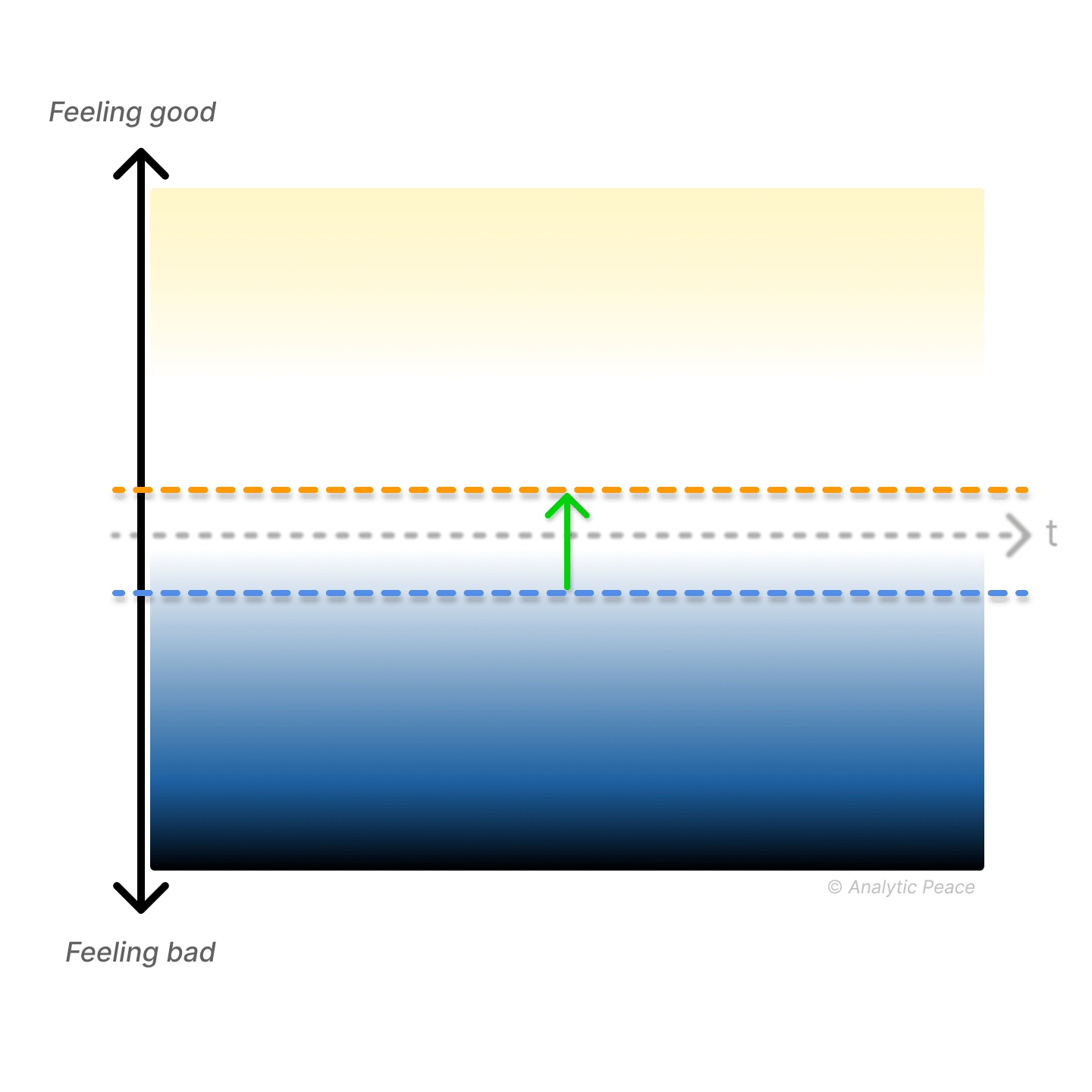
In particular, I will be heavily utilizing the framework from The Happiness Trap→Well-being as water throughout this article to explain the value of the advice below. The goal of this blog is to teach you ways to increase your water level. The pursuit of peace (eudaemonia) is a pursuit of things that will, in essence, fill our cup up (and prevent water from leaking out) in a sustainable way. So you’ll want to understand that framework in order to fully understand this article.
Eating your vegetables
– 7%
"I gave water to the soil and now it feeds me"
-- Beyoncé, Protector

I know there’s going to be some you who read this and go “Waaaaah, I don’t wanna! Eudaemonia sounds like it tastes bad. I like my easy pleasures.” And like yeah, this is going to be kind of like eating your vegetables. But like… vegetables are good for you. And if you feel that eating your vegetables is bad, you need to read The Happiness Trap.
To be clear, I’m not saying you can’t live a fun, fast life. I have cultivated inner peace and I live a fun, full life. You can eat your candy too. All I’m saying is this: have a balanced diet (see Core Tenets→Balance). Don’t make every mental meal ice cream and cookies. We know what foods and activities are good for our body; now we have to figure out what habits and activities are good for our mind. Balance the exciting with the serene.
Like starting a new diet, it may not be easy. It will take time and discipline. But the payoff is worth it.
The Equation
– 8%
I have to start out by qualifying that this equation is in no way scientific. This isn’t validated by anything other than my own experience of eudaemonia.
There are a few elements of this equation, but it’s not that any one element on its own will produce profound shifts in your life. It’s where these ideas connect that the value is born (see About→Connected Ideas). A string on its own can’t hold much weight, but multiple strings woven together become strong.
This is most exemplified by the multiplication of knowing yourself and mindfulness. Those two concepts feed off of each other and serve as the two largest contributors to my peace.
Taken together, I believe that with just these 9 components, you can sustainably raise your water level above the center line.
If I had to break it down by percent
– 10%
I would say (for me) peace is:
- 30% mindfulness
- 15% knowing yourself
- 10% moderation
- 8% mindset shifts
- 8% relationships
- 7% spending idle time meaningfully
- 7% understanding the world
- 6% boundary setting
- 6% health
And yes, that’s only 97%. There are some miscellaneous ideas that I’ll detail at the end of the article. And in truth, the actual values aren’t that important nor accurate. The relative weights of each of the components to the others is really what’s important here.
The better these components are, the more peace you will have
– 10%
I want to note that this article isn’t an ordered list, nor is cultivating inner peace a linear process. In fact, I figured out what I now call “The Foundational Components” last. This is just a list of all the components I believe contribute to my sense of eudaemonia.
So the good news is, you can work on all of these things in parallel, or one at a time, in whatever order you want. Some of the sections will feed off and reinforce other sections. You don’t need to “complete” any one of them first (and in reality, you never really complete any of these things). You maybe get to a point where you are satisfied with a component, but there is no finish line.
The key point is this: the better you incorporate these components into your life, the better your sense of eudaemonia will become.
And as you cultivate more and more eudaemonia, incorporating and maintaining each of these components will become easier.
The zig-zag method
– 12%
You may encounter articles that I deem “foundational” that end up becoming easier the more inner peace you cultivate. Such is the case with Modern Moderation. In order to free up the time to cultivate inner peace, you may need to moderate your engagement quick hits of dopamine like TikTok. But also, the ability to separate from TikTok also gets easier the more inner peace you cultivate, since you feel less reliant on it to feel good. This isn’t logically incoherent nor is it circular.
You can navigate both sides of this apparent dichotomy by zig-zagging between improvements in each. Cultivate a little bit of peace, start moderating. Cultivate a little more peace, moderate a little more. Cultivate some mental strength through Mindfulness, moderate some more. Improve your Health, improve your ability to moderate. Go out into the world, spend less time at home where much of our temptation lays (see Health→Go touch grass).
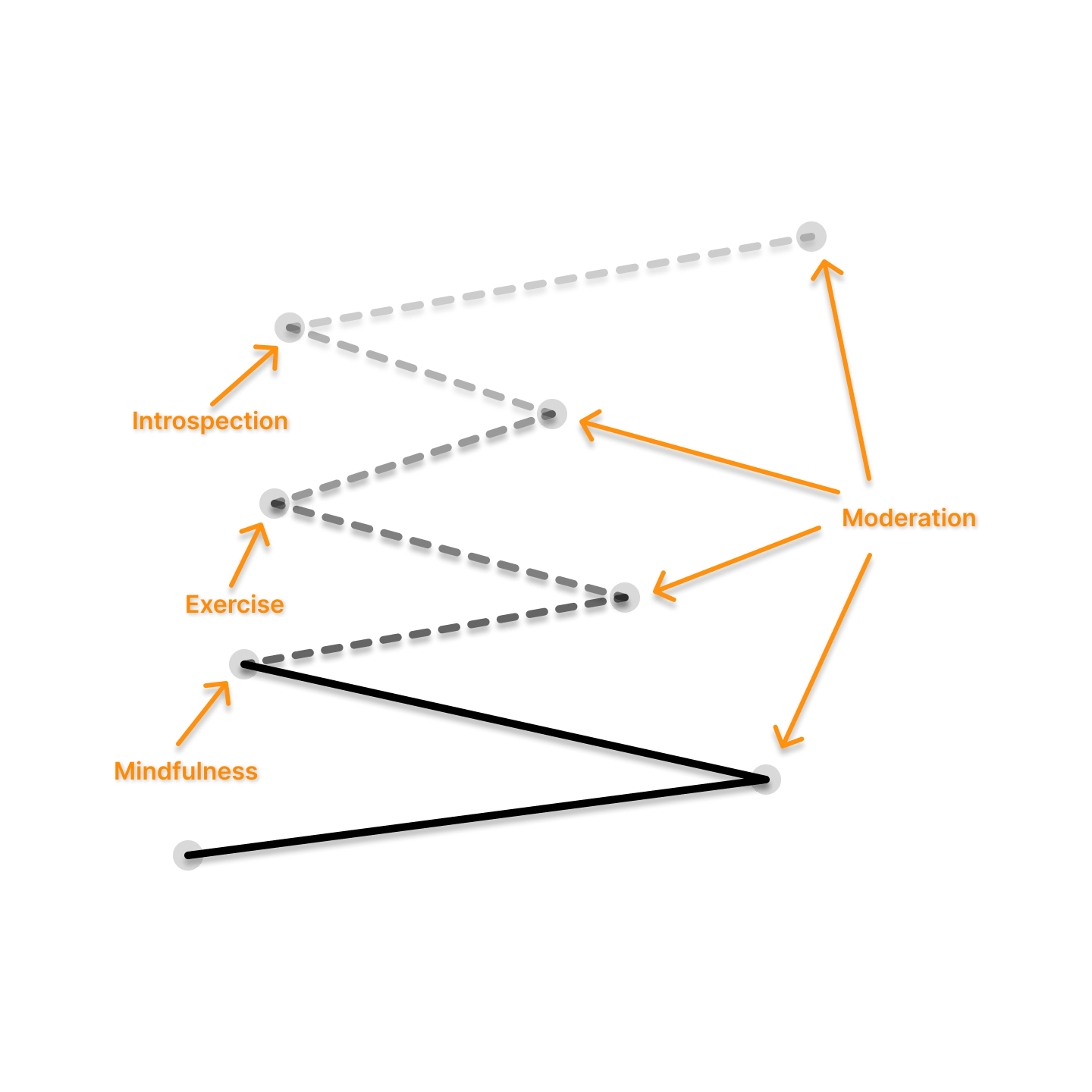
As you incorporate more of the other components of inner peace (see How I Cultivated Eudaemonia→The Equation) and move your baseline higher, moderating will become easier, which will make it easier to move your baseline higher. And so on. This is also true for Spending Idle Time Meaningfully. If you develop skills, it makes easier to apply those skills in meaningful ways (see Developing A Good Understanding Of The World→Develop Skills).
If this feels like a lot
– 14%
Like yeah, it is. And I’ll tell you this much. For how much I was suffering before I found inner peace, the investment toward peace was more than worth it. A core tenet of this blog is action (see Core Tenets→Action). You’ll need to work towards inner peace.
Being at peace makes life just so much easier. You can play the game of life without eudaemonia. But if you do, you’re playing life on hard mode.
To anyone who groans in dismay, "A dozen factors are a lot to remember, why don't you reduce them to just a few?" I reply: it would be absurd to think that the outcomes of people's lives,... could be usefully reduced to just a few catchwords. If you should have the misfortune to pick up a book claiming to achieve that, throw it away without read- ing any further. Conversely, if you have the misfortune to pick up a book proposing to discuss all 76 factors influencing crisis resolution, throw that book away also: it's the job of a book's author, not of a book's readers, to digest and prioritize life's infinite complexity into a useful framework. I found that using a dozen factors offers an acceptable compromise between those two extremes: detailed enough to explain much of reality, without being so detailed as to constitute a laundry list useful for tracking laundry but not for understanding the world.
-- Jared Diamond, Upheaval: Turning Points for Nations in Crisis
While I like this quote a lot, I think there is some value in breaking ideas down to their base levels – sort of like coming at an idea from “first principles”. A big struggle I had with self-help was I could intellectually understand why a certain piece of advice was valuable, but I wasn’t clever enough to figure out how to practically apply it in my life (see About→My Problem with Self-Help). I wanted examples.
And so, I’m going to give you both the main points and the laundry list of ways to implement them. You get to decide to what depth you want to read (see About→How To Read This Blog).
The Foundational Components
– 17%
The three most important components of my inner peace are Mindfulness, Knowing Yourself, and Modern Moderation. Funnily enough, I figured out these “foundations” last. The reason I am still calling these “foundational components” is because they give you a stable base upon which all the other advice can sit.
Prior to figuring out these foundational components, I had most of the other six components of my equation for eudaemonia. For example, I’ve always been active and had many friends. I had learned a lot of good mindset shifts. I was making sufficient money. But it wasn’t ever enough. I still felt miserable. Once I had discovered mindfulness, defined my core values through introspection, and learned to moderate, though, it felt like I was almost catapulted into inner peace.
These three components feel most necessary for peace and hence carry the most weight in my formulation. While the next three sections will introduce these components, I would strongly urge you to read the full articles associated with them as they’ll make the advice in the later sections of this article easier to implement. But you can do what you want. I’m not your mom.
Mindfulness – Control over your mind
– 19%
"The inner machinations of my mind are an enigma."
-- Patrick Star
- develop discipline
- learn to moderate yourself
- reduce anxiety
- self-regulate
- be more present
- improve your mood
- lower your ego
- introspect
- make better decisions
- become more brave
The list goes on and on. You’ll find mindfulness mentioned in many of the articles across this blog.
I promise that mindfulness is more than just about focusing on your breath and quieting your mind. It’s about taking control of an otherwise chaotic mind and aligning it with who you are and want to be. A lot of our decision making is automatic. Mindfulness trains you to slow down so that your decision making is better informed by your consciousness.
If you’re asking yourself, “How do I become more confident?” “How do I become more brave?” How do I become more thoughtful?” “How do I…”, the answer is mindfulness.
Self-help is insufficient without mindfulness
– 20%
The problem with a lot of self-help is that the authors give you valuable mindset shifts to adopt, but there is almost never any discussion on how to actually shift your mind in that direction (see About→My Problem with Self-Help).
The only way I have found to consistently apply the advice I’ve accumulated from the self-help space is by having a good grip on my mind. I have only found that control through mindfulness.
It cannot be understated how valuable mindfulness is for self-help.
Why it’s important
– 21%
Note: I’m invoking the framework from The Happiness Trap→Well-being as water in my descriptions here, so be sure to read that to understand what I’m about to say.
Mindfulness carries the largest weight in my formulation because it is one of the best ways to heal cracks in our tank and prevent new ones from forming. Our minds are constantly producing thoughts and those thoughts may not always be positive. Some people, like myself, are just unlucky and are predisposed to negative thinking.
That negative thinking creates unnecessary cracks in our tank. We damage ourselves in this way. But you can push back against those thoughts. You can train your conscious mind to be stronger than your unconscious. You can break that vicious cycle.
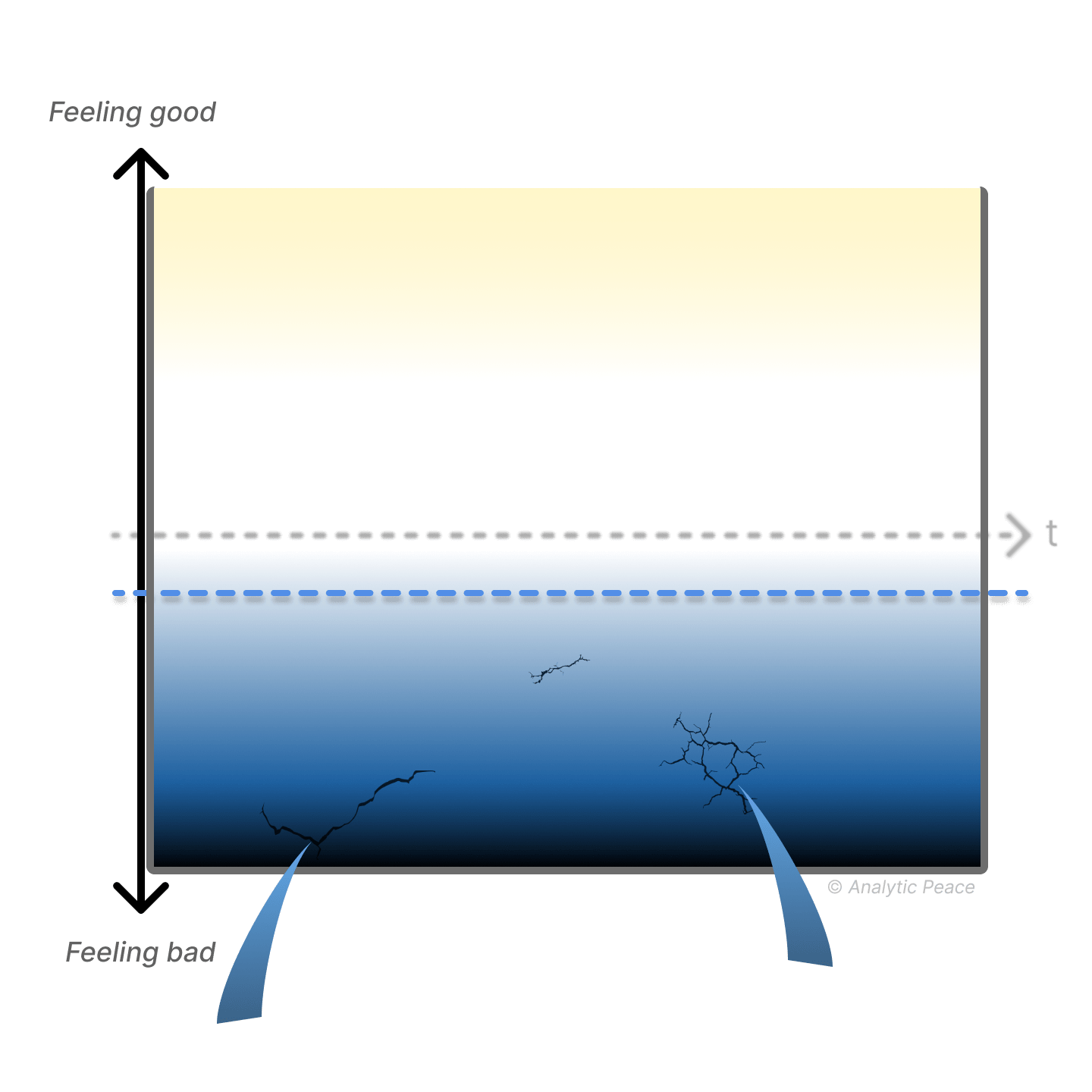
Sometimes our minds are predisposed to inaction. We have a desire to just sit and waste away. This lets the water leak out of our tank without any replenishment. Mindfulness can help you cultivate the motivation necessary to take action.
Some of us are predisposed to compulsive behavior or consumption. We fall prey to The Happiness Trap and think our lives are good because our ball is up in the air. In reality, we are artificially high and our water level may be actively lowering. Mindfulness allows you to exert more conscious control over yourself and push back against your urges.
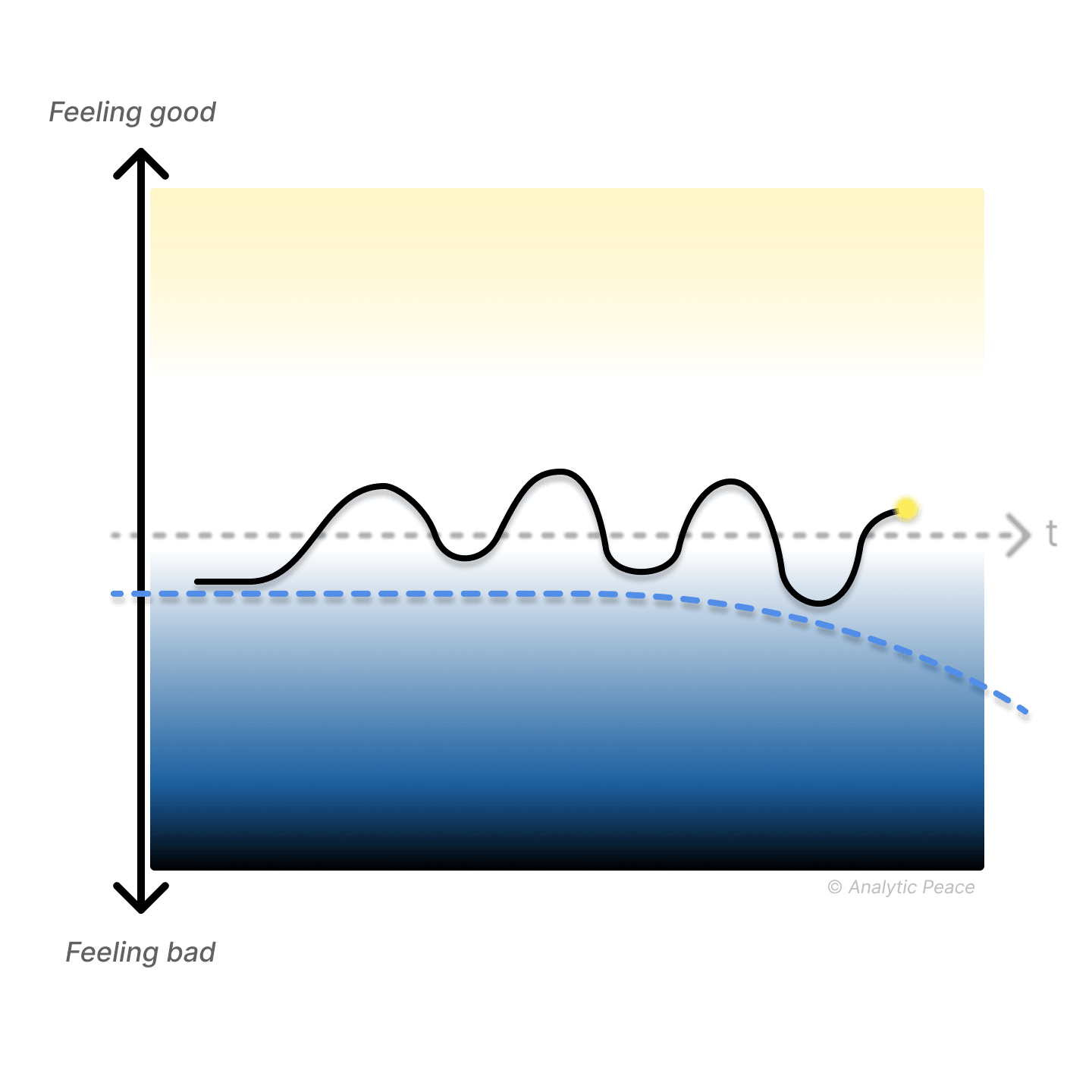
Our lives move so fast and we are so distracted nowadays, that it can be hard to make space for slow-living and Modern Moderation. Mindfulness helps you become more aware of yourself and how you are living, allowing you to make that space.
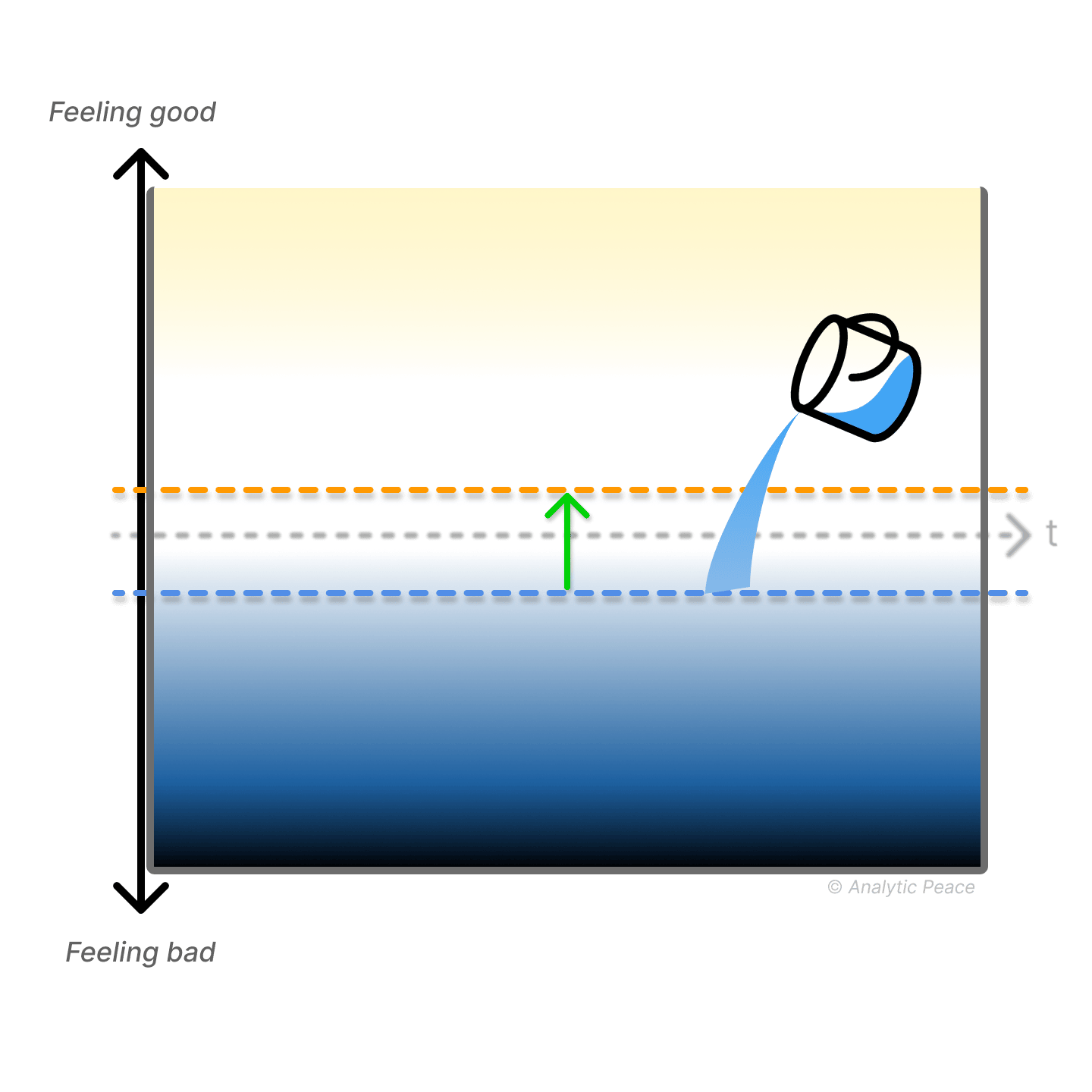
Mindfulness can actually add water to your tank through practices like gratitude and Metha (see Mindfulness→Mehta.)
Managing unnecessary anxiety
– 24%
It might seem intuitive that being anxious and having inner peace aren’t exactly compatible. And as I’ve explored the ideas that I’ve landed upon, I understand that the pursuit of eudaemonia does eliminate a lot of the basis for unnecessary anxiety and suffering.
At the same time, there are some strategies that can help with managing anxiety. I’ve detailed all of this in Managing Unnecessary Anxiety which is both a sub-component of eudaemonia and a benefit of its cultivation. Perhaps you’ll find some useful information there.
Ultimately what you’ll find is that Mindfulness ends up being a really valuable tool for both preventing anxiety from arising and dealing with it once it has arisen which is why it’s included here under Mindfulness instead of having its own dedicated section.
Now, if you don’t struggle with anxiety, then I guess just have a nice day.
Knowing Yourself
– 25%
"That I know nothing about myself, that Siddhartha has remained thus alien and unknown to me, stems from one cause, a single cause: I was afraid of myself, I was fleeing from myself!"
-- Herman Hesse, Siddhartha
Note: I’m invoking the framework from The Happiness Trap→Well-being as water in my descriptions here, so be sure to read that to understand what I’m about to say.
Knowing Yourself enables you to live a life in accordance with who you are, creating coherence and harmony (see Core Tenets→Coherence). Living in conflict with yourself is one of the biggest cracks we create in our tanks. Furthermore, not knowing yourself makes it difficult to find the most appropriate way to address the cracks in your tank.One thing that helps with knowing yourself is Modern Moderation, which I’ll touch on next. Moderation helps you know yourself better as you’re not distracted by other things stealing your attention. You may think you desire being on social media, but that may only stem from an addiction to a platform.
Is moderation necessary for knowing yourself? No. This is just one of those instances where different ideas work together to be better than they are just on their own. You’ll know yourself better if you are closer to your baseline, which moderation will help you get to.
Most importantly, you should read Knowing Yourself→Write down your core values. When you hear people say “figure out who you are”, this is kind of what they’re getting at. At least, that’s what it felt like for me. I don’t think people are aware of the value of this, even if they are doing it implicitly. Defining my core values was one of the most valuable exercises I ever undertook. Everything else about knowing yourself will stem from your core values and the direction of your life will be guided by them.
If you want real confidence – confidence that you don’t have to fake – you’ll want to define your core values and pursue peace (see more in Becoming Sustainably Confident).
Why it’s important
– 28%
- Instilling confidence that you are working in a manner that aligns with who you are
- Understanding how you behave – which behaviors are helping you and which habits are hurting you
- Understanding what you want out of life, pointing you in the direction of your purpose
- Understanding and establishing your personal Boundaries
- Knowing what things push you into the happiness trap so you can decide whether you want to continue engaging with them
Modern Moderation
– 29%
This is an issue that is more common now than ever. With consistent access to information and stimulation, we’ve lost sight of the value of moderation. Modern Moderation is one of the points that’s going to feel like I’m telling you you need to eat your vegetables. We’ve lost sight of the value of moderation not only in our food diets, but also our information diets and workload diets. It’s become easy to feel overwhelmed because we are overwhelmed!
I’ll qualify here (as I do in Modern Moderation), that cultivating eudaemonia is not asceticism. I am not telling you to become a monk and stop engaging with stimulating content, sugary food, and other distractions. I am not telling you to live a life of abstinence, nor am I telling you not to do cool shit. It’s about the idea of everything in moderation, including moderation (see Core Tenets→Everything in moderation, including moderation. That means engaging with pleasurable things, without overdoing it.
Some people might feel turned off by this because they worry they don’t have the self control necessary to moderate themselves. And maybe you don’t. But you can cultivate it through Mindfulness. The more control you have over yourself, the more you can look temptation in the face and say “No.”
Why it’s important
– 31%
Note: I’m invoking the framework from The Happiness Trap→Well-being as water in my descriptions here, so be sure to read that to understand what I’m about to say.
Our lack of moderation combined with our ease of access to simple pleasures sends us into and keeps us in The Happiness Trap. We think we’re doing well because we feel good, but this is an illusion. Eventually, there is a break from the constant stream of pleasures (see The Happiness Trap→Eventually, you will miss the ball on its way down). And then in the absence of pleasure, we suffer.
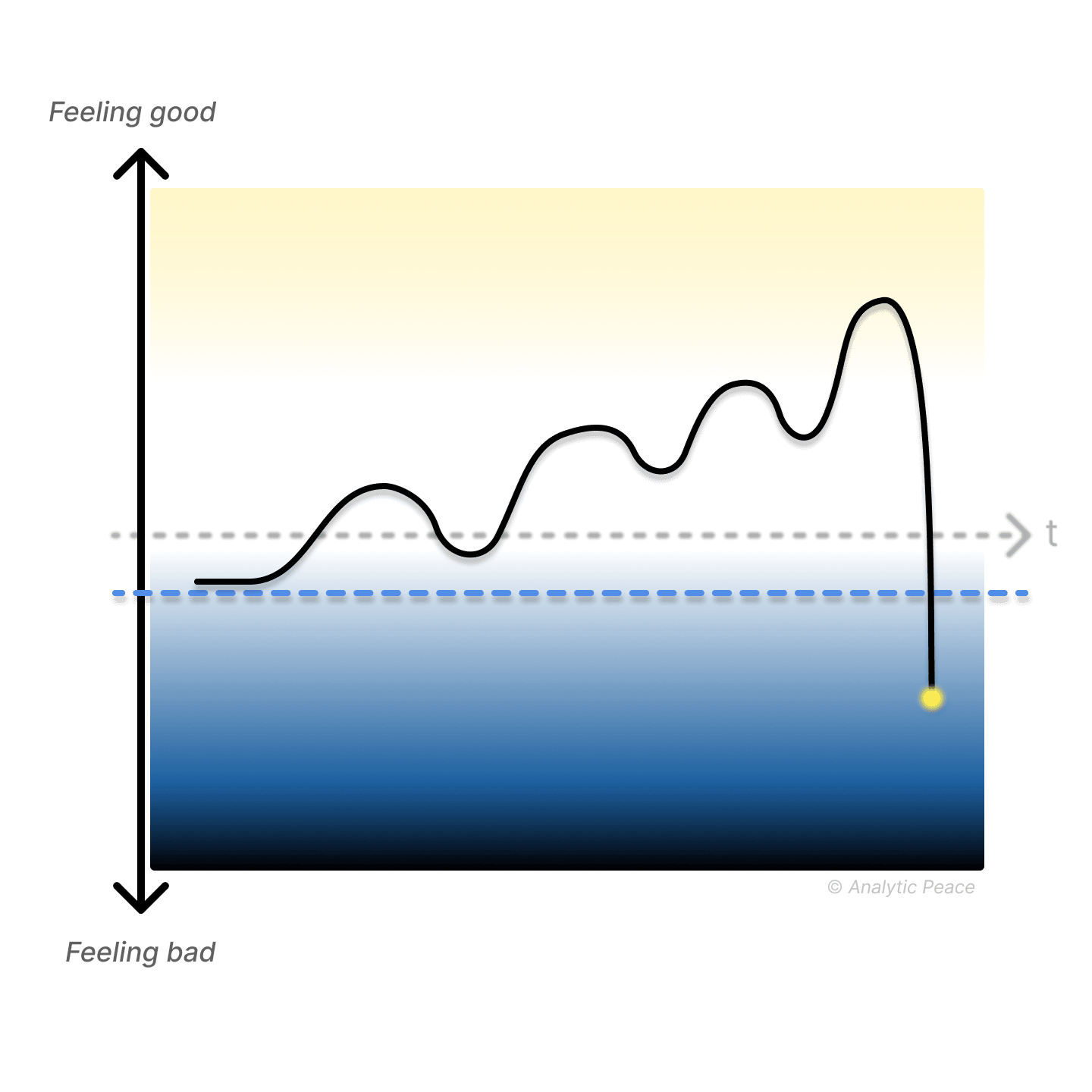
And this process of chasing highs and crashing down has gotten worse in the modern age. A healthy dose of moderation can do wonders.
Additionally, moderation has benefits in Knowing Yourself. Put simply, it’s hard to properly assess what you want out of life when you’re compelled to pursue cheap pleasure. When you’re living in the sky you can’t tell where your baseline is because you’re so disassociated from it. You can know yourself best when you return to your baseline.
You might be afraid to return to your baseline because it may lie in the feeling bad region and that can be uncomfortable. But it’s important to know where exactly your baseline is so you can take the appropriate steps to the appropriate degree to move your baseline out of the feeling bad region.
The Mindset Shifts
– 33%
"Throw out your misperceptions and you'll be fine. (And who's stopping you from throwing them out?)"
-- Marcus Aurelius, Meditations
With the foundations of Mindfulness from above, you develop control over your mind, allowing yourself to be better able to actually remember and implement the mindset shift that will lead to your peace.
But what are the set of ideas you should remember? What thoughts should you be replacing bad thoughts with?
These are the mindset shifts that brought me peace. I (obviously) think these are valuable. I also believe these mindset shifts can benefit a majority of people. My list may or may not be exhaustive for you. If this set of mindset shifts feels incomplete, there may be additional mindset shifts you need to discover to handle your own unique circumstances. I touch on how to do this in Developing A Good Understanding Of The World.
Mindset shifts as tools
– 34%
"Doctors keep their scalpels and other instruments handy, for emergencies. Keep your philosophy ready too - ready to understand heaven and earth. In everything you do, even the smallest thing, remember the chain that links them. Nothing earthly succeeds by ignoring heaven, nothing heavenly by ignoring the earth."
-- Marcus Aurelius, Meditations
Mindset shifts are like a set of tools. You accumulate tools as you are introduced to new ideas. You carry this toolset with you wherever you go.
However, no tool is universal. What works for one job won’t necessarily work for another. You wouldn’t use a screwdriver to hammer a nail in (I mean, you can. But there are better tools to get the job done).
So you need to know in which circumstances to apply which idea. You also may need different tools based on where you live, what resources you have, and what you’re trying to build.
This list is what I believe to be the most robust set of mindset shifts that are independent of where you live or what resources you have.
Don’t seek to be happy, seek to be at peace
– 36%
The first and most important mindset shift (in my opinion) is to not pursue happiness, and to pursue eudaemonia instead. You will have already seen this if you have read The Happiness Trap like I told you to at the beginning of the article.
The pursuit of happiness is likely to lead to your lack of it. When you pursue happiness, you are pursuing a fleeting feeling. However, the pursuit of peace will bring you sustainable good feeling.
Never put your peace in something outside yourself
– 37%
Change will not come if we wait for some other person or ... some other time.
We are the ones we've been waiting for.
We are the change that we seek.
-- Barack Obama
You can put your happiness in something outside yourself. But never put your peace in something outside yourself.
Your partner can make you happy, but your peace has to come from within. You can be happy that your team won their playoff game, but your peace should not depend on them doing so. You can look forward to that next trip, but your well-being shouldn’t be deferred until you get there.
And importantly – you are the only person who can complete yourself. Everything you need for inner peace and consistent well-being already exists inside you. You just have to bring it forth. Take action (see Core Tenets→Action) and grow into a complete person (see Balancing Self Maximization With Self Compassion). This isn’t about detaching from people and becoming solitary. It’s about becoming self-reliant – having the ability to solve your own troubles for yourself.
Stoicism
– 38%
"ON THE BOOK OF MARCUS

If you desire to master pain
Unroll this book and read with care,
And in it find abundantly
A knowledge of the things that are,
Those that have been, and those to come.

And know as well that joy and grief
Are nothing more than empty smoke"
-- Unknown Byzantine Poet, on the meditations of Marcus Aurelius
Stoicism is a philosophy that I think many people would benefit from studying. Stoicism doesn’t provide a guide for being happy or joyful – but like I said earlier, that shouldn’t be your goal anyway. What it does offer is incredible teachings on mitigating suffering, which of course is powerful in the aim of living a happy life. It also gives an ideal to aspire to: that of a virtuous person. I would argue that a virtuous person better sets themselves up for a life of peace than the average bear (Social Relationships→Being a good person).
You’ll find many references to Stoicism throughout this blog even beyond the specific lessons I mention here.
Many of the lessons that inspired this blog came from reading the book Breakfast With Seneca by David Fideler (see About→Recommended Reading). It distills many Stoic writings into a form that applies to the modern world. I distilled that book into my own summary citing the quotes most relevant to me. You can find that here: My Thoughts On Stoicism. I use these quotes in combination with Mindfulness to remind myself of a positive perspective when I feel anxiety or negative thoughts arising.
I would still recommend reading the full book as you may find other parts of it relevant to your life. But suffice to say this book changed my life. I read it during an incredibly anxious time in my life and it rescued me from the pain I was experiencing.
The only thing the book is missing is the exploration of Mindfulness as a technique that will actually enable you to apply the wisdom that you learn. The Stoics did believe in mindful living, but the mention of it is not quite as explicit as I would like and can be easily overlooked if not called out.
Stoicism basically provides a host of mindset shifts around:
- the value of being present
- the handling and mitigation of anxiety
- the handling and mitigation of anger
- the value of purpose
- the value of leisure
- how to deal with people who have wronged you
- perseverance
- acceptance
- contending with the world as it
- understanding that most people are good, but are victims of their circumstances
- how to make peace with death
- how to be a virtuous person
- and many, many more.
The items bolded are ones that were particularly influential for me.
Managing anxiety
– 42%
I’ve already linked to Managing Unnecessary Anxiety in How I Cultivated Eudaemonia→Mindfulness – Control over your mind. However, in that article I employ Stoicism heavily so it bears mentioning again here.
Stoicism taught me incredibly valuable lessons for managing my anxiety. I had only wished I had found them sooner and saved myself a lot of pain.
Stoicism is not about not feeling your emotions
– 43%
A common critique of Stoicism is that its reliance on rationality suggests people shut down their emotions. And so the idea goes that people use Stoicism as justification to not feel their emotions. This may be because people conflate Stoicism with “being stoic”.
David Fideler explains in his book Breakfast With Seneca (see About→Recommended Reading):
Before we start exploring Stoicism, we must clear up one popular misconception. Stoicism has nothing to do with "keeping a stiff upper lip" or "bottling up your emotions," which everyone knows to be unhealthy. While Seneca was a Stoic philosopher, it's essential to recognize that over the centuries the meaning of *stoic* has changed radically: the word stoic today, written with a small s, has no relationship with the capital-S Stoicism of the ancient world. While the modern word stoic means "to repress your emotions," the ancient Stoics never advocated anything along those lines. Like everyone else, the Stoic philosophers had no issue with normal, healthy feelings like love and affection. As the philosopher Epictetus wrote, the Stoic should not be "unfeeling like a statue." Rather, the Stoics developed a "therapy of the passions" to help prevent extreme, violent, and negative emotions that can overwhelm the personality, like anger, fear, and anxiety. Rather than repress these negative emotions, their goal was to transform them through understanding.
And while it is true that some people misinterpret Stoic teachings as an argument for not experiencing emotion, it is incorrect to say Stoicism teaches the rejection of emotion. Stoicism’s foundations are built on rationalism, but it also acknowledges that emotional experience is necessary for truly rational evaluation of a situation. As such, it promotes the healthy expression of emotion.
In fact, Stoics very much argue for the importance of feeling your emotion. Naseem Taleb writes that “Stoicism is about the domestication of emotions, not their elimination,” which I believe is an accurate assessment.
Surrender
– 46%
And that lifestyle was just so exhausting. The world is random and you can’t insulate yourself from everything; not everything is going to go your way. In fact, the only thing you have true control over is yourself (see Core Tenets→The only thing you have true control over is yourself). So you know what? Some battles just aren’t worth fighting.
There’s a balance to find between taking action, building the life you want, knowing where the limits of your abilities are, and accepting the world as it is. I attempt to cover these in The (not so) Simple Art Of Letting Go
Why it’s important
– 47%
Note: I’m invoking the framework from The Happiness Trap→Well-being as water in my descriptions here, so be sure to read that to understand what I’m about to say.
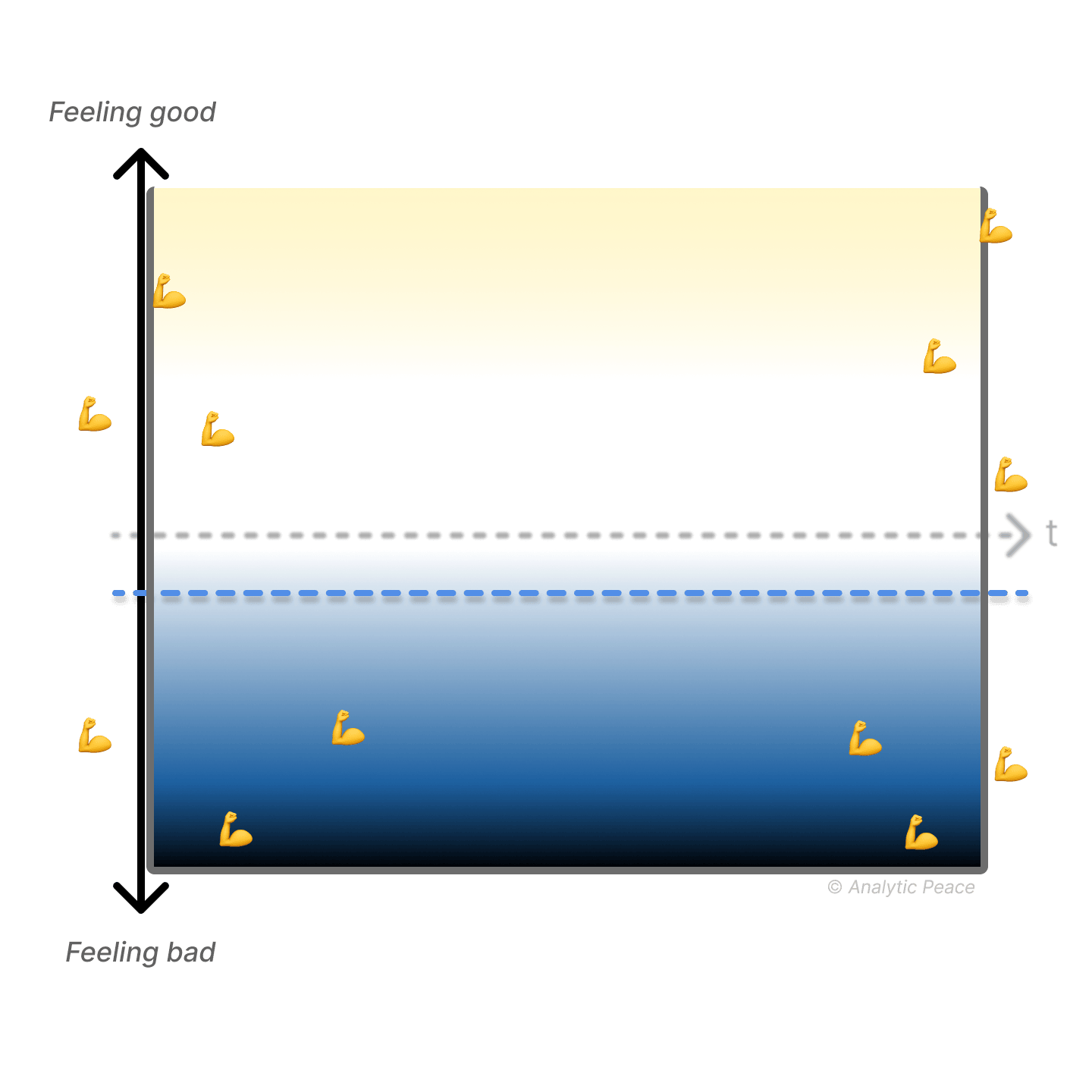
Without surrender, the tank which holds your water is hard and rigid, but brittle – like porcelain or glass. This makes the tank more easily susceptible to breakage and cracks when the world comes and hits it.
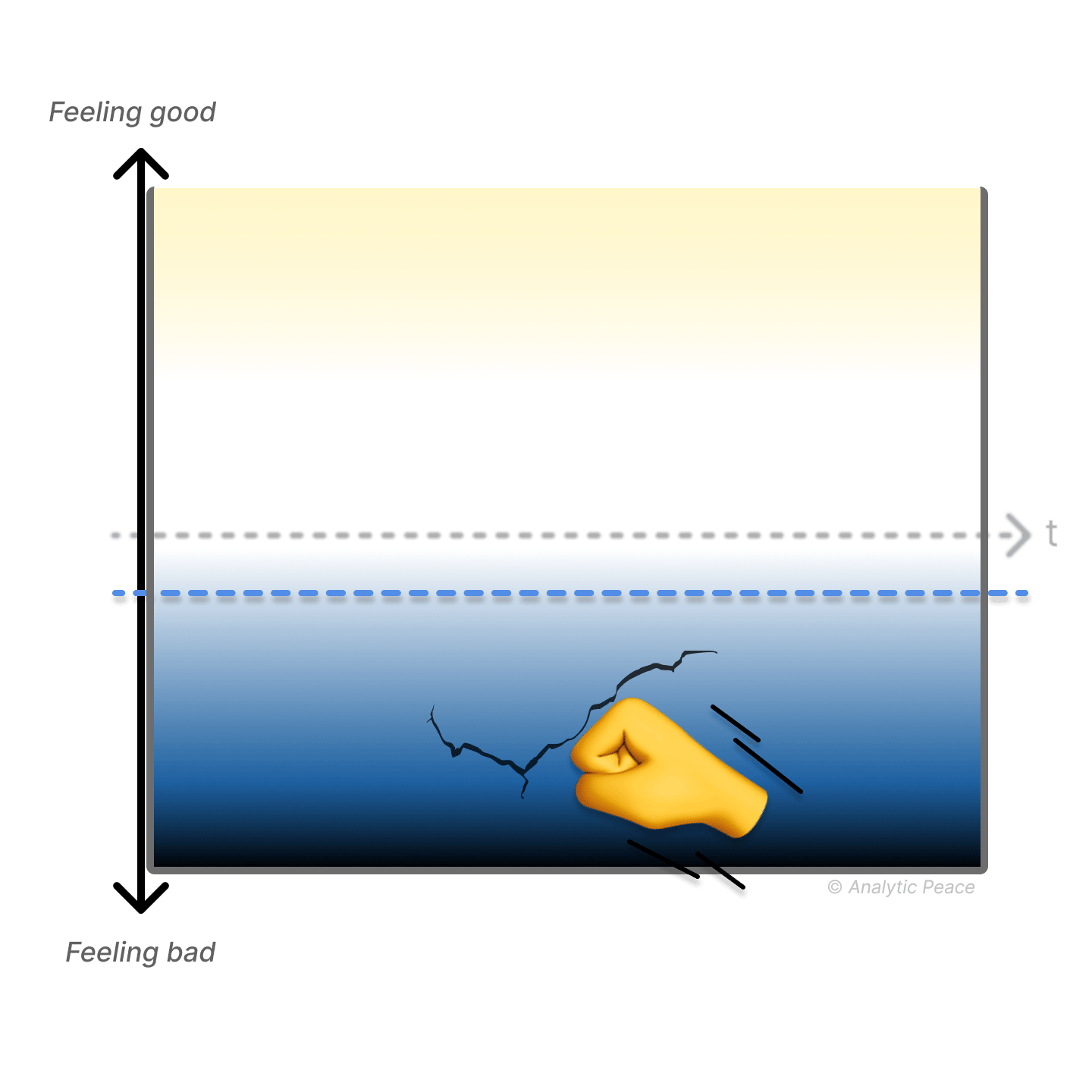
When you learn how to let go, the tank becomes more malleable; that is, it can deform under pressure. You might think this is a bad thing – as though I’m implying that it will allow the world to change you. However, it’s not that simple.
One intrinsic quality of everyone’s tank is elasticity – the tank returns to its original form after being hit (given time). The tank returns more quickly from smaller impacts than from larger ones, but it does always return. However, when your tank is hard and rigid, it doesn’t deform. There’s no place from which the tank can return. Instead, it cracks. The crack remains like a scar.
By making the tank malleable, the tank may be temporarily deformed, but a crack is not created. Thus, the intrinsic elasticity quality can shine, returning the tank to its original form.
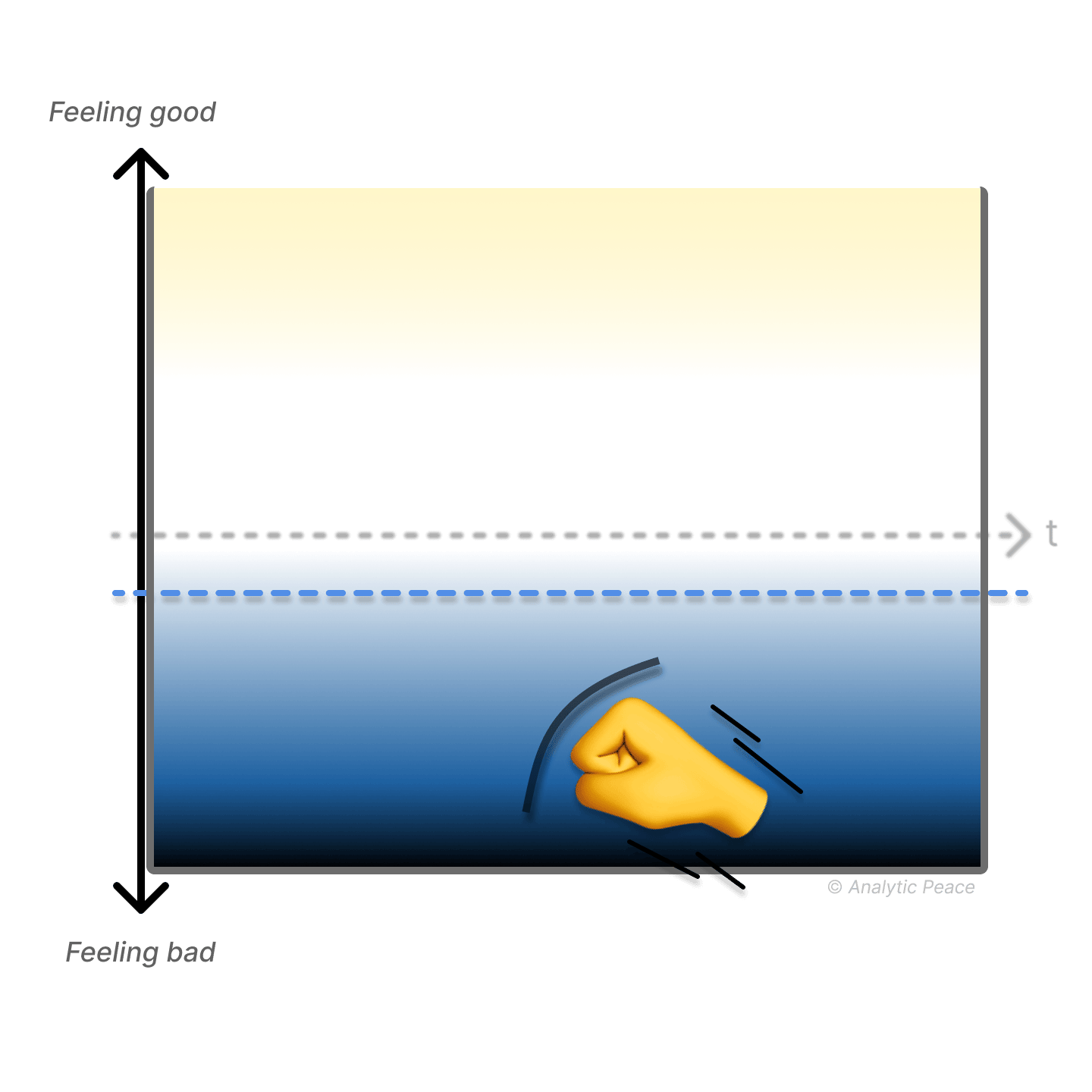
You have to understand that the hits are going to come. You might as well learn how to roll with the punches.
A second intrinsic quality of everyone’s tank, that can only be seen with a malleable tank, is that of antifragility. Naseem Taleb, the man who coined the term, explains, “Antifragility is beyond resilience or robustness. The resilient resists shocks and stays the same; the antifragile gets better.”
When the tank returns to its original form, it forms back stronger – like your immune system which becomes better at fighting a pathogen once it’s been exposed to it.
Money
– 50%
Look, the truth of the matter is having money will better enable you to find inner peace. Full stop. I understand not everyone is going to have the same amount of resources. And I’ve been lucky enough to never have had to worry about where my next meal would come from. So I can’t say a ton on the topic, but what I can say is: to be in a good financial situation you actually don’t need as much money as you think. And more importantly, you can have all the money in the world, but not use it in a way that will bring you inner peace. You need to learn how to use money in a way which will bring you inner peace.
I won’t underestimate how difficult it can be to improve one’s financial situation, but I think there is a lot to be said of simply being financially educated (ala Developing A Good Understanding Of The World). For people at a certain income bracket, financial education can turn their financial situation from worrisome to stable very quickly. I detail a great resource for financial education and a host of mindset shifts associated with money in the aptly-titled: Money.
Financial education and these mindset shifts around money freed me from my financial worries at a time when I had to live quite frugally. This is why I chose to include it within the mindset shifts section.
Why it’s important
– 52%
Note: I’m invoking the framework from The Happiness Trap→Well-being as water in my descriptions here, so be sure to read that to understand what I’m about to say.
Obviously, being broke can be a source of anxiety. There are real consequences in not being able to meet your financial obligations. And these things can cause damage to your tank and cause you misery.
On the other hand, there are ways you can use money to help repair or otherwise improve the integrity of your tank such as:
- repairing cracks in your tank through therapy and doctor’s visits
- making the tank more antifragile through exercise
- adding water to your tank by
- buying higher quality, healthier, but more expensive foods
- allowing you to experience more of life’s wonders
- paying for classes to develop additional skills
- liberating time to focus on other activities which promote inner peace
Remember to be present
– 53%
“If you are depressed you are living in the past.
If you are anxious you are living in the future.
If you are at peace you are living in the present.”
-- Lao Tzu
In trying to run toward things in the future, you never leave yourself time to be present with anything. In looking forward to achieving your goal, you are necessarily living in the future. This can cause anxiety. I don’t have an article specifically on being present, but Mindfulness teaches this skill.
That being said, we have to plan for the future. We can’t avoid thinking about it. We must also learn from our past. If we ignore it, we lose information. What’s important is that you do not dwell in either the past or future.
Live in the future long enough to develop the vision of your goal and plan what you need to do to get there. Look to the past for information about who you are, how you behave, and who you want to be. But when you are doing the work to achieve your goal or to know yourself, be sure to do so with complete presence.
The Medium Stuff
– 55%
Relationships
– 55%
This is another obvious one. Having social relationships is essential for any human being. There are a whole host of benefits to having people in your life. I’ve distilled what I know about non-romantic relationships into Social Relationships.
If you’ve read Knowing Yourself, you know that one of the most import sections of that article is Knowing Yourself→Define a small list of people who align with your core values. You can’t produce that list without having people in your life.
Part of cultivating good relationships revolves around being a good person. In being a good person, you will attract more people into your life and those people will be on average good. But there’s a risk you’ll attract bad people too. You’ll attract good people who want to be around other good people and you’ll attract bad people who will want to take advantage of your virtue. This is why you need to combine being a good person with Boundaries. Boundaries will help you discern and eliminate bad people from your life who don’t deserve you. This will make the vast majority of people in your life good. I dive into the nuances of being a good person and how to make sure you surround yourself with good people in Social Relationships.
Relationships won’t bring you all the way to inner peace. Relationships are by definition external. Getting more relationships or relationships of higher quality won’t save you. There is a ceiling to what other people can add. So relationships are necessary, but insufficient for peace.
And some might think, “well then maybe I should just be independent and not need people.” But that’s the wrong conclusion. As a human, you need relationships, even if you are introverted or socially anxious. The cost of being lonely is much worse.
Why it’s important
– 58%
Note: I’m invoking the framework from The Happiness Trap→Well-being as water in my descriptions here, so be sure to read that to understand what I’m about to say.
Unlike other forms of happiness, which shoot your ball up into the air, relationships add water to your tank. Relationships don’t purely breed happiness. They breed joy and contentedness.
Relationships can help you repair cracks in your tank or prevent new cracks from appearing. They can do this through being a support system for you or by enabling you to have a dialogue, not unlike Therapy. Relationships can introduce you to new ideas you would have never encountered otherwise.
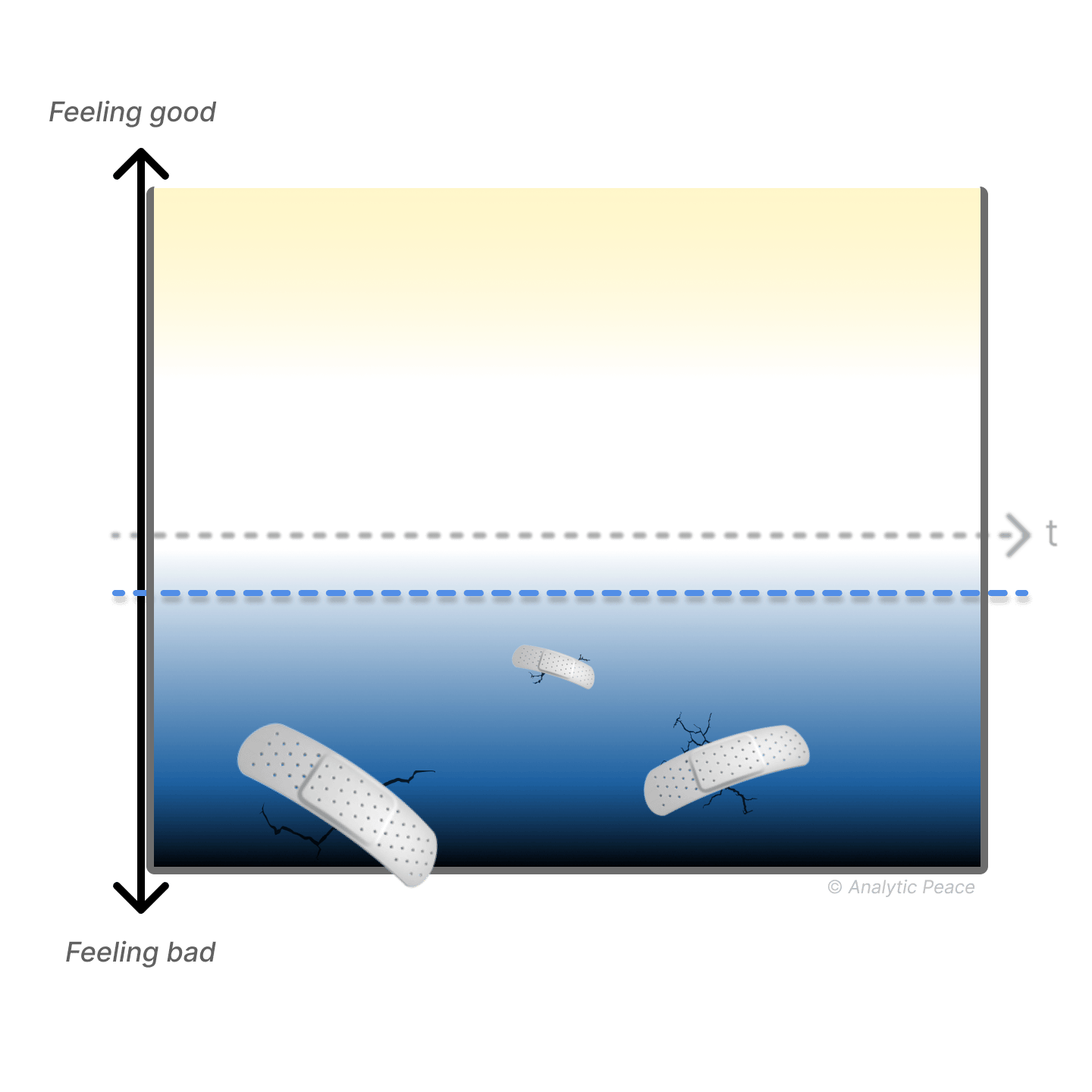
Having social relationships helps socialize us, enabling us to better integrate into society. Relationships inspire us in ways that can (and often do) make us better. Relationships catch us when we’re falling, aid us when we need help, and can make up for areas where we are insufficient.
Our species became the dominant species on earth not because we were the biggest, fastest, or strongest. We didn’t even become the dominant species solely because we were the most intelligent. We became the dominant species, in large part, because of our ability to organize into groups which cooperate, coordinate, and support each other.
Loneliness
– 60%
In fact, there are actually health issues associated with loneliness. Evolutionary theory holds that those humans who socialized poorly and were cast out from the tribe were far more likely to die on their own. So, evolution has wired us to physically require social groups. If we don’t have them, our mind starts to make us feel bad by releasing cortisol, a stress hormone, in an effort to get us to reintegrate with a group. And so, loneliness will form cracks in your tank.
And so even if you focus all your energy on maximizing the amount of eudaemonia you cultivate from the other components, if you actively ignore cultivating relationships, larger and larger cracks will form in your tank and they won’t be healed. The water will eventually be leaking out of your tank at a faster rate than you are replenishing it and you will suffer for it.
The conclusion is: you shouldn’t need people to keep you in the feeling good region, but you should still cultivate relationships.
This is not about romantic relationships
– 61%
There is an important distinction between having people in your life and being in a relationship with a partner. Romantic Relationships are not necessary for eudaemonia, but cultivating eudaemonia will benefit your romantic relationships. Being at peace makes you more confident, less needy, and more attuned with yourself, and better enables you to advocate for yourself, set boundaries, avoid codependency, and love genuinely. These are all important qualities for healthy, long-term romantic relationships.
There’s a peace that can come from understanding romantic relationships and avoiding certain pitfalls – I go over those in that article too. But, my main point here is this: another person will not bring you peace.
Spend idle time meaningfully
– 62%
In successfully implementing Modern Moderation, you may find yourself with more free time since you won’t be as consistently distracted by short-term pleasures. While I do argue you should have some idle time for both leisure and boredom, it is possible to have too much free time. Too much free time may result in your regression back into The Happiness Trap.
For that reason, you should be spending this newfound idle time meaningfully (Spending Idle Time Meaningfully). This isn’t about a grand purpose, it’s just about being engaged with the way you’re spending your time, even if that activity isn’t a direct dopamine IV drip straight into your brain.
You’ll notice that purpose isn’t really mentioned throughout this article. That’s purposeful. There’s so much discussion about finding your “purpose” in life as a path toward fulfillment. I think the discourse we have around purpose is far too overloaded. We put so much pressure on ourselves to find the one thing that we think will bring us fulfillment and that mostly ends up keeping us from appreciating any of the other meaningful work that we do.
Purpose isn’t some grandiose thing that will save you. All purpose is is something that you really care about, that you can work on and make progress in, and that captures your attention enough to ground yourself in the present – a blog, a business, cultivating a family, community service, your education, etc… And while I believe that a purpose is a nice thing to have,
- you have to be kind of lucky to find it
- I first experienced peace in the absence of any grand purpose
So I don’t think purpose is a necessary ingredient for inner peace. In fact, a grand purpose can actually disturb your peace depending on how involved you get with it. It can cause you to neglect the other parts of yourself that do bring peace, not unlike The Happiness Trap→Achieving everything you want.
So I do think it’s important to spend idle time meaningfully, it just doesn’t have to be such a big deal. I dive deeper into this distinction as well as provide some advice for how one can spend one’s time meaningfully in Spending Idle Time Meaningfully.
Why it’s important
– 65%
Note: I’m invoking the framework from The Happiness Trap→Well-being as water in my descriptions here, so be sure to read that to understand what I’m about to say.
Put simply, spending idle time meaningfully is an activity that adds water to your tank. The goal of cultivating eudaemonia is to get into the feeling good region, but distracting yourself with indulgence or cheap pleasures only temporarily shoots your ball up into the air, making you feel better. Spending idle time meaningfully raises the ball by raising the water that it floats on top of.
In this way, even when you’re not engaging with the task which is providing you meaning, you still feel good because overall, your baseline is higher. And so you can go and spend your time outside of the task with a greater sense of contentment and well-being because your ball is sitting on a higher foundation.
Be prepared: Develop a good understanding of the world
– 67%
"When the damn flood comes, you want to be the person who built the damn ark."
-- Jordan Peterson
There are so many lessons hidden in the world. It’s not just about figuring out how to solve your problems; it’s about making life a journey of constant learning. You’ll need a good bit of curiosity and epistemic humility to be open to the lessons of the world, but here’s the good news: if you don’t already have that, you can cultivate it. I go over how to do that in the article.
If mindset shifts are tools to apply at certain times, pieces of knowledge are parts that you use to construct a vessel to better navigate the world. We’re looking to build a coherent vessel, which hits on another core tenet of this blog: coherence (see Core Tenets→Coherence). And you want to construct this vessel before the flood comes. Most people wait until disaster presents itself before trying to understand how to deal with it. And it makes sense. A lot of the time you just can’t imagine or foresee something bad happening.
But this is why the more you learn, the better you set yourself up to be well. We can’t prepare for everything, but it would be naive not to try.
Why it’s important
– 69%
The more you can understand about the world, the better you can navigate it. The better you can navigate the world, the better you can steer clear of things which will create cracks in your tank and the better you’ll be able to find things which will add water to your tank.
When you don’t have a wide enough understanding of how the world really works, you start to develop malformed expectations about how the world should work. This disparity is a particularly common crack in people’s tanks.
Another issue – that applies more to analytic types than others – is the acute discomfort that comes from a lack of understanding. Analytics like to think things through and become frustrated when they can’t resolve a problem. This frustration can become a crack in their tank. Developing a good understanding of the world can patch over that crack.
Be challenged – develop skills
– 71%
"Man needs difficulties; they are necessary for health."
-- Carl Jung
You’ve likely heard this said as “get out of your comfort zone.” It is in our nature to grow and develop new skills, pushing the boundaries of what we can achieve. When you’re not challenged, life becomes too easy and this can lead to despair.
For the majority of human history, members of groups had to work together in order to hunt animals, gather food, and protect tribe members. In order to perform these tasks, humans needed to develop the requisite skills: tracking, trapping, coordinating, identifying, fighting, etc.. Building skills is still relevant today. They’re just more specialized and less related to pure survival.
To develop good skills you also need a good understanding of the world as we just talked about in the section above. And developing skills will help you develop a good understanding of the world. The concepts benefit each other in bidirectional ways.
I describe this in further detail in both Developing A Good Understanding Of The World→Develop Skills and Balancing Self Maximization With Self Compassion→Growth Mindset.
Why it’s important
– 72%
Note: I’m invoking the framework from The Happiness Trap→Well-being as water in my descriptions here, so be sure to read that to understand what I’m about to say.
Challenging yourself and growing from this process adds water to your tank. It makes you more whole, self-reliant, and robust. Certain skills (like Mindfulness), moreover, can help you repair or prevent cracks from forming in your tank.
Go out into the world
– 73%
"And -- such is my thinking, o Exalted One -- no one attains deliverance through teaching"
-- Herman Hesse, Siddhartha
The best way to develop skills and a good understanding of the world is to go out into it and experience it. You can only understand intellectually what I am teaching through this blog. You probably will not find peace just from reading all my articles.
There is only so much information you can garner from a book, YouTube video, or lecture. There’s a whole other aspect of real understanding that comes from the real experience of a given thing. You might call this “emotional experience.” What does it actually feel like to do the thing?
You can watch a dozen YouTube videos on how to wire a ceiling fan, but you won’t truly understand it until you do it yourself. Watching a video or reading a book won’t tell you what it feels like to keep your arms above your head for an extended period of time. You won’t understand, through books or videos alone, the sensation of pushing two tiny wires together into a wire nut and having the current flow through. You won’t know what it feels like to look at the finished product and say “I did that.”
So while I advise that you prepare yourself, learning a new thing won’t be complete until you go out into the world and do it. Leave your house. Talk directly to real people; look them in the eye. Shoot a basketball into a net. Press down on the mechanical shutter button of a camera. Cook your own food.
Go out and engage with the world as it is. Not the fake shit you see on the internet. Going out into the world will make you more courageous (see Becoming Sustainably Confident→Bravery).
The world is rich with sensations just waiting to be experienced by you.
Boundaries
– 76%
Note: I’m invoking the framework from The Happiness Trap→Well-being as water in my descriptions here, so be sure to read that to understand what I’m about to say.
Boundaries, quite simply, protect our sense of eudaemonia. While our ability to cultivate eudaemonia is an internal ability, we interact with the external world: other people, nature, the economy. Some things in the world are going to disturb our sense of peace. The world is going to put pressure on our tank and that pressure will produce cracks. Boundaries help soften the blow or otherwise prevent hits from landing on the tank.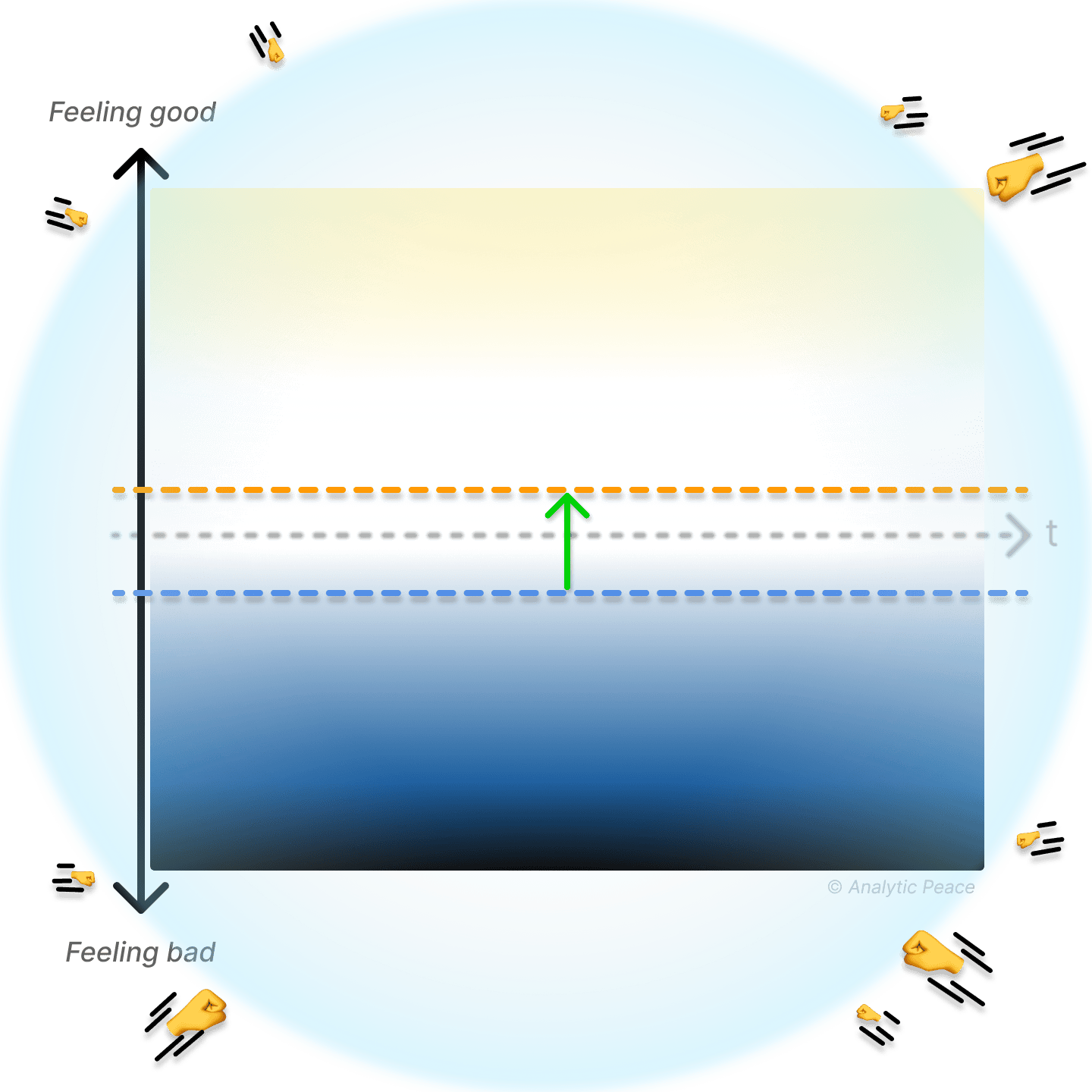
It is no one else’s job but our own to protect our peace. What good is repairing cracks and adding water to our tank if we just let the world walk all over us and produce new cracks?
Boundaries, however, are a tricky subject. How rigid should your boundaries be? Should you ever change your boundaries? How do you enforce boundaries in a non-toxic way? How should you interact with other people’s boundaries? I touch on all this and more in the article: Boundaries.
Health – Control over your body
– 77%
“Hold fast, then, to this sound and wholesome rule of life - that you indulge the body only so far as is needful for good health. The body should be treated more rigorously, that it may not be disobedient to the mind.”
-- Seneca
This component is an obvious one. The more physically healthy you are, the better you feel. I’ve been lucky to be healthy and active most of my life. However, in my mid-twenties I started to deal with some chronic pain that took me out of my active lifestyle for a period of time.
That experience illuminated to me just how important all aspects of health are for cultivating inner peace. I won’t have too much to say in that article that you probably haven’t already heard. I’m sure if you don’t yet have good health, you may be on your own journey toward it.
Some of us can do things about our health; some of us aren’t so fortunate. But, not having good health doesn’t completely disqualify you from peace. Some of you may have seen or heard anecdotal cases of people who, despite terrible health circumstances, found their own peace. This implies that in some instances, lack of great health can be made up for elsewhere. I touch on a few strategies in the article Health that can help with acceptance of health circumstances.
Why it’s important
– 79%
Note: I’m invoking the framework from The Happiness Trap→Well-being as water in my descriptions here, so be sure to read that to understand what I’m about to say.
Put simply, it’s just really hard to be at peace when you’re in pain. That pain is a big ol’ crack in your tank.
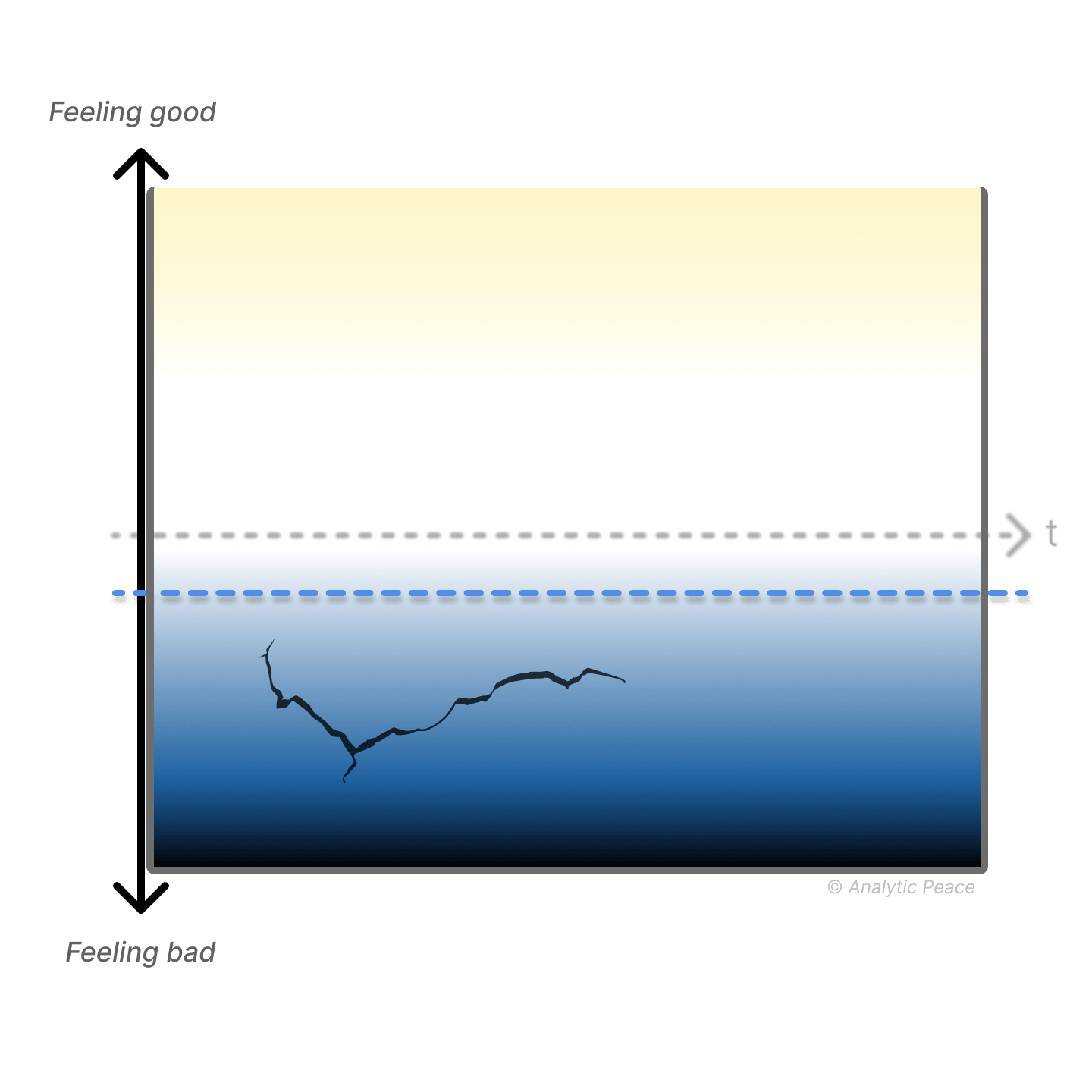
This pain can come from illness, lack of sleep, or unhealthy lifestyle habits (chronic eating, smoking, lack of exercise, etc.).
This is where the notion of “pushing the ball down” (see The Happiness Trap→Sometimes pushing the ball down will raise your water level) is most relevant. It turns out that making yourself “suffer” by exercising, moderating your consumption of delicious but unhealthy foods, and dealing with your pain at the root will actually cause you to suffer less overall, despite requiring effort and sacrifice up front.
Additionally, eating healthy foods and exercise add water to your tank. Nutrients make your body strong and healthy and your body will reward you for treating it well. Exercise prepares your body to take on the world and so your body rewards you as you maintain and grow it.
The Other 3%
– 81%
By now you have seen the majority of things that I feel contributed to my sense of eudaemonia. The ideas listed below are definitely sections you can explore – they’re valuable for living a full life – but their direct contribution to peace will be small. I would focus primarily on the other 97% of the components of peace preceding this section, but maybe you’ll find that the components below have a great contribution to your inner peace.
Therapy: Untangle beliefs which aren’t serving you
– 82%
We all have our conceptions about the world and sometimes there is a delta between those conceptions and how the world really is. Sometimes that delta is never corrected and our beliefs, whether about a particular thing or the world in general, become embedded in our mind.
If we continue to operate in the world with malformed beliefs we risk having unfair expectations of the world, letting our fear hold us back, and/or continuing to live with pain we need not bear. Having a dialogue with others can help avoid these problems.
Therapy can move mountains for some and do very little for others. Therapy can be particularly valuable for those with specific traumas that a therapist is going to be equipped to advise on. That’s not to say therapy can’t be valuable with those dealing with more common issues. In fact, therapists can provide valuable advice that may not be as publicly available. You can really only figure out if it’s going to be valuable for you by trying it.So if you can afford therapy, can have therapy paid for through your employer, or if you have someone with whom you can have therapeutic sessions, therapy is at least worth trying. I put this in How I Cultivated Eudaemonia→The Other 3%, because its effect is rather small in comparison to the other components. And in all likelihood the benefit from this can be made up for with the other components like Developing A Good Understanding Of The World, Knowing Yourself, and Mindfulness. But if you are curious on how to get the most out of therapy, I detail that too in Therapy.
Why it’s important
– 84%
There’s a lot of independent types who believe that they can figure it out on their own. What they miss is that “figuring it out on their own” is having a monologue with oneself. When you have a monologue, you only have the ideas which you currently are aware of. Dialogue with others could introduce you to ideas you would have never stumbled into on your own.
The greatest growth will come from having dialogue with other people – a therapist, a friend, a family member, etc. (see Social Relationships). I had a lot of beliefs about the world that were causing problems in my life, particularly around Romantic Relationships. These malformed beliefs were cracks in my tank. Clearing that up through dialogue with other people who could check me was incredibly valuable.
However, therapy isn’t enough on its own. Therapy may introduce you to new mindset shifts, but you may not have the discipline needed to apply the strategies learned in therapy in your everyday life. This is another area where Mindfulness can be incredibly valuable.
Environment
– 86%
If your environment is constantly bringing you down – whether it be living in a bad area, having a job you hate, or being around abusive people – it’s going to be hard to cultivate inner peace. It’s important to create an environment you want to live in. Boundaries can somewhat make up for this, but if you’re living in a war-torn region it’s less realistic that just having the right mindset will fix your problems.
I don’t have much advice on this. I was very lucky with the environment I was born into. So in all honesty, my advice here likely wouldn’t be of value anyway.
Your ability to find peace is going to vary based on circumstances that are out of our control and are not distributed equally. So some people will have to work harder than others for their peace. I don’t think that makes the journey any less worthwhile. If it’s a journey you want to take on, go for it.
Maintenance
– 87%
"Peace is not something we achieve but rather something we return to... By realizing we are out for a walk, we can return home to awareness... Until we reach a point, through practice, where we are able to remain home no matter where we are in the world. Peace is simply the absence of the urge that seeks it."
--Alexander den Heijer
Eudaemonia is not a finish line. You don’t get there, “have it”, and then you’re done. Eudaemonia is a state you have to maintain. It is possible to lose it. In particular, you want to be wary of falling back into The Happiness Trap, especially when you first start cultivating eudaemonia.
The nice thing is that once you cultivate eudaemonia, you know where it is. Therefore, if you have to leave it behind in order to devote your time to a project or obligation, you can always return when the deed is done.
You might be wondering: what things are worth leaving peace behind for? I will touch on that shortly in How I Cultivated Eudaemonia→Leaving eudaemonia behind (temporarily).
A full life includes some hedonism
– 89%
More paradoxically, pain is the cause of pleasure, and the Cynics are a strange breed of ascetic hedonists, or hedonistic ascetics. Or, rather, theirs is the hedonism of nature itself.
-- William Desmond, Cynics
I think a lot of people turn away from doing things that are good for them because doing the right thing isn’t always fun, or sexy, or engaging. Some might think that cultivating eudaemonia requires living a boring life. Maybe they think that eudaemonia is about leaving the world behind and becoming a monk or an ascetic.
I’ll say it again: eudaemonia is not asceticism. Pleasure and eudaemonia are not mutually exclusive – you can have both. In fact, I would encourage you to have both. Avoiding all pleasure does not make for a very enjoyable life.
You can’t know good without bad, warm without cold. A good human experience balances the opposites.
So, you can still do stimulating activities. It’s just about balancing those activities with mindfulness, healthy living, moderation, enriching activities, leisure, and rest. Remember, it’s about moderating everything, including moderation (see Core Tenets→Everything in moderation, including moderation).
Achieving what you set out to do
– 90%
"Joy is your goal, but you're wandering off course! You think you'll arrive there among riches and official accolades. That is to say, you seek joy surrounded by anxieties! You chase after these things as if they'll bring happiness and pleasure when, in fact, they are sources of pain."
-- Seneca
Some people may worry that optimizing for peace will make them complacent because they believe discomfort or insecurity are good catalysts for growth and don’t want to give those up. They may think that they can’t be at peace until they achieve what they set out to do.
And that is (kind of) true. Discomfort and anxiety can be powerful fuels for growth. The tortured artists are oftentimes some of the best. But being in pain isn’t the only way to be great.
Discomfort and insecurity are like fossil fuels
– 92%
Fossil fuels are incredibly dense packets of energy. And that’s why they are the predominant energy source across the globe. They are reliable, portable, and produce energy quickly. But they are also unsustainable and harmful to our planet.
In the same way, using insecurity, discomfort, and anxiety as one’s fuel for growth is unsustainable and causes damage to oneself.
One could make an argument that using those sources of fuel might push you to get where you want to go faster. Human’s have a negativity bias – we’re often more motivated by negative emotion than positive emotion. But there’s a debt to pay for using these toxic fuel sources and that debt will be collected at some point in your life.
There is a better fuel source available.
Peace is like renewable energy
– 93%
With eudaemonia, the energy needed for motivation is still provided, but in a different form. This energy is abundant, clean, and truly sustainable.
Being at peace with yourself doesn’t prevent you from working toward achieving something. And, in actuality, eudaemonia can help you achieve and appreciate your dream sooner, easier, and with less stress and mental/bodily harm.
How does eudaemonia allow for growth
– 93%
- Having eudaemonia frees up mental energy that would otherwise be focused on managing your own anxiety and fighting back negative or insecure thoughts
- Having eudaemonia creates deep, sustainable confidence which can help you feel ready to take on and follow through on a task
- Eudaemonia softens the blow of negative experiences
- Knowing where eudaemonia is gives you a place to return to, should you need to step away for a while
Leaving eudaemonia behind (temporarily)
– 94%
I would never advise you not to set a high aim and work toward achieving it. But you should be aware of the costs that can be incurred in the pursuit of high aims (see The Happiness Trap→Achieving everything you want).
Pursuing your aim can cause you to neglect the activities which cultivate and maintain peace. There are only so many hours in the day and sometimes deadlines can get in the way.
Ideally, you want to continue doing the things that cultivate eudaemonia alongside working toward your aim. This can require some sacrifice on the side of the goal or on the side of eudaemonia.
This is why I would advise you to find peace first, then go and disturb it. Once you know where peace is, it’s much easier to return.
What things are worth leaving inner peace behind for?
– 95%
There are going to be times in life where you’re just not going to have the bandwidth to live life and do the things that maintain peace. A tight deadline for your job, an entrepreneurial venture, caring for a vulnerable family member – I would still argue all of these things benefit from finding inner peace first, but there are times where you may have to sacrifice your peace to make sure a task gets done.
You want to have inner peace first because your mind won’t be distracted by negative feelings, you’ll be more clear about your goal, and/or you’ll be less motivated by bad motivations like pleasure seeking or validation and more motivated by genuine interest in the task.
How much friction do you want?
– 96%
I don’t believe that achievement or purpose are truly necessary for cultivating eudaemonia. Whether or not you will need it in your life for fulfillment is another question. You can only answer this by Knowing Yourself.
I achieved inner peace and then started working on this blog. I’d be lying if I said writing this blog doesn’t disturb my peace sometimes. I feel overwhelmed between my social life, a full time job, several hobbies, meditation, exercise, and writing. But the blog is also so incredibly fulfilling that the sacrifice is worth it.
Plus, it allows me to appreciate even more the moments where I do simply relax.
But when I feel myself slipping away from peace, I always carve out time to return back to it. The fact that I have inner peace is what allows me to do as much as I do. I have sustainable well-being, so I don’t have to be constantly managing my negative emotions.
Some friction is good, it creates warmth
– 97%
In physics, there’s the concept of the static and dynamic coefficients of friction. Any two materials have some number that multiplies how much force is needed to move one material over the other. The static coefficient of friction is the multiplier required to start motion between the objects, and the dynamic coefficient of friction is the amount required to continue that movement.
The dynamic coefficient of friction is always less than the static coefficient of friction. For every material.
I bring this up to say this: starting the cultivation of eudaemonia is always harder than sustaining it. Once you’ve cultivated it, it’s easier to go further in life because the coefficient of friction is lower.
How to best prioritize these things
– 98%
In your day to day, prioritize the components in this order:
- Movement
- Exercise and sunlight
- Go for a walk outside everyday
- Or workout/play a sport 2-3 times a week
- Mindfulness practice
- This is secondary to movement because often you’ll be mindful while engaging in movement
- Your job
- After all, you need to pay your bills to live
- Introspection (i.e. Knowing Yourself)
- This is not a daily practice so once you get this down, you won’t need to actively work on this until you’re ready to re-examine yourself
- Everything else
- Relationships, financial education, mindset shifts, etc.
How do you know if you have eudaemonia?
– 99%
The real test of eudaemonia is simple. When you remove all stimulation (phone, friends, TV, work, books, music, video games, food, etc) how do you feel?
How do you feel in a room by yourself just looking at a wall for several minutes? How long could you just sit there without something in your face, distracting your attention?
How does your mind speak to you when you don’t numb it?
If you feel well, content, or even happy, you likely have cultivated eudaemonia.
Peace is available where you are
– 100%
"Not to assume it's impossible because you find it hard. But to recognize that if it's humanly possible, you can do it too."
-- Marcus Aurelius, Meditations
Eudaemonia is available within you. It might be buried under anxiety, insecurity, or trauma. Or it could be sitting at the top of your soul just waiting for you to pick it up.
There’s nothing special about me that allowed me to find inner peace in a way that others can’t also follow.
And I know, I’m sitting here at the bottom of the mountain, having come down from my climb to deliver the message of how amazing the view is from the top. And you’re supposed to believe me. I’ll never be able to show the view the way I saw it at the top. The journey requires you to not know for certain whether it’s worth it and to go for it anyway.
All I can offer you is a guide that I hope will be the correct way up for as many people as possible. I believe it’s worth it and I think when you find it, you’ll agree.
What do you all think? Feel free to share your thoughts in the comments. Your story, likes, and constructive disagreement are all appreciated. If there’s someone you know who might appreciate this too, share this with them. Word of mouth is one of the best ways to amplify this message. And if you’ve gotten any value from this article or any of the others, consider supporting me. It really helps me to dedicate more resources to getting this message out there. Go in peace.
Leave a Reply
You must be logged in to post a comment.