Action
– 0%
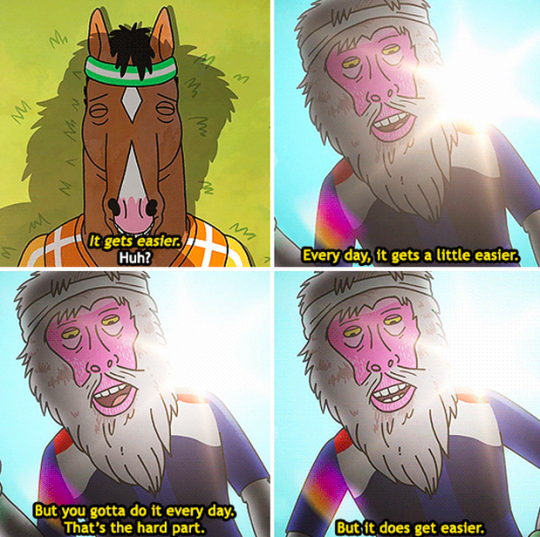
The first (and arguably) most important tenet of this blog is that of action. All of the advice provided in this blog will require you to exert some sort of effort. Whether that’s exercising, resisting temptation, practicing introspection, actively learning, or even surrendering, it all requires you to do something.
The natural state of the world is chaos. It is only through our effort that we can create a world of stability. That effort may need to be exerted every day. Life is better in that form, even after the effort. There are many, many distractions nowadays that either limit the amount of time we can spend taking action or that outright incentivize us away from taking action.
Life is hard, but we can make it easier. What people who refuse to do hard work miss is that their lives will be harder overall if they don’t do the hard work now. Hard work is what makes life increasingly easy over time.
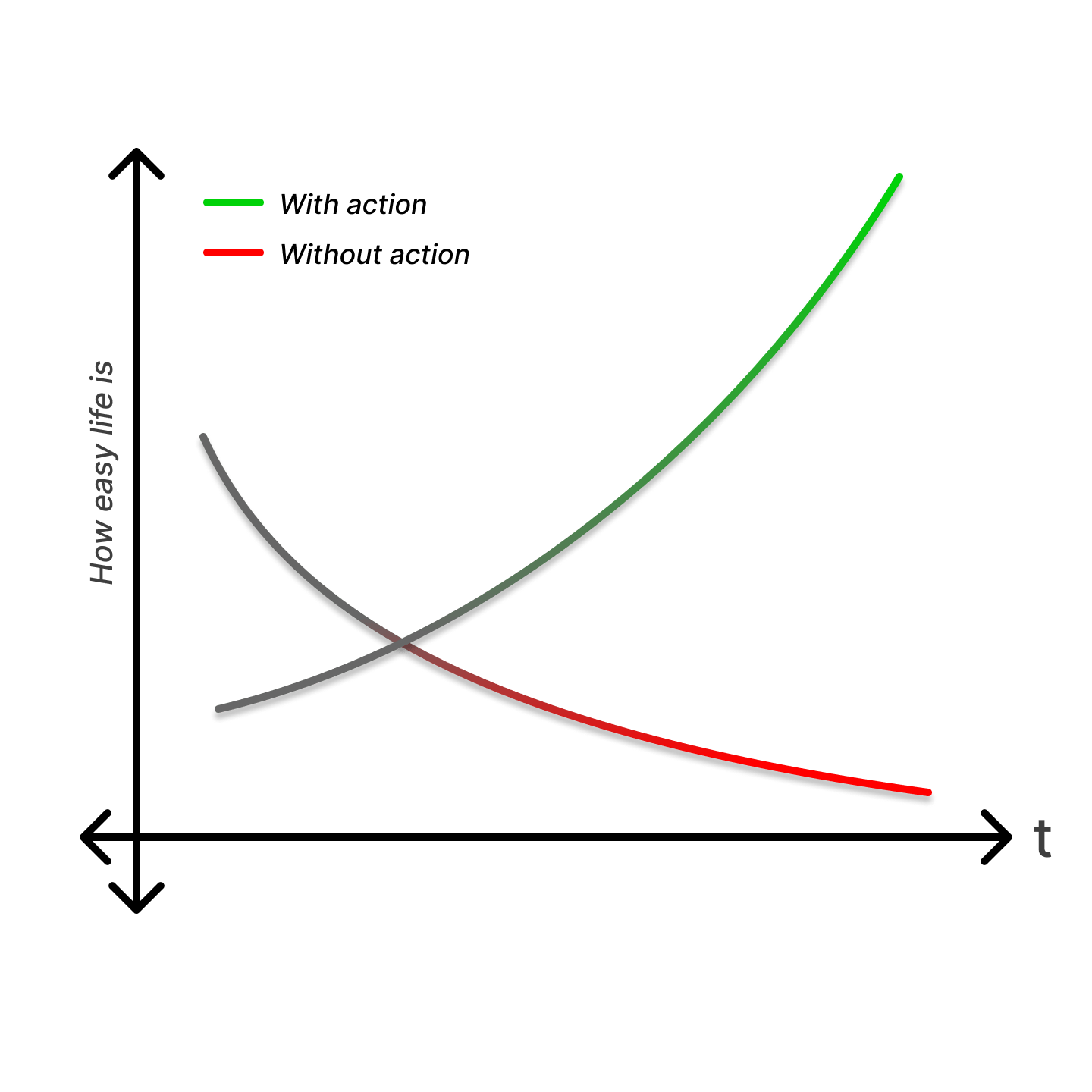
I’d love to be able to say that I did this one unique thing that made it all click together and I was bestowed with inner peace. But the world is not quite so simple. If there is anything unique about what I did, it’s where I saw the connections between all the advice (see About→Connected Ideas).
In truth, the way I got here was this: I tried out a lot of the conventional advice and kept the things that helped me the most. I figured there had to be something to this advice if it was so widespread. I searched every day for the best and most coherent set of advice and I didn’t stop until I got what I was looking for. And when I found the good advice, I applied it. I sat down and meditated – I stuck with it even when it was boring. I learned how to surrender and let go of control – I let myself succumb to the fall. I learned to set and enforce boundaries, even when I was scared to do so. I put barriers in front of the things that made me feel good now, but distracted from the things I should’ve been doing – even when I really didn’t want to.
And it was fucking hard, and frustrating, and there were setbacks, and I didn’t know where I was going, and sometimes I felt like it wasn’t worth it.
And then one day it was.
Life is about taking responsibility
– 10%
"Life ultimately means taking the responsibility to find the right answer to its problems and to fulfill the tasks which it constantly sets for each individual."
-- Viktor Frankl, Man's Search for Meaning
There is no way around this. This is what the world demands of us. You can debate until you’re blue in the face about how the world should be or that we shouldn’t have to work this hard to maintain our bodies, minds, and souls (I did this for a long time), but the reality is, it is what it is. That discussion (usually) doesn’t give you actionable steps to take to make your life better. Pissing and moaning is only valuable so long as it catalyzes action. If all you do is complain on the internet, you’re doing it wrong.
The more you work toward something, the better you’ll get at it but you gotta put up with the frustration along the way. That journey is worth it!
And even if you do everything right, nothing is guaranteed
– 15%
"Nana korobi, ya oki"
Translation: "Fall down seven times, get up eight"
-- Japanese Proverb
Even if you implement all the best advice from all the best thinkers and make yourself the best possible person you can be, you’re still not guaranteed everything will go your way. No one thing (or collection of things) can guarantee you anything! The best we can do is maximize the odds. And that’s still worth the upfront effort! Even if you get kicked down, stand back up and keep pushing through.
El Camino
– 17%
There’s a scene in the Breaking Bad movie El Camino where Jesse Pinkman relives a flashback with his girlfriend Jane Margolis. Jesse recalls how at one point, Jane had told him that she just let the universe take her where it may. Jesse thought that was a really beautiful idea.
In a subversion of expectation, Jane basically tells him “Fuck that. That’s a stupid idea.” She explains that at some point you have to take some control over your life. If you don’t, you might not like where you end up.
The debate surrounding this notion has been going on for a long time. Should you fight for control over your life? Or surrender to the relentless stream of life?
My perspective is this: Life is a river that is pushing you downstream. If you’re trying to swim upstream, all you’re going to do is end up downstream… and tired. But! You can swim side to side while going with the flow of the river. You might not be able to get back to the river bank upstream, but you can get to a different point on the bank downstream.
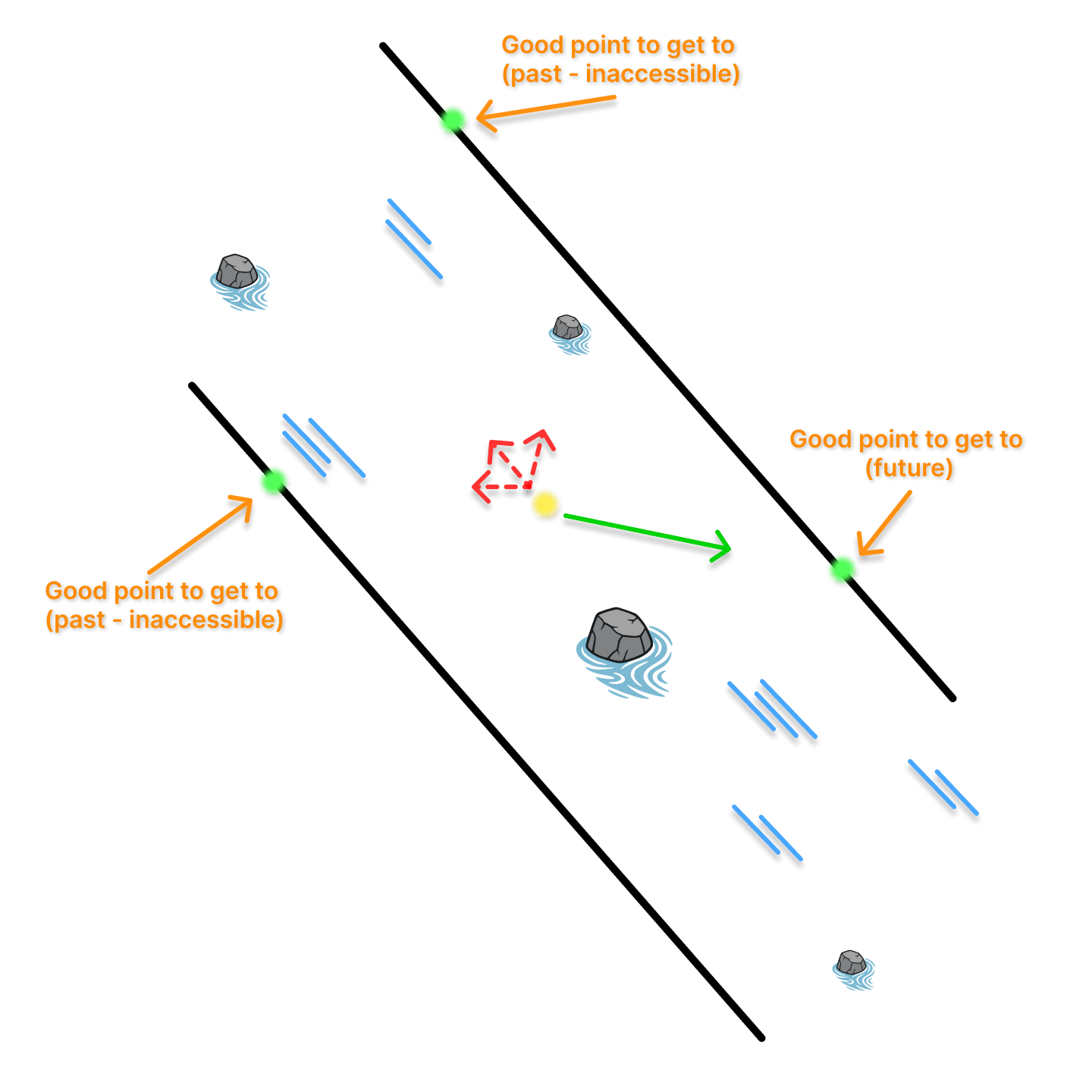
The lesson is that the universe is going to push you in certain directions and sometimes you’ll have to let go and accept that. You’ll have to work with the universe from time to time. You can’t work against it (learning The (not so) Simple Art Of Letting Go can help you with that). But you do have some play within that relentless force of the universe. Control what you can within that space. The universe doesn’t have to entirely decide where you go.
Coherence
– 24%
"So many blank ends of meaning in her past reached out now and linked."
-- Frank Herbert, Dune
My epistemology (my view on knowledge) is that good knowledge is derived from how ideas cohere together – how well they reinforce each other in a positive way. In my search for peace and understanding, I wanted to find a set of ideas that not only don’t conflict, but also build on each other.
Ideas as waves
– 26%
Think of ideas as waves. With that, you can think of coherence like constructive interference. The ideas resonate (with you) when they vibrate at certain, complementary frequencies. Their peaks and troughs line up.
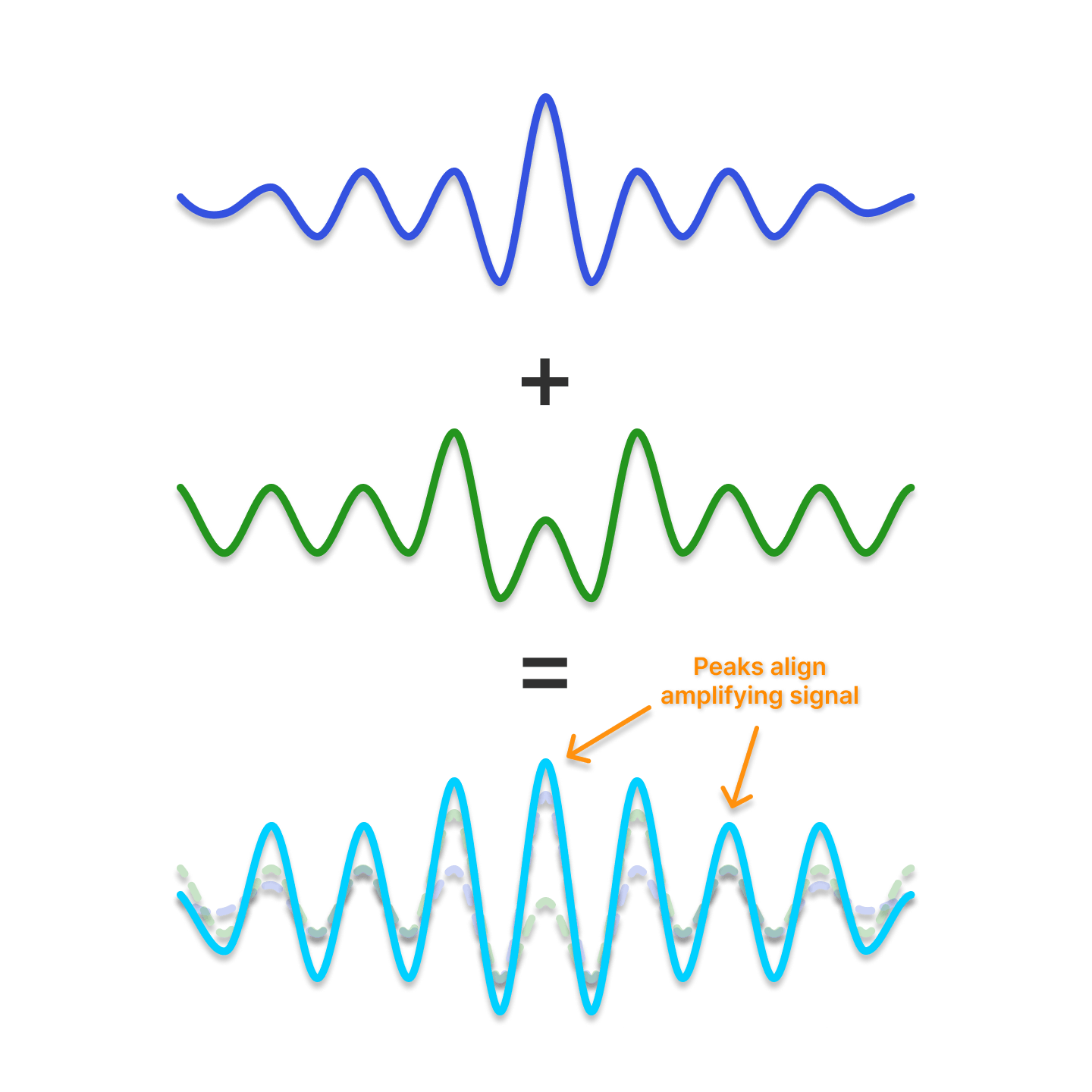
Then you introduce other ideas that vibrate at other frequencies. When these waves (ideas) interact, they have an effect on each other. Where the peaks and troughs line up they amplify their signals (the ideas make sense with each other at those points). Where they don’t, they reduce each other’s signals (the ideas contradict one another).
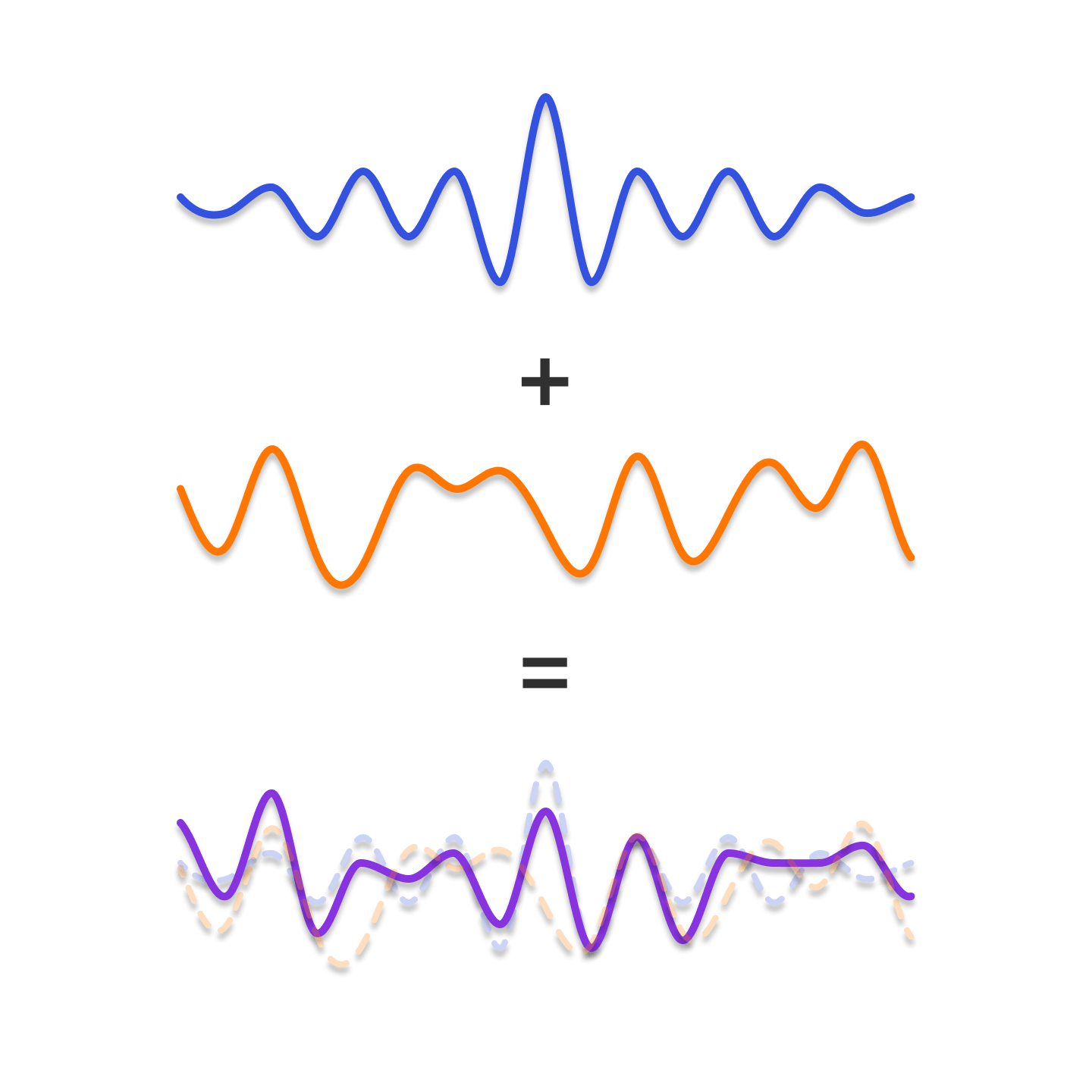
What you want is for these waves to line up in such a way that (at a minimum) they don’t cancel each other out at any point(s). If they do cancel each other out, that’s an indication that either 1) the ideas aren’t compatible or 2) the ideas might be compatible, but you don’t understand it in the right form yet.
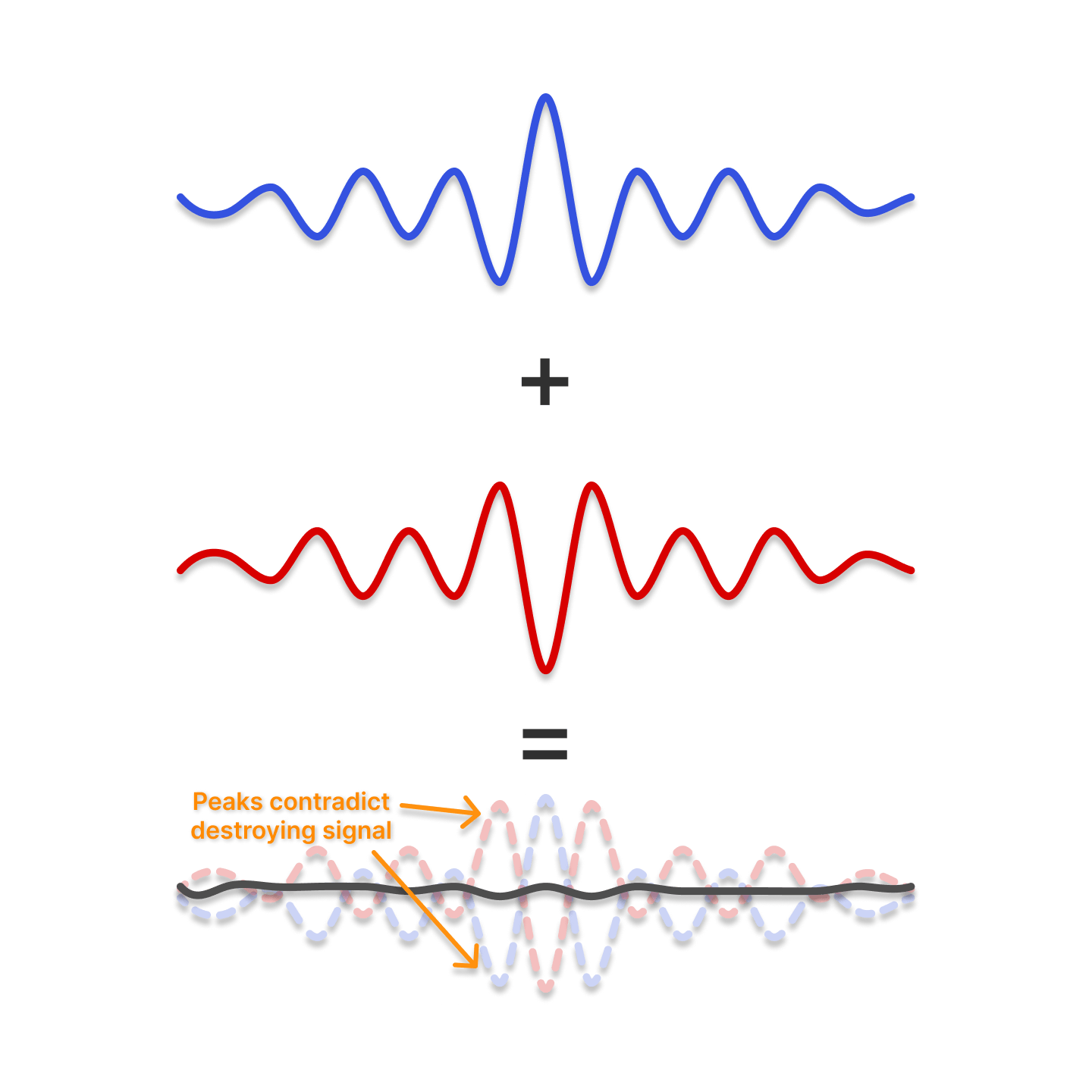
Now in practice, we’re not actually trying to convert our ideas into waves and then see if they align, but there is an approximation of this idea that you can apply yourself. Ask yourself whether your ideas contradict each other at any point(s). For a lot of our ideas, the core body of the ideas might be aligned, but at the ends, there may be contradictions.
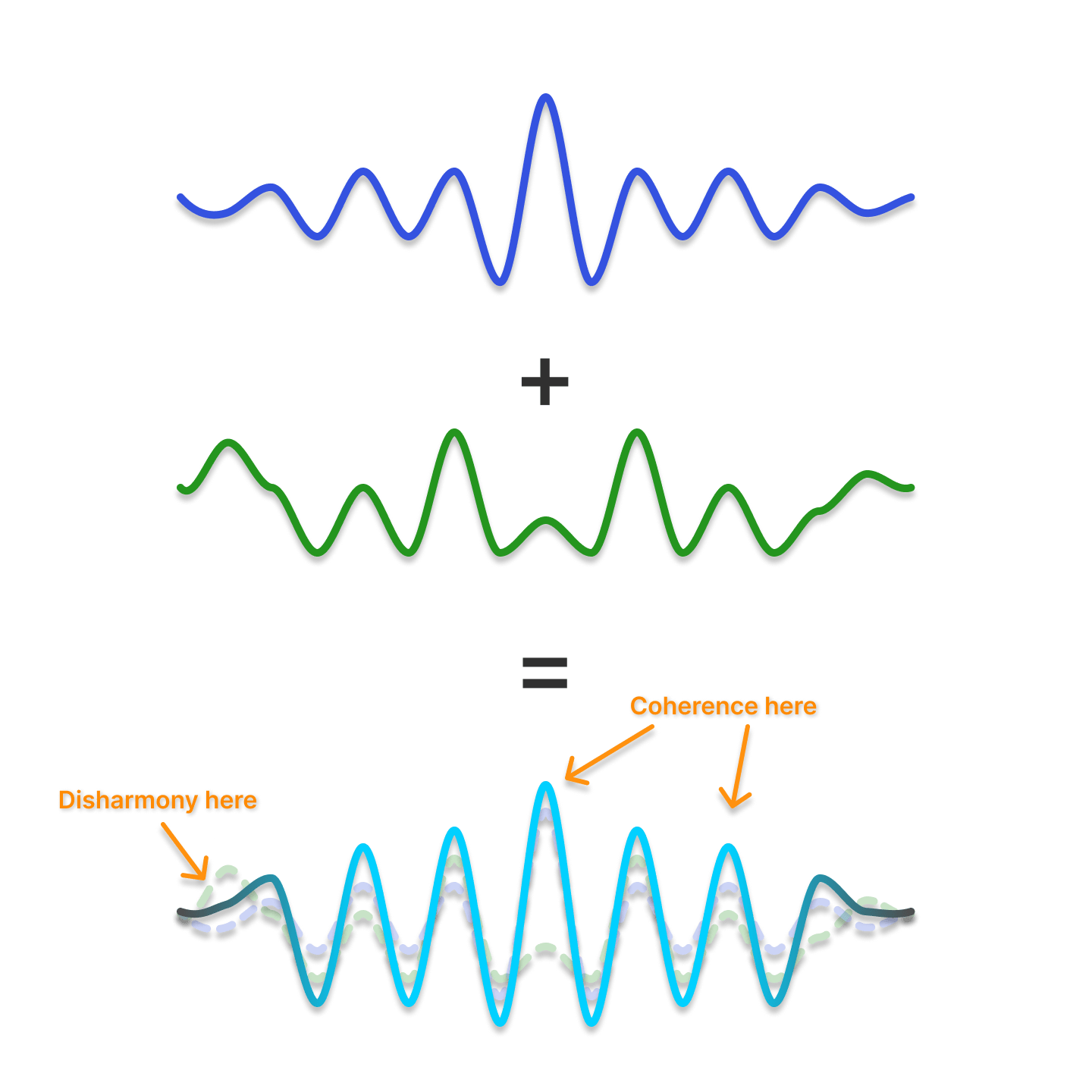
For example, pacifists would argue that you should never be violent. For many years of my life I agreed with this sentiment wholeheartedly (I thought). I believed there were peaceful resolutions to most problems. I agreed with the core body of the idea. This could be represented by the blue wave in the image above.
But I had never really examined the ends. Then, I was pressed on the idea. What if someone is attacking you? Should you try to find a peaceful resolution? I doubt I’d find one while being actively beaten up. This can be thought of as the green wave being added. So at the extremes, there was disharmony and I had to adjust my idea. Don’t commit violence against others… unless necessary for your own security (there are even finer minutiae that we could argue about, but that’s beyond the scope of this section).
The second way you can do this is observing whether or not you feel a resonance when you are introduced to a new idea. This can sometimes feel like an idea “clicking” into place in the puzzle that is your world model (see Developing A Good Understanding Of The World→World Models). It’s a sort of aha! moment. You may feel a sense of ease or relief from the struggle of previous ideas not working together. Resonance occurs once both your conscious and unconscious minds have integrated the idea. It becomes intuitive. This is an emotional experience, not an intellectual one.
If you understand music theory, you may know the idea of a chord progression resolving back and you feel at home again. This is similar to that feeling. When I adjusted my perspective on pacifism to enable boundary setting and security, I felt a higher resonance among my ideas.
If your ideas meet the above criteria with respect to one another, then they cohere.
Your ideas should not only cohere in your head, but also with the
world
– 39%
You can create a vision of a perfectly coherent world in your head, but you’re going to be disappointed when you go out into the real world and your ideas don’t match reality.
For example, you could make an internally coherent set of ideas that describes the earth as being flat. And these ideas could theoretically resonate with each other. But once you take that idea-set out into the real world, it won’t resonate with the multitude of evidence to the contrary (I hope I don’t have to provide evidence for the earth being round).
The flat earth example is trivial, but this is also true for the pacifism example in the preceding section. We don’t (yet) live in a world where complete pacifism is possible. I hope you never have to use violence against another person, but that doesn’t mean won’t have to.
Ultimately, we need to examine each idea we have with respect to every other idea and with respect to the external world to find any points of disharmony. If we find any, then that’s evidence we need to adjust the idea, let go of it completely, or find something else to take its place. Aligning with the world’s frequency is the most important test for coherence.
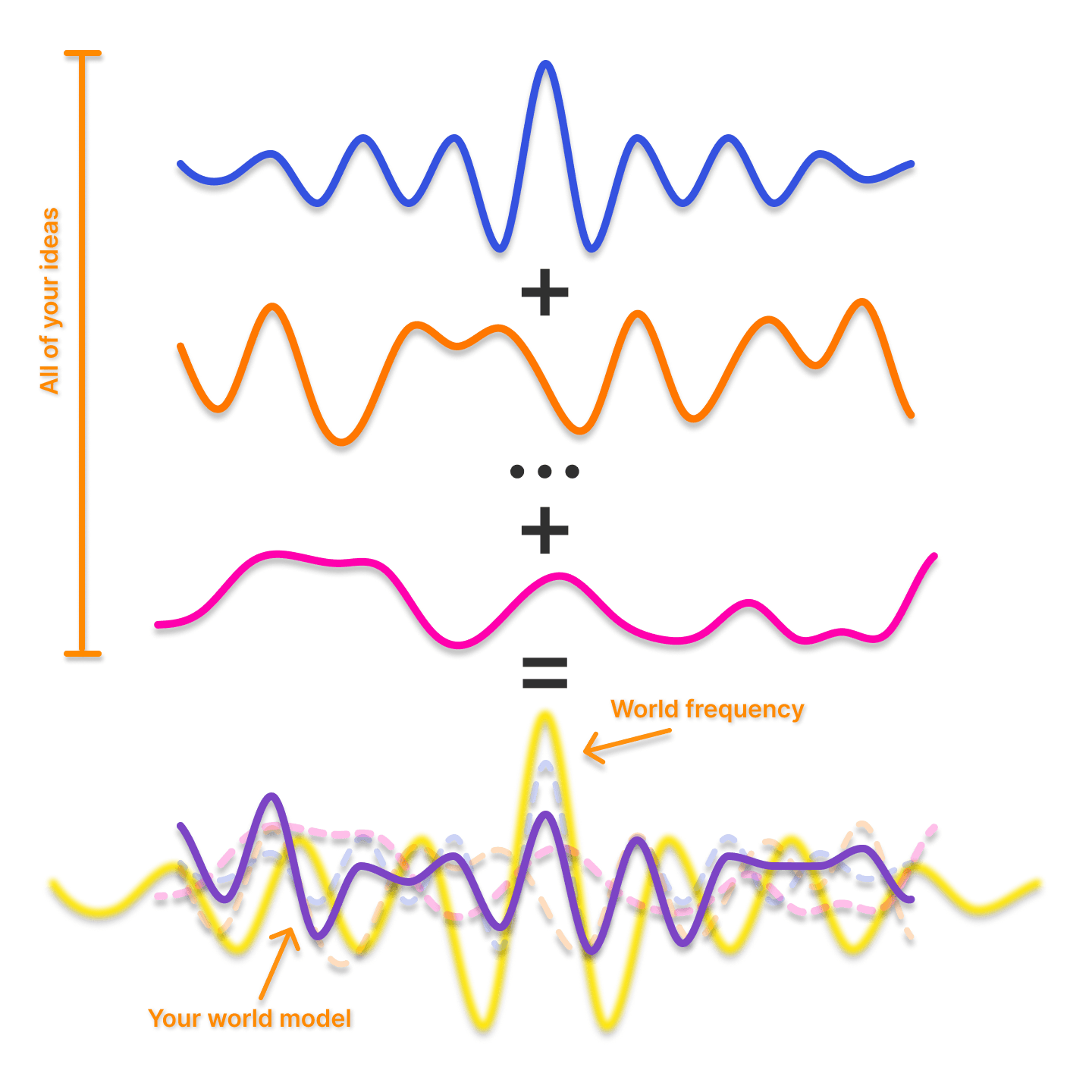
Now, I wouldn’t expect people to sit down and work through every idea in their head, but it’s a useful framework to think about. The better your ideas cohere, the easier it will be to navigate the world. Coherence doesn’t make a set of ideas “true.” But in the absence of concrete absolute truth (see Developing A Good Understanding Of The World→The Problem With Objectivity), this may be the best we have.
These ideas are explored more in Developing A Good Understanding Of The World. I hope you’ll find that the ideas in this blog cohere together well and reinforce each other, rather than conflict.
Everything in moderation, including moderation
– 47%

At the entrance to the temple of Apollo in Delphi were three inscriptions, one of which was Μηδὲν ἄγαν (nothing in excess).
When I discovered peace, I discovered that a big portion of the suffering I was experiencing in life was coming from my lack of moderation. I tried to maximize everything, especially happiness and enjoyment. This counter-intuitively made me less happy (see The Happiness Trap).
Just as there are natural mechanisms in the body that lead us toward indulgence, there are some mechanisms designed to help prevent it. The trick is to apply the latter, in order to facilitate moderation. It turns out when you moderate yourself, don’t give into temptation, and defer immediate gratification, your life becomes more full, more enjoyable, and happier more sustainably.
That being said, I’m not going to sit here and tell you you should only be eating whole foods, and you should never drink alcohol or smoke, and you should always get good sleep, and you should never go on social media.
This is where the “including moderation” part comes in. Are all the above healthy habits good for you? Sure! But let’s be honest, most of us are never going to be able to maintain a pristinely healthy lifestyle. And even if we did, it leads to a pretty boring life.
It’s better to say, “you should do these things that are healthy for you and you should have some fun in your life too.”
Moderate, but also enjoy life. Pursue peace, but participate in pleasure too. Go out and have a couple drinks with your buddies! But don’t get obliterated every day. Engage with social media! But don’t doom-scroll until you feel numb. Love those around you deeply! And also recognize that friends and lovers are gifts of Fortune – they can be taken from you at any time (see My Thoughts On Stoicism→Fortune).
The idea of moderation extends beyond vices too! Never speak in absolutes! You’ll undoubtedly find a counterexample to your beliefs at some point.
Be confident in your beliefs! And maintain some humility that you may be wrong – strong opinions loosely held.
Don’t be violent! Unless absolutely necessary to protect yourself and those close to you.
Get up and do good work for yourself and those around you every day! And also take time for yourself to make sure you’re doing okay.
Enjoy whatever pleasures the universe gifts to you! And also recognize that you could be receiving those things by little more than luck.
Spend time learning as much as you can! And give your mind rest to ingest it all too.
This core tenet is reinforced by and highly related to…
Balance
– 59%
"Only a Sith deals in absolutes!"
-- Obi-wan Kenobi, Star Wars: Episode III - Revenge of The Sith
Everything in nature seeks to be in balance with everything. Therefore, so should you.
When the population of a species gets too large, the lack of resources in the environment forces the population back down to a manageable level.
The floor pushes up on you in an amount equal to the amount that gravity pulls you down.
Animal bodies work to maintain homeostasis.
Atoms bond with each other because the bond they produce is the most energetically balanced and stable state.
The Stoics believe the universe has an inherent rationality to it called “natural order” (see My Thoughts On Stoicism→Natural Order). Most things in the world progress as they should.
Our bodies seek balance. You can see this for yourself. Get too stressed – your body starts to deteriorate. Sleep too little – your body forces you to sleep. Train too hard – your body feels pain. Indulge in too much food – you feel sick.
The opposite is true too. Don’t challenge yourself enough – you’ll feel like you’re languishing. Rest too much – your body yearns for action. Eat too little – you get hungry.
The idea of balance extends into how we operate in the world as well. Find balance in how many activities you take on in life – balancing skill building with time for rest. Balance your diet – eat healthy whole foods, with some sweets and treats thrown in. Exercise, be active, and put your body in good form – and also give your body time to recover.
If you are shy, work on being more open and amicable. If you try too hard to be the center of attention, work on feeling okay being on the sideline once in a while. If you are too independent, work on including people in your life. If you are too dependent on others, work on self-reliance and feeling comfortable being alone. Work hard and make something of yourself, but temper it with self-compassion and time for leisure.
In the book Siddhartha by Hermann Hesse (see About→Recommended Reading), Siddhartha does not find enlightenment among the monks nor does he find it by numbing himself away with the “child-like people”. He finds it in the center, in balance, through knowledge of himself, garnered by the fullness of his past experiences.
Even the idea of wanting to be “the best” requires balance. Best doesn’t necessarily mean the maximum of a given quality. Best (often) means being the appropriate balance of many valuable qualities.
How do I know if I’m unbalanced?
– 70%
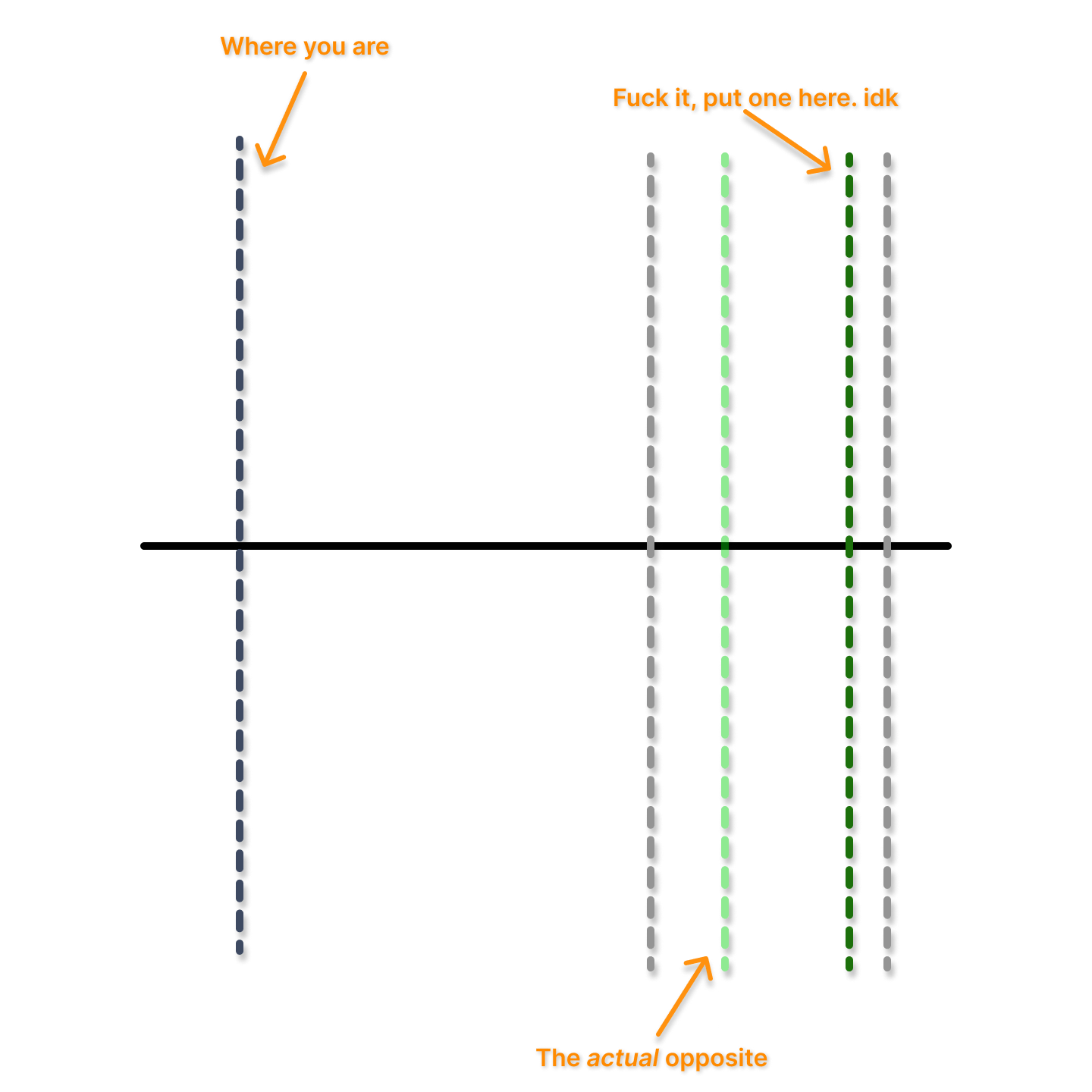
In the pursuit of balance, it can be hard to know if you are unbalanced, especially if you don’t know where the opposite line is.
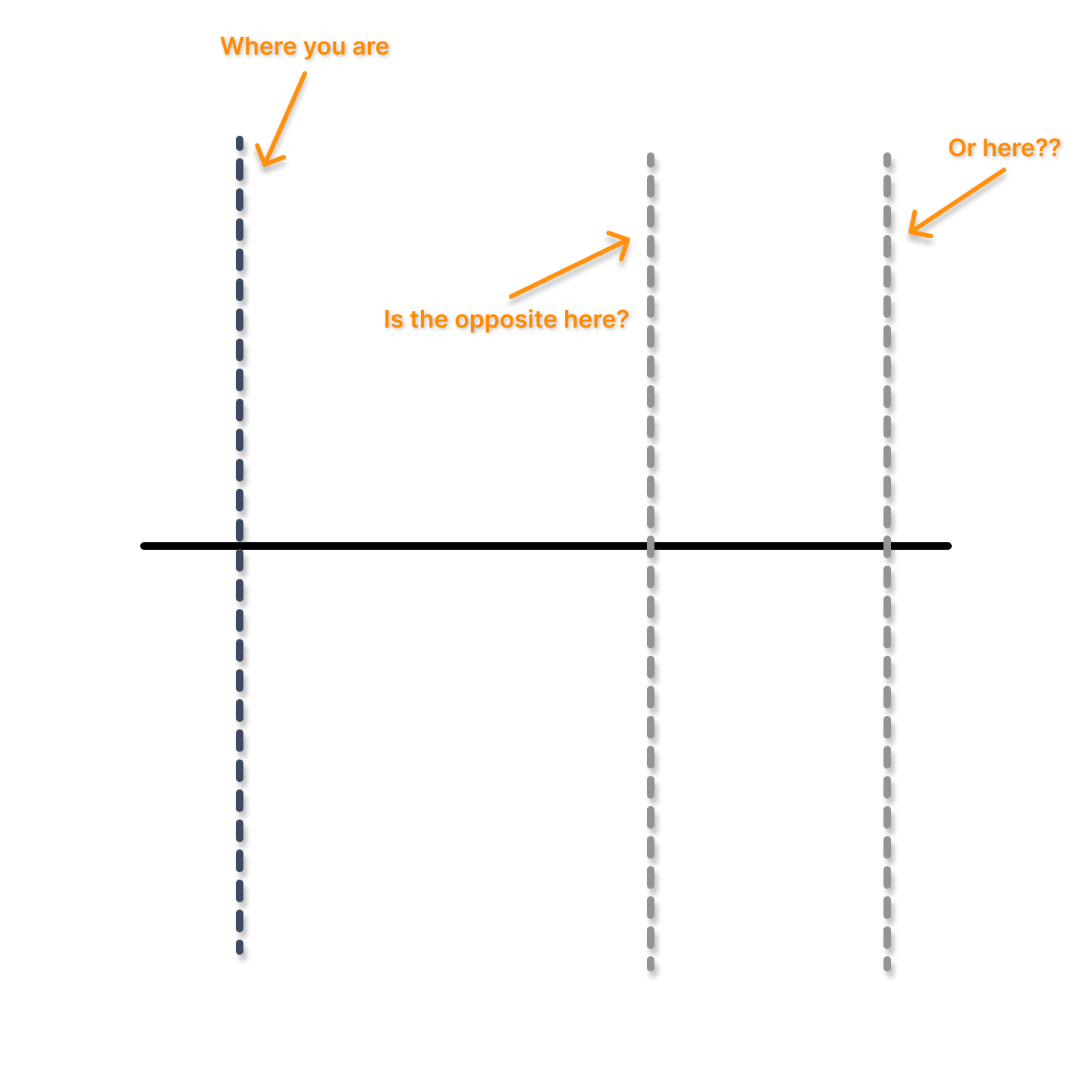
There’s not a universal answer for every situation, but a good barometer is this – ask yourself these questions:
- Am I relying on X too much?
- Is it my only strategy for solving this problem?
- Have I considered alternatives?
- What might doing the opposite look like?
From that line of questioning you’ll be able to determine what the line might look like for yourself. You’re not always going to be right. In fact, you’ll probably be wrong. But visualizing any line where the opposite might be will at least give you a gauge. And that’s better than nothing.
Call things by their proper name
– 73%
"The beginning of wisdom is to call things by their proper name."
-- Confucius
Language is among the most powerful capabilities humans possess. Our ability as humans to use symbols to organize concepts is an incredibly powerful one. When you give something a name (symbol), you make it distinct from something else. You bring it out from the chaos surrounding it. When something becomes distinct from something else you can reason about it effectively.
At the same time, our language is limited. There are things we simply cannot currently describe. You may have experienced this with your emotions. There are feelings that you can have that you may not have a word for.
For example, in My Past→The Call Of The Void, I talk about my mental health struggles, particularly in college. For a long time, I didn’t know what the feeling I was having was. Because I didn’t know what it was, I couldn’t do anything to effectively treat it.
For some time, I tried to understand it. Initially, I thought, “Do I have depression?” Depression didn’t seem like the right word. I wasn’t feeling persistent sadness or hopelessness; it was more of a constant dread and worry. I had difficulty concentrating, but not because my thinking was slowed; my thinking was actually hyperactive. I wasn’t having symptoms that coincide with depression like excessive fatigue or sluggishness; I was more restless and tense. I wasn’t oversleeping, but I was having trouble falling and staying asleep.
Eventually, through conversations with friends, my family, and a couple of therapists (coupled with some personal research), I understood what I was feeling to be anxiety. I gave it not only a name, but the proper one. Anxiety and depression are tough to untangle because some of the symptoms overlap (sleep and appetite changes, irritability, difficulty concentrating), but I didn’t have the emotional flatness that is more consistent with depression.
Once I understood what I was actually dealing with, I was able to more appropriately deal with it. I started to pursue solutions to treat anxiety specifically. Those solutions ended up proving fruitful. If I had never assigned a word to my experience, I wouldn’t have had a foundation which to look into and implement solutions.
The specificity to which you can describe something defines the depth to which you can reason about it.
This same idea is the one that underlies the thesis of The Happiness Trap. People often say they are trying to be happy. But I’ve found that that pursuing happiness leads to the lack of it (for various reasons – see The Happiness Trap→Why does this happen?). I claim that what people are actually looking for is eudaemonia (inner peace) and that when you pursue that instead of happiness, you actually make your life feel good consistently and sustainably.
How do I know if I’m calling something by the right name?
– 85%
It can be hard to know if you are or are not calling something by the right name (especially if you don’t know what possible words a given thing might be).
Learn how to speak good [sic]
– 86%
Developing a good understanding of language is incredibly valuable. Obviously you may want to do this for your own native language, but having an understanding of other languages and linguistics as a whole can be useful here. Fundamentally, it’s about Increasing your vocabulary.
You don’t need to read the dictionary like you’re Eminem. There’s enough books and content creators speaking at a high enough level for you to be able to learn new words. It’s more about attacking life as a constant journey of learning (see Developing A Good Understanding Of The World→Attack life as a journey of constant learning).
For the particularly curious among you, there are even content creators focused on linguistics and etymology. etymologynerd makes fun and enticing videos about many aspects of linguistics. The Dictionary of Obscure Sorrows by (John Koenig (see About→Recommended Reading) is a really cool book where the author comes up with words for a variety of experiences for which we don’t have words yet. He provides both a definition as well as an exploration of the etymological origin for the word he created. By reading through this fun exploration of language and emotion, you can develop a better understanding of the roots and origins of words and how they are used to help us reason about the world.
For example, anti-religious people will argue that religion has no utility and instead exploits people’s fears and anxieties in an effort to subjugate them. But the word religion comes from the Latin religio which means to bind. Knowing that, we can argue that religion does have utility – it binds groups of people together under shared rules and beliefs.
With respect to my anxiety versus depression distinction before, had I known that anxiety comes from the Latin anxietas meaning “troubled in mind, uneasy” and that it was closely related to the Latin angere meaning “to choke, squeeze, or torment,” I could have much more easily said “Oh yeah that’s what I’m feeling!” In contrast, depression comes from the Latin dēprimere, meaning “to press down,” which was much less consistent with what I was feeling.
All that is to say the internet and the world is rich with information in increasingly consumable forms for you to explore. Use it for that. It’s better than doom-scrolling.
Examine if the name you gave to a thing is serving you
– 96%
For the first two and a half decades of my life, I was searching for happiness. I thought that was the thing I wanted. I became very frustrated that I wasn’t getting the results I wanted. It wasn’t until I found another word that served as a better name (eudaemonia) for what I was looking for that I found the results I yearned for (see My Past→The Growth). So by realizing happiness wasn’t what I wanted, I was able to let go and latch onto something new.
So in general, search for coherence between the solutions you’re taking to solve a problem and the results you’re getting. If you’re not getting the solution you want, you can (obviously) adjust the solutions, but you can also adjust the name of the thing you are trying to resolve. As an example, if you think your problem may be depression, but the treatments associated with depression aren’t working for you, maybe you need to find a better name (or names) to describe what it is you’re experiencing.
The only thing you have true control over is yourself
– 100%
It’s very natural to desire control. The world is random and unpredictable. For most of our evolutionary history, danger loomed everywhere. So it makes sense that we want to tamp down on that uncertainty. Less uncertainty allows us to make more correct predictions about the future.
But what I’ve learned on my journey to peace is that the amount of control we can exert on the world is incredibly small. We like to think we can influence people… and get them to change… and do what we want them to do, but this is rarely the case. Those who try to control more than they can often find themselves frustrated, disappointed, and hurt by the world around them.
I was this person. I had an idea about how the world should be. And I tried to force it to behave that way. Needless to say, it rarely did.
Once I recognized the limits of my own control, I found myself more comfortable with the world. I realized that the only thing we have true control over is ourselves. (And if you’ve studied Mindfulness you know that there are limits to the degree to which we can control our own minds – see Mindfulness Theory→Your mind is a machine).
Even with that, we make do with what control we do have. Anything external to us is not in our dominion. Even though it may seem that we have dominion over the earth and the animals in it, Nature ultimately has control over us. Hurricanes, earthquakes, tornadoes and tsunamis are all more powerful than us. At any point, an asteroid could strike the earth and end the human experiment. We can still contend with this by learning to accept these as possibilities, rather than adopting a completely fatalist viewpoint. Accepting this idea required me to learn The (not so) Simple Art Of Letting Go.
I can preach until I’m blue in the face about how people should behave; however, there ultimately are pressures beyond what any of us can control at the individual level, which drives us toward non-optimal behaviors (I may one day write an article about this). People won’t often adopt good behaviors because it is hard to do so. It’s hard to give their attention to themselves enough to fix their behavior. A lot of people are just trying to get by. You may not be able to fix the entire world, but if you are aware enough yourself, you can fix your individual behaviors. That is the thing you have the most control over.
The best way we can make change in the world is to lead by example. Control yourself. Be the change you want to see in the world. Make sure other people see it. It’s truthfully the only thing you have. Let your virtue be the thing that inspires others to follow. Even if they do, it’s by their own choice, not your control.
Leave a Reply
You must be logged in to post a comment.