
Everyone talks about the benefits of confidence. From better job prospects to increased attractiveness to a greater ability to get what you want, confidence is an incredibly powerful feeling to cultivate.
For years, I wanted to discover the “secret” to confidence. I had low self-esteem and deep anxiety issues. I looked around at other people and saw them seemingly navigating the world as though they knew what to do. I saw men effortlessly striking up conversations with women, women with an aura of strength, poise, and completeness, and people willing to “just go for it.”
Why couldn’t I have that? Why was I so confused? What was I missing?
There were times I thought I had found confidence, only for it to be ripped from my grasp when something didn’t go my way. I’ve now found it for myself in a reproducible and sustainable way. I’d like to share what I’ve learned.
TL;DR Confidence is…
– 2%
Confidence is the consistent, felt probability of success. It arises from having full trust in your abilities (to do any given thing). It’s your body saying “Yes, this is working.” That feeling is inspired by two things: action and experiencing success from that action. To have success, you need skills.
It is a feeling that arises when you believe that you will probably succeed at what you are trying to accomplish. You feel it from within, but the feeling is inspired through real-world validation of your skills.
To cultivate sustainable confidence, you need three things:
- Skills
- Consistent application of those skills resulting in validated success
- You need to let yourself feel that success
So how do we get to this conclusion? What does it take to inspire that feeling of confidence from zero? And is confidence really the main thing you should pursue?
Let’s break it down.
Where does confidence come from?
– 4%
If our goal is to understand how to become confident, it’s important that we pay attention to what things actually drive confidence to make them distinct from things that drive other positive feelings such as happiness, peace, or meaning (see Core Tenets→Call things by their proper name). There were times in my life where I felt like I had finally become confident because I was riding the high of some pleasure. I thought “Yeah this is it. I can do anything.” And I did feel that way! But then I would be faced with a situation where I would lose, and my confidence would evaporate in an instant.
The word confidence comes from the Latin confidere which means “to have full trust”. Modern definitions of confidence include: the feeling or belief that one can rely on someone or something; firm trust or a feeling of self-assurance arising from one’s appreciation of one’s own abilities or qualities. For me at least, that feeling of having full trust in myself only seemed to arise in response to having done something right. I thought it was something that would last once I “got there.” But by and large, I now find confidence to be a fleeting feeling requiring constant renewal just like satiation or happiness. This is likely why I often felt it taken away from me – it’s not meant to be a finish line! It’s just a reward signal.
Just like thirst arises as a signal that the body needs water or fear arises as a signal of potential danger, confidence arises as a signal that you are doing something right – by whatever definition your mind (and your body) may have.
You may have experienced some confidence after something went your way – winning a sports game, getting lots of matches on a dating app, getting a promotion at work. So this leads us to one aspect of confidence: it comes from success. How is it that you have this success?
Confidence is a reward signal for having become competent
– 9%
What I mean by that is this: to feel confident, you need to inspire that feeling. That feeling is a reward signal inspired by success. And to get success, you need skills.
Fundamentally, if you want to experience confidence, you need to 1) be doing something and 2) be doing it well. You don’t need to be a master, you just need to be doing it well enough.
Your skills need to be cultivated to a degree such that they enable you to have success in whatever it is you want to accomplish. You must be competent. If you lose every game you play, if you don’t get your job done at work, or if you don’t feel like you can have a conversation with another person, how are you supposed to feel the experience of confidere? How are you supposed to have full trust in your abilities if you never cultivate them in the first place?
Confidence will not come from reading a book or watching a YouTube video on the subject. Confidence cannot be inspired (sustainably) through a motivational speech or a pep talk. It will only come once you go out into the world, take action (see Core Tenets→Action), and see the benefits of that action. If you yourself are not doing something to tangibly produce confidence, whatever motivation you gathered from a pep talk will feel disingenuous.
But it’s not enough to have skills. You also need to validate that those skills are valuable and/or useful. How are you supposed to have full trust in your abilities if you never validate them out in the real world?
Validation
– 13%
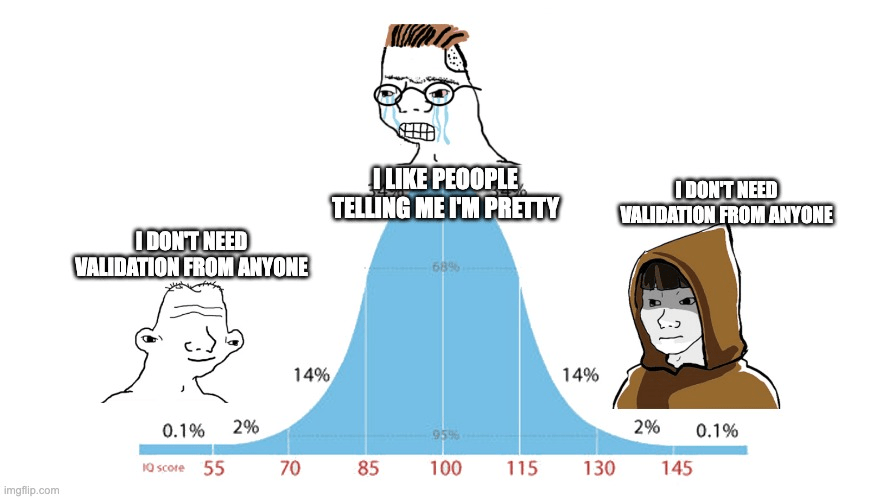
Confidence, being a reward signal, requires some feedback mechanism which validates that something was done successfully. And this feedback can come in a variety of ways.
And a lot of popular advice will tell you that you shouldn’t care about what other people think. And there’s value to this sentiment. But I think when people are talking about “finding confidence from within,” I think they’re talking about something else (and we’ll address that in another section – see Becoming Sustainably Confident→Confidence needs to be felt).
You don’t necessarily need other people to feel confident. But you should validate your skills in the external world. For example, one time I took a solo trip to Oregon and went kayaking on the Columbia Gorge. It was a particularly windy day, but I was allowed to rent a kayak regardless.
About thirty minutes into my venture, I was right smack in the middle of the gorge, equidistant from either shoreline. The wind picked up considerably and waves started to appear. Pretty soon I was in the water, my boat upside-down. Given the depth of the water I was in and the roughness of the waves, I couldn’t easily flip and get back onto my kayak. I looked around and saw no-one within ear shot who could help me. I was all alone.
I started to think and saw that the waves were calmer closer to shore. So I tugged my kayak alongside me as I swam to calmer waters. Once I was there, I flipped my boat back over and tried to climb in. Coming in from the side, caused me to capsize again. Eventually, I figured I could jump on from the back and wiggle back onboard without flipping. I did so and began paddling back to the rental shop. The waves were still rough and I found myself flipping many times before I made it back. I realized by the third time that the waves were coming toward the side of my boat, causing frequent flips. I turned my direction to be perpendicular to the waves, and while that ended up being more tumultuous, I didn’t capsize again.
In that whole experience, I validated several things without anyone else:
- I can handle tough situations on my own
- I didn’t panic, even when I noticed no one could help me
- My understanding of balance
- In figuring out how to get back on my kayak
- My quick thinking
- Finding a safer place to reboard without wasting too much energy
- My forethought
- I had decided to leave my phone in the car and to put my car keys in a sealed jacket pocket that I tied into the netting on the kayak. Had I left those things in my shorts pockets, I likely would have lost both in the water with the number times I capsized
- My ability to learn quickly and adapt
- Realizing the direction I was paddling had an effect on my staying upright
All of this was done independent of “external factors,” but it was validated in the external world.
So fair enough. But let’s be honest, sometimes getting external validation (from other people) can be a good kick-starter to your confidence.
Validation from others
– 20%
"While it is always great to believe in oneself, a little help from others can be a great blessing."
-- Uncle Iroh, Avatar The Last Airbender S2E14
Put simply, humans are social creatures and no matter what people say about “being independent” or “not caring what people think” we all care a little bit (unless you’re a sociopath). Even after having cultivated inner peace (eudaemonia) for myself – where my baseline level of good feeling is well within the feeling good region (reference The Happiness Trap→Well-being as water) – I am still affected somewhat by the opinions of others.
And it’s important that we don’t rely on ourselves fully to know what’s right or wrong. As I write about in Core Tenets→Coherence, you can delude yourself by creating a coherent set of ideas in your own mind, but that set of ideas has to ultimately cohere with the world frequency. Other people are a useful proxy for that.
Should you rely entirely on validation from others for your well-being? Absolutely not. But there are cases where that validation can be useful. It’s about balance (see Core Tenets→Balance).
Confidence needs to be consistent
– 23%
So clearly, you can feel confident when things go your way, but how do you sustain it? I stated earlier confidence is fleeting. If it’s fleeting, how do you sustain it? Can something be both fleeting and sustainable?
Yes, and here’s an example most people have been able to experience: consistent satiation. People get hungry. If you’re hungry, you eat. If you eat enough, you become satiated. But then you get hungry again – fleeting. But, if you eat enough food before you get hungry again, you can feel consistently satiated – sustainable. And, if you (or your society) cultivate enough food, you can reproduce the feeling of satiation even if you get hungry again.
Bringing it back to confidence, because I developed skills around talking to and connecting with people, I can consistently revalidate my social skills making me feel confident in social situations.
That being said, you don’t want your skills to be too narrow. If you want to be sustainably confident, you need to have a variety of skills to make things go your way as much as possible. This broad set of skills and successes creates this belief that you have probability of success in whatever you do. That way, even if you fail at something, and lose your confidence, you can have full trust that you will be able to build it back up. And there will be times when you will lose your confidence. It’s when, not if.
The feeling of confidence from each individual success is fleeting, but the ability to keep doing things which foster confidence is sustainable.
The experience of confidence crosses domains
– 27%
A great quality of confidence is that you can carry over confidence from one domain to another. If you know that you are providing value to the world and you trust in your ability to do so, you can use that confidence to inspire trust in your abilities when presented with a new domain.
Men (myself included) often want to learn how to become confident in talking to women. And while it’s true that that skill can be cultivated effectively simply through approaching, trial and error, and listening to feedback, having confidence in your abilities to play a sport, or do well in your job, or in making people laugh, can inspire confidence that carries over into talking with another person.
My experience playing sports gave me greater confidence in social dancing. Many sports require you to have a sense of where other people are on the court/field even if you can’t see them. This skill transfers to dancing. Social dance floors can be crowded. When performing spins and dips, it can be hard to keep track of where everyone is. The last thing you want is to be knocking yourself or your partner into other people.
Social dancing, in turn, helped me get over my approach-anxiety since (as a man) I most often had to be the one asking for a dance. Getting over my approach-anxiety allowed me to have more conversations with women. More conversations resulted in greater skills engaging with other people.
So if you want to be confident in one domain, but struggle to find success within that domain, you can always try becoming confident in some other domain and having that confidence carry over.
With each new skill and each success that comes as a result of that skill, you start to create a fire that burns bright and strong. That warmth starts to influence other domains, creating a feedback loop that allows you to take more risks to start building confidence in those other domains.
In the context of Romantic Relationships, I used to tell myself “There’s no way she’s into me.” After I had cultivated skills in talking to girls, I told myself, “I’m going to go talk to her anyway.” And even if she ended up not being into me, I knew I would be okay because I had confidence in being able to talk to other people or have success in other domains. Confidence is about going through life knowing it’s all going to be okay. Not because the universe guarantees anything to you, but because you have the ability to make it so. Confidence is something you know for yourself that other people can pick up on.
Confidence needs to be felt
– 33%
Because confidence is fleeting and because it is a feeling, not only do you have to be competent, you have to be consistent, and you have to be in touch with your Emotions and Intuitions to allow yourself to appreciate your abilities.
I’ve always considered myself a hard worker. My mom has always praised me for being basically on auto-pilot – she didn’t need to do all that much to raise me. I was good at school. I didn’t get into (too much) trouble. Entering college, I knew my mission was to get good grades, graduate, and prepare for my future. And I did those things. I also got really social. I started to have success with dating. I started to go to the gym, I put on some weight, and I continued to play sports like I did in high school (except this time I was actually kind of good).
So by everything I’ve described above, you would think I would have been confident. I had skills: professional, social, and athletic. I was engaging with the world. And shit, I was having success. But I still didn’t feel confident.
And it was my own damn fault for that. The reason I couldn’t feel confident was because I wasn’t allowing myself to feel confident. I doubted myself constantly. I had deep anxiety issues. I would put myself down. I didn’t have full trust in my abilities. I had intuitive trust in my abilities as evidenced by my doing a given thing, but I didn’t have emotional trust in my abilities.
The intuitive trust came from my ability to just go for it. I would take on challenges. I even had some sense that I would probably succeed. But emotionally, I was in such a bad place. My anxiety and toxic self-talk prevented me from being able to feel good about any success I was having (at least past the first few minutes).
And this continued for years after college. I could not sustain that confidence, even though I was “doing everything right.” I kept extinguishing my own felt experience.
Wait, extinguish. That inspires an image of fire. And fire is actually a really good analogy for this.
Confidence as building a fire
– 38%
I think this is a really useful framework for putting together all I’m describing.
To be entirely accurate, confidence is not the fire itself but rather the warmth provided by the fire. That is the felt experience. Your successes are all the things that burn: the kindling, the tinder, and the wood. Your action is the spark – you need one to start the fire. The bigger the success, the more fuel you will have and the longer the fire will burn without the need for additional wood.
So then what is the flame? The flame is the validation of your success. It’s the part of the fire that you see. The flame is what converts the wood (your success) into warmth (confidence). You see the flame, but you feel the warmth. Confidence can’t be the flame, because the warmth can still be there without a flame – think of embers.
Like any fire, confidence has to be maintained. You have to feed the flame. Eventually, you have to provide more fuel – confidence is fleeting. Your skills define your ability to effectively go out and collect fuel (successes). And, the more skills you have, the more effectively you can gather wood.
A fire is much easier to maintain once it’s been started. And this is why it’s important not to put out your own fire. If you let your fire go out, the night is cold and scary.
How do you not extinguish your fire?
– 42%
It wasn’t until I had cultivated my inner peace that I was finally able to sustainably feel that sensation of confidence. I wasn’t putting out my own fire via anxiety, self-doubt, and general bad feeling. My toxic self-talk was preventing me from truly feeling that confidence.
When you are in the feeling bad region (see The Happiness Trap→Well-being as water), you are prone to negative thinking. That negative thinking can put out your fire.
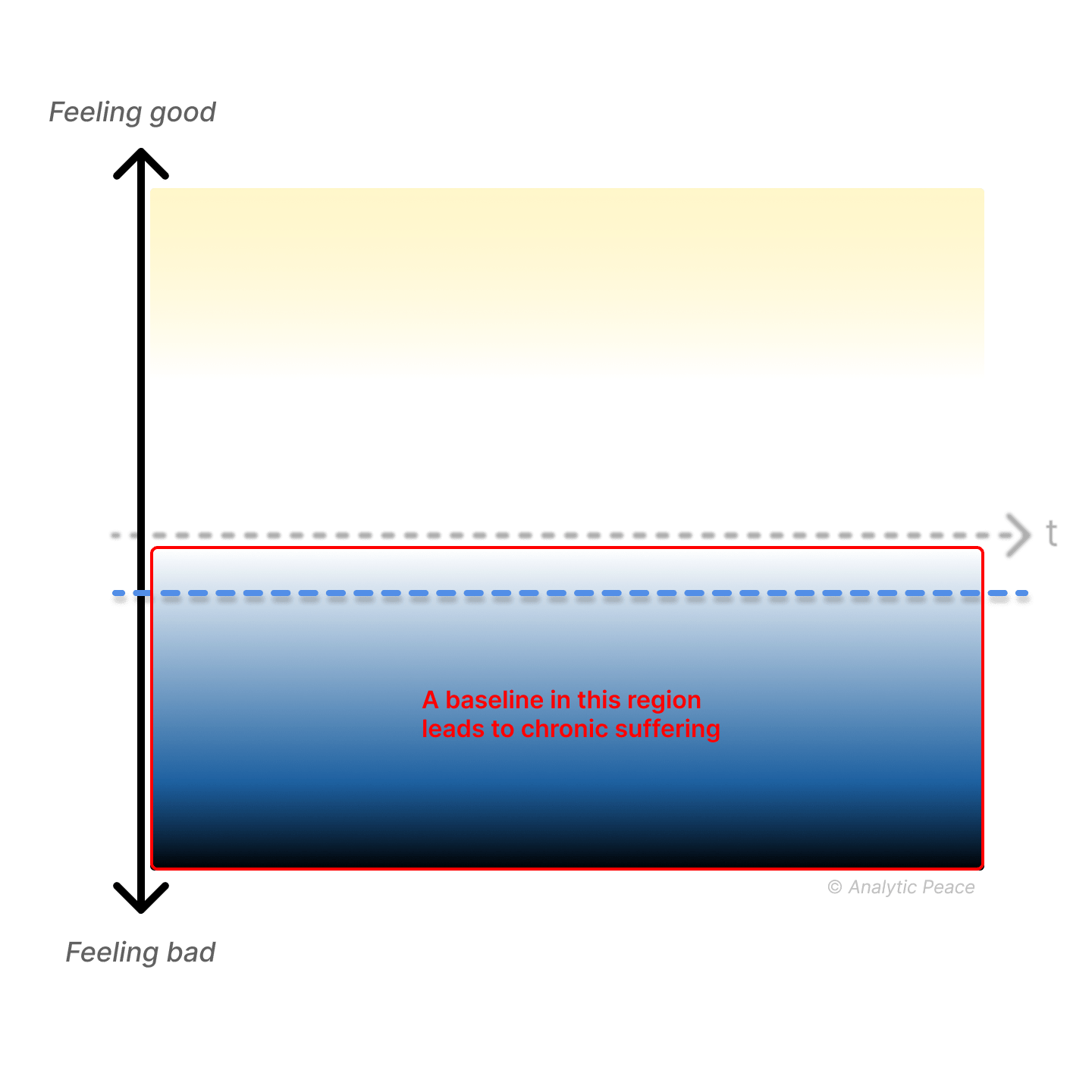
It was as simple as that. If you do not put yourself in a position where you feel good about yourself, you will not feel good about yourself! 🤯 You can be doing everything right and still feel like you are not.
So yes, confidence requires maintenance. And it can be maintained longer by not putting out your own fire. It won’t stay on forever on its own – you need to go out and collect new wood – but you shouldn’t be the one stomping it out, throwing sand on it, choking it out, or allowing it to get rained on. Even when I was having success, I would tell myself “Yeah I did it, but I didn’t do it well enough,” or “Oh I just got lucky this time. I’m not actually that good.” My anxiety and toxic self-talk was so powerful, it put out the fire of my confidence before it even started to burn.
And so if you want confidence that lasts as long as possible, you also want to cultivate inner peace. And lucky for you, I have a guide for that 😉 (see How I Cultivated Eudaemonia).
How do you make it easy to maintain your fire?
– 46%
You can imagine that when searching for things to burn, you might find twigs, logs, leaves, even litter. Developing skills in just one domain, is like learning only how to only collect leaves. You might be able to sustain your fire with just leaves, but you’ll need a lot of them and it’s a lot harder. Leaves could be like getting a Like on Instagram, or a compliment on your outfit. It feels good, sure, but it doesn’t last long. Why not use other things?
Twigs can be the success of completing a workout, marking tasks off your todo list, speaking up in a meeting, etc.. Kindling (think sticks, bark, shavings) are like the wins associated with skill development – they still flare up quickly, but they’re good for building heat to burn bigger logs. Logs are those big successes – think winning a competitive sports game, successfully navigating a tough situation, or achieving a long-term milestone.
Similarly, you want to develop competence in as many domains as possible (see Developing A Good Understanding Of The World→Attack life as a journey of constant learning) so that you don’t rely on one thing for your confidence. I’m sure many of us have seen someone who’s really good at, say, a sport, but they take it way too seriously. I see that as a consequence of their only having developed a skill in that sport and them making that sport the only thing which makes them feel good about themselves.
So if that’s all they’ve got (and if they’re not at peace with themselves), and they don’t win, that good feeling gets taken away from them. That experience may be the only thing keeping them in the feeling good region (reference The Happiness Trap→Well-being as water).
So if you want to maintain your fire, you definitely can’t extinguish it, but you also want to allow yourself to use as much fuel around as you can find. Your fire will go out from time to time – you can’t control everything. So why not be able to use as many things (leaves, twigs, and logs) as possible to build it back up?
This isn’t an argument against specialization, if you want to get really good at something you do have to focus on that thing. But at the same time, too much specialization can leave you trapped. What specialists miss is that skills learned in one domain can have applications in other domains. You can plateau in your improvement in your specialization. Sometimes the way out isn’t deeper specialization. The way out is learning something completely new is something completely different so that you can see an angle that you never saw before in your narrow, specialized view.
It pays to have a robust skillset not just for the sake of having those skills, but also because doing so will inspire confidence to be able to build even more skills whenever you need to address new challenges. Sometimes the skills cultivated in one domain will make picking up other skills in other domains easier.
And as you develop the skills to gather your wood, your confidence will reinforce your confidence.
Getting your first success
– 53%
Archie Gates: You're scared, right?

Conrad Vig: Maybe.

Archie Gates: The way it works is, you do the thing you're scared shitless of, and you get the courage AFTER you do it, not before you do it.

Conrad Vig: That's a dumbass way to work. It should be the other way around.

Archie Gates: I know. That's the way it works.
-- Three Kings
So far, I’ve made it sound like confidence is just a feedback loop whereby your confidence begets more confidence. But people clearly go from not confident to confident. I went from not confident to confident. So how does that happen?
Like most things in life, the first step is the hardest. The first time you try a sport you’re (likely) going to suck. The first time you go dancing, you’re (likely) going to feel like you have two left feet. The first time you strike up a conversation with a stranger you might feel like a wierdo. Anyone who says these things are easy are people who have already done the work and have gotten good at something (see My Past→I Don’t Have A Fucking PhD). But when you don’t have any skills, starting a new activity can be incredibly daunting.
You have to embrace the suck
– 56%

As a kid, I would often ask my older brother “how do I become cool?” A piece of his advice that really stuck with me is to “embrace the suck.” Developing skills is a process.
There are two types of suck in this process:
- sucking at something when you’ve never done it before
- the feeling of failure sucks
To get competent at something you often have to go through these. It’s a toss up whether you’ll be naturally gifted at something and have success right off the bat or have to struggle through it. You might even have the skills and still lose. That’s life. But that’s in the on-off case. If you keep trying and keep getting better, the odds tile greatly in your favor. Just because you fail doesn’t mean you can’t try again.
Fear
– 58%
"A man who isn't scared out here is either a liar or dead."
-- Ack Ack, The Pacific S1E6
In order to get the fire of confidence started, you have to take action (see Core Tenets→Action). However, I have seen both within myself and others that the first step is often the hardest challenge. Having talked with many people about what holds them back, the main theme I’ve noticed is that some sort of fear holds the person back – fear of rejection, fear of failure, fear of death, even when that fear isn’t necessarily warranted.
And what is fear? It comes from the Old English fǣr meaning “calamity” or “danger”. A modern definition is “a feeling of anxiety concerning the outcome of something.” Fear is a function of likelihoods. It arises when our mind is considering the chance of something going wrong or something hurting us. But that’s the thing, it’s just a chance. It’s not a guarantee.
Your first success requires risk taking. But each one will get easier after that, until facing a fear becomes intuitive. You can cultivate that intuition; everyone has that capability (see Emotions and Intuitions). You just have to go for it.
Bravery
– 61%
"I must not fear. Fear is the mind-killer. Fear is the little-death that brings total obliteration. I will face my fear. I will permit it to pass over me and through me. And when it has gone past I will turn the inner eye to see its path. Where the fear has gone there will be nothing. Only I will remain."
-- Frank Herbert, Dune
The best conceptualization I have of bravery is this: bravery is not about being not afraid. It’s about being afraid, and doing it anyway.
Fear is everywhere. Most people have it, but people still act. And sometimes you’ll be in a situation where an opportunity is in front of you and if you don’t act, you’ll lose that opportunity. Sometimes you won’t be able to look at a situation and say “I need to go home and prepare for this before I do it.”
So, if you want to go for it when the situation is in front of you, one strategy you can employ is to just assume that you can do the thing (even if it hasn’t been validated yet). You don’t really know until you learn otherwise. Until you do the thing, you’re sort of in a superposition of being able to and not being able to do it. That’s bravery. You don’t know one way or another, but you do it anyway.
Even if you fail, it’s just a learning experience. You’ll either learn that the opportunity is not for you, in which case you don’t have to engage again, or you’ll learn something that will make you better at the thing the next time you try it.
The degree to which you can say “Are you guys silly? I’m still going to send it!” will define how brave you are. It’s not a function of what you don’t fear.
Rarely do you decrease fear. You simply become more courageous. People often think of confidence as something that some people just have. But confidence isn’t the thing they have. It’s courage and bravery that they have. Confidence comes after the fact.
And I won’t pretend that it’s easy. It’s not. But what else are you going to do?
Faking it until you make it
– 66%
"Don't walk into a place like you wanna buy it. Walk in like you own it."
-- Matthew McConaughey
Sometimes you’ll need to foster the appearance of confidence in others to let some opportunity be afforded to you, or perform in a situation while it’s in front of you. And a strategy you can use here is faking confidence.
You can do that in short bursts. I did this on and off for many years. However, this isn’t particularly sustainable.
As I’ve spoken to more and more people, I’ve found that a lot of people adopt this strategy (especially when they’re young and lack skills) but try to use it long term.
In fact, shortly after finding my inner peace, I asked one of my friends about his experience of confidence. I asked him what his secret was because he seemed like such a confident guy. I told him that I had never felt what I saw in him.
He told me that that was funny because he had always looked to me as someone who was incredibly confident. He had no idea I truly had such low self-esteem.

I was certainly good at putting on a mask of confidence, but deep down it always felt like others could see right through it (especially women) – that wasn’t what I wanted. My friend confided in me that his anxiety also made him feel unconfident at times, but he just assumed that everyone was faking it, so he wasn’t really doing anything wrong. He didn’t think himself confident, but that’s not really the important part here.
The overarching point of this article is how to build sustainable confidence, but the subpoint for this section is this: many people are (likely) faking it. There’s a reason people do that. It’s so they don’t miss out on opportunities. It’s so that you don’t get in your own way.
I had to learn that it’s okay to fake confidence in the short term. You just have to continue to build skills for the long term so that eventually you can sustain that confidence.
But you have to eventually make it
– 71%
The goal with faking it until you make it is not to use faking it as a long term strategy. You have to be working on “making it” or eventually the faking will catch up to you. It’s not a matter of if, it’s a matter of when.
That being said, in the meantime, you can feel some confidence in knowing that you are working towards your goal of becoming competent. I’ve found that you don’t have to have it all figured out, you just need to feel like you are progressing. And if you struggle with this, I have an article on Balancing Self Maximization With Self Compassion.
Will other people see my false confidence?
– 73%
"Enter their minds, and you'll find the judges you're so afraid of. And how judiciously they judge themselves."
-- Marcus Aurelius, Meditations
I never felt good about faking it because I was worried that other people had some skill by which they could sniff out my false confidence. And some people can! (Others can’t.) Some people will care, some will not.
But like, that doesn’t ultimately matter. If you don’t take the steps to start building the skills to inspire genuine confidence within yourself, then you will know that your confidence is bullshit. And that won’t do you any favors. Your knowing of your own lack of confidence gets subtly communicated to others, making it easier for them to assess whether you are actually confident. So, the better way to think about this is to simply focus on bettering yourself and once you get there, others will see your genuine confidence.
And if you care enough about a thing, you’ll do it
– 75%
"Courage is not the absence of fear. It's the assessment that something else is more important than fear."
-- Franklin D. Roosevelt
Once you do, you may come to find there was nothing to worry about in the first place. I know I’m not saying anything new there. But in truth, the best way to do something is simply to just do it!

I used to think I had to understand something fully or strike at just the right moment to be sure I could succeed – I had to know how deep the pool was, I had to know all the ways I could fall off my bike, I had to wait for that third or fourth or fifth eye contact to go and approach that girl. The best way to start is to stop waiting for the perfect moment. Take the first imperfect step.
And because confidence can cross domains, your first action resulting in success will help foster confidence in other domains.
What you can do before action to increase your courage
– 77%
I won’t sit here and tell you that the following things will make you confident overnight. Nor will I say that they’ll radically transform your confidence.
But they will provide some support. Mindfulness and Developing A Good Understanding Of The World can play a role in developing that courage.
Mindfulness
– 78%
Mindfulness gives you greater control over your mind. When you feel the signal of fear arising in your body, you can use the technique of Interception (see Mindfulness→Interception) to replace the thought of fear with another thought. You can tell yourself “I’m going to succeed even though I haven’t done this before (you might or might not, but the positive thought will get you to go for it).” Or you can remind yourself that in this situation there is nothing to fear for x, y, or z reasons. You will still feel the pangs of fear all the way up until you face it, but at least you can control yourself enough to catalyze that action!
Developing a good understanding
– 80%
When I asked him why he wouldn’t go, he paused and said, “I’m not sure. I guess I’m afraid of something going wrong.” I asked him if he knew anything about the statistics of skydiving accidents.
Skydiving is one of the safest things you can do. It is safer than driving a car. You are more likely to be killed by a wasp sting or struck by lightning than die skydiving.
And while my explaining that to him alone did not change his mind, he became more curious and asked if I had ever been. I told him I had and that it was one of the most terrifying things I had ever done. I told him that while terrifying, it was also insanely fun and also described the benefits of having faced that fear. Like how it made me more confident because other tasks became less scary in comparison.
And all this understanding together lowered the threshold of fear he had to cross to actually engage with the experience.
All that is to say, if you can understand the reality of a situation and the likelihood of the outcomes, you can get yourself to take more action. A lot of the time overcoming fear for me has stemmed from asking myself, “So what if it doesn’t go right? What will happen?”, and walking through the likely outcomes and the probabilities of those outcomes. “Oh, that girl will tell me she isn’t interested? Cool, either way I’ll probably never see her again.” Nothing changed.
And if you effectively combine good understanding with Mindfulness, you’re far more likely to reach that threshold where you will take action.
So do you want confidence?
– 85%
Confidence certainly has its benefits, but it’s not without its effort. If you’re willing to take action (see Core Tenets→Action), attack life as a constant journey of learning (see Developing A Good Understanding Of The World→Attack life as a journey of constant learning), and develop skills (see Developing A Good Understanding Of The World→Develop Skills), you will open yourself up to reap the rewards of your effort.
However, I don’t think confidence is what someone should optimize for over their lifetime. Confidence fades if you aren’t consistently getting successes. That puts your good feeling outside yourself. So if confidence isn’t what you should pursue, what should you pursue?
I believe eudaemonia (inner peace) is a better thing to pursue. If you cultivate eudaemonia, you will also cultivate confidence as a byproduct. The path to cultivating eudaemonia takes you along the path that also cultivates confidence. Many of the things which cultivate inner peace also cultivate confidence. And maybe most importantly, cultivating inner peace is the best way to learn not to trample on your own fire of confidence and allow yourself to feel the results. So peace isn’t necessarily extra work, it’s more like it allows confidence to flow naturally.
Cultivating eudaemonia makes your life better in more ways than just cultivating confidence. You get confidence as a result of that pursuit anyway.
How do the components of eudaemonia cultivate confidence?
– 88%
Mindfulness can help you push back on negative self-talk or fear using the Interception technique (see Mindfulness→Interception). Mindfulness gives you control over your mind so that you can start your fire, sustain it, and not put it out.
Knowing Yourself enables you to decide what success looks like for yourself. Knowing yourself also requires you to get in touch with your Emotions and Intuitions allowing you to *feel* the results of your success.Modern Moderation frees up the time and mental energy to go about Developing A Good Understanding Of The World. The modern era has so many distractions that are more enticing and easier to enjoy than cultivating skills. Moderation also prevents you from getting stuck in The Happiness Trap which allows you to feel good more sustainably, keeping the fire of your confidence alive.With the free time that will be garnered from moderation, you will need to be Spending Idle Time Meaningfully. Part of this can include the development or application of skills.
Balancing Self Maximization With Self Compassion is all about being the best and most useful person you can be, while also giving yourself compassion to be okay with where you are knowing you’re on the path to improving. That compassion prevents you from putting out your own fire.Boundaries help you protect your fire from being trampled by others, having water or sand thrown on it, or being rained on.The (not so) Simple Art Of Letting Go helps you become comfortable under uncertainty lowering the barrier of fear which prevents action.Social Relationships can push you to be more confident or provide you with easier wins due the rapport you’ve cultivated with others.Therapy can help you break down fears into more manageable chunks, lowering the threshold you need to cross.Health makes you feel good, look good, and do good by your body, all of which are great for cultivating confidence.The pursuit of inner peace sustains your confidence. It also gives you a softer landing should your confidence fall off for whatever reason.
All this is to say, if you want to be confident, you might as well pursue inner peace as well.
A few things to keep in mind
– 93%
There are no quick fixes to confidence.
– 93%

Becoming genuinely confident is going to take time and effort. This is true of many things in life. The experience of confidence pays dividends into the future. The journey is worth it, but it does require upfront investment (see Core Tenets→Action). No matter what, though, you’re not too far behind. You can always start today.
So why do some people just have it naturally?
– 94%
"The problem with the world is that the intelligent people are full of doubts, while the stupid ones are full of confidence."
-- Charles Bukowski
Luck (mostly). If you’re attractive, people will treat you better, which feels like you’re succeeding more. Sometimes people are born into wealth. Wealth makes it easier to win. This is purely luck of the draw. Sometimes people get natural athleticism that helps them win games and make the football team.
A child born into a supportive family that shows them love gets validation. That child is more likely to replicate that amongst their social circle, fostering a community of love and support, it will validate that they are cultivating friendships correctly.
Not all of us get this by default. Some get part, some get nothing. But if you don’t have it naturally, that doesn’t mean you can’t cultivate it! Confidence isn’t like eye color where you can’t control it. It’s more like fitness. Where you start matters less than the fact that you keep showing up.
Confidence is not…
– 97%
Throughout my life I had other ideas about what confidence is or was supposed to be.
I thought confidence was the result of being better than others – it’s not. I thought confidence was about always being happy – but as I’ve written in The Happiness Trap, this is not a good goal to shoot for. Confidence is not the feeling you get from pulling all the reigns and levers of pleasure. That feeling is illusory.
I thought confidence was about setting boundaries and standing up for yourself – it’s not, but it does help with that. I thought confidence was having it all figured out – do any of us? I thought confidence was a finish line, you get there after accomplishing…. something. And then once you got there, you were set for life – that’s not how it works.
I used to think confidence was the difference between just walking, and walking with your chin up and your shoulders back. Or that it was the difference between walking into a room with your resting face and walking in with a smile. That’s what all the mainstream advice was saying: “just make these behavioral changes and your confidence will show through.” But that’s backwards.
It’s because you have confidence that you can feel comfortable walking into a room with your chin up, shoulders back, sporting a smile.
Summary
– 100%
Confidence is the consistent, felt probability of success. It comes from a trust in your own abilities to do what you want in the world. In order to have success, you must have skills, you must consistently act on those skills and have success, and you let yourself feel like you are succeeding. There is not another way to experience genuine, sustainable confidence.
It’s not easy, but it is simple.
Some people have natural confidence and others have to work for it. You don’t need to be a master at what you do, even a wide set of competent skills can be enough to inspire that feeling. Confidence can be taken away from you and you can take it away from yourself. While you can fake confidence, you can’t fake it forever. So it’s worth undertaking the necessary work to get good at many things. Confidence pays dividends well into the future.
The benefits of confidence cross domains. You can take confidence with you from one place and apply it elsewhere. The first step is the hardest and it requires bravery, but it gets easier with each step and each challenge. But ultimately, why just shoot for becoming confident? Why not take on the pursuit of inner peace (euademonia) too? You’ll get confidence along the way.
Here are some other articles that will be useful for becoming sustainably confident:
- How I Cultivated Eudaemonia
- Balancing Self Maximization With Self Compassion
- Developing A Good Understanding Of The World
- Modern Moderation
What do you all think? Feel free to share your thoughts in the comments. Your story, likes, and constructive disagreement are all appreciated. Feel free to subscribe to be notified when I make new posts. It’s free and the button can be found in the bottom right corner. If there’s someone you know who might appreciate this too, share this with them. Word of mouth is one of the best ways to amplify this message. And if you’ve gotten any value from this article or any of the others, consider supporting me. It really helps me to dedicate more resources to getting this message out there. Go in peace.
Leave a Reply
You must be logged in to post a comment.